Caffeine Timing and the Cortisol Awakening Response
Delaying your first cup protects the brain's natural morning awakening system.
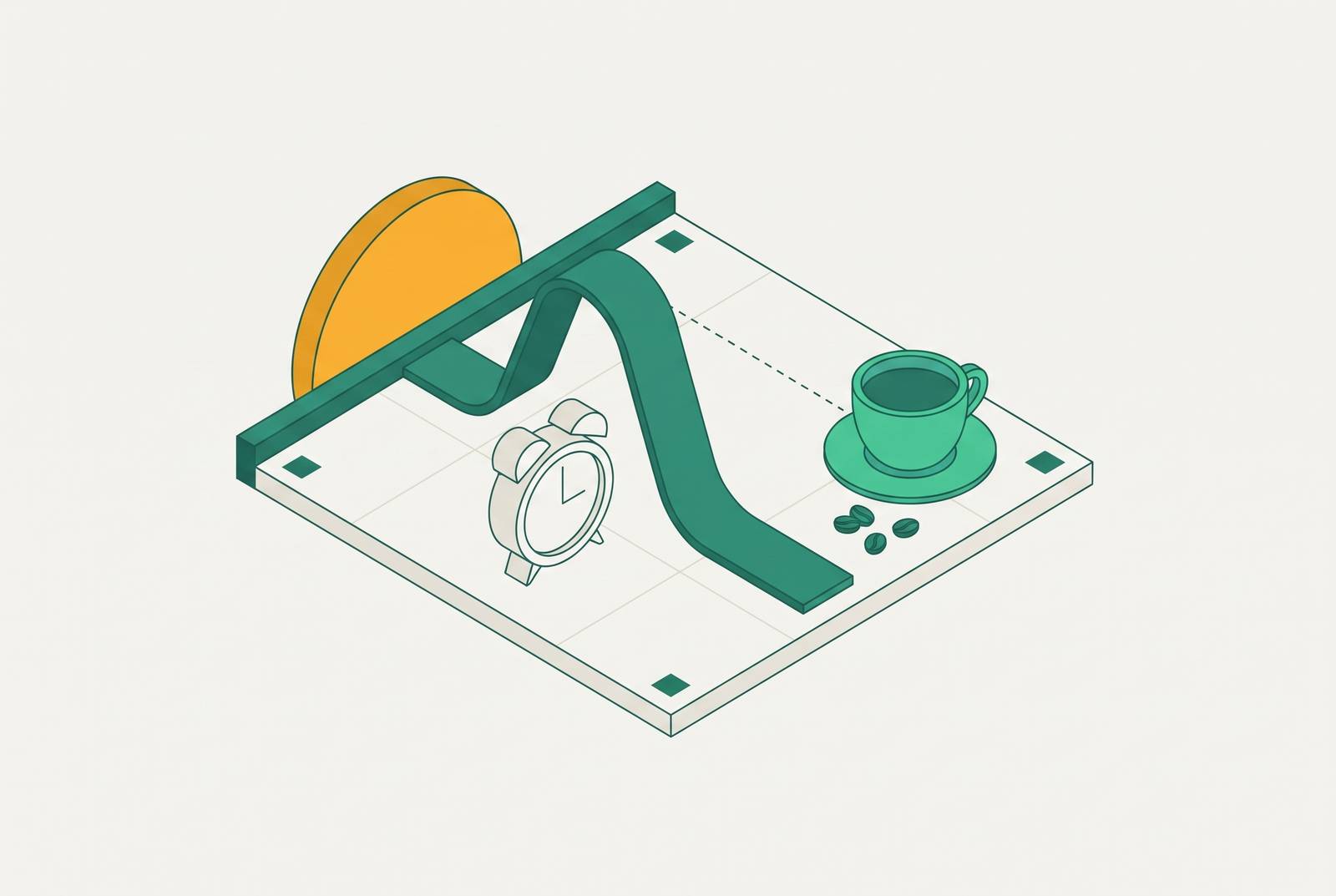
Caffeine timing works with the cortisol awakening response. That response helps get the brain ready for the day before caffeine comes into play. Delaying caffeine can give that natural process room to run, but the widely circulated 90-to-120-minute window is a practical guideline.
What the cortisol awakening response actually does in the first hour after waking
Cortisol is often treated as a stress hormone to suppress. That is the wrong starting point for mornings. The cortisol awakening response, or CAR, is a sharp surge layered on top of the normal circadian rise in cortisol. It peaks roughly 30–45 minutes after waking. Rather than being simply a stress reaction, it is thought to help the brain move into consciousness and prepare for the demands ahead.
That preparation goes beyond feeling awake. The CAR may bring memory representations of future goals to mind and help with higher-order thinking throughout the day. The brain preparedness preprint frames it as a process that organizes large-scale brain networks involved in emotional and executive functions.
The stakes therefore extend beyond morning energy. Beijing Normal University's registered trial, NCT02799134, investigates the neural mechanisms linking CAR suppression with higher-order and social cognition. It shows why researchers treat this response as more than an alarm clock.
From the inside, a disrupted pattern can feel less precise. Grogginess that coffee does not fix, energy that takes hours to arrive, or feeling wired before leaving bed may match the patterns seen with a blunted or exaggerated CAR. Those feelings do not measure the response, however. To measure it, saliva samples must be taken at set times, so an afternoon crash alone cannot tell someone what their morning cortisol did.
How caffeine works — and why the mechanism makes timing the central variable
Caffeine masks the signal that tells you to rest. Its effect involves adenosine receptors, which are part of the system through which the brain registers sleep pressure. Blocking that signal can make a person feel more alert without removing the need for sleep underneath it.
The distinction is simple but easy to miss. Feeling less tired is not the same as being more rested. As caffeine clears, the fatigue signal can be felt again, bringing on the familiar rebound known as a caffeine crash. The stimulation has faded, while the need for rest has not necessarily changed.
That makes the body's starting state important. Caffeine meets the brain in a different state when the morning alerting system is still rising than when that rise has eased. The same masking effect may be more or less useful depending on what the brain is already doing. Timing is therefore part of the dose's effect.
Using caffeine over time appears to make adenosine receptors more numerous and more sensitive, so caffeine has a stronger signaling system to work against. The result can be diminishing returns. A morning routine that once gave a dependable boost may become something a person needs just to feel normal.
What happens when caffeine meets the CAR — the redundancy and blunting problem
Caffeine during the CAR stacks stimulation onto an already rising alerting system. Instead of extending useful alertness into a later part of the morning, the dose overlaps with a period when the body is already preparing itself for action.
The stronger claim is that this overlap may interfere with the CAR's natural cascade, weakening some of its cognitive preparation. That remains a proposed risk. The distinction is important because showing that caffeine affects cortisol is not the same as showing that an early dose suppresses the whole day's executive and emotional functioning.
Running both alerting systems together may lead to habituation, so later caffeine does less and larger doses become more tempting. Yet the specific claim that early timing accelerates tolerance needs stronger direct evidence than the general observation that habitual caffeine use produces diminishing returns.
Stress makes this interaction less forgiving. Under high stress or after poor sleep, caffeine's cortisol-amplifying effect can be partially restored even in habitual drinkers. Those are also the mornings when reaching for caffeine immediately feels most appealing. Extra stimulation may arrive when the system is already under strain.
The 90-to-120-minute window — what the research supports and where it gets contested
Waiting roughly 90 to 120 minutes after waking gives the early cortisol surge time to pass before caffeine enters the picture. The principle is reasonable. The exact interval is less settled, because research specifically comparing morning caffeine schedules remains thin and studies differ in dose and ingestion time.
ClinicalTrials NCT07466628 examines caffeine ingestion and morning cognitive and muscle strength measures in males. NCT05995314 studies caffeine's effects on cognitive performance. These are the kinds of controlled studies that can sharpen the evidence, but their registration does not establish a universal waiting period. The 90-minute rule should not be mistaken for a clinically precise prescription.
Individual metabolism further limits a single schedule. Slow caffeine metabolizers with a CYP1A2 gene variant can have a substantially longer caffeine half-life, making late doses more consequential. For them, delaying the first dose does not make later caffeine harmless. The whole day's schedule still has to protect sleep.
The practical framework begins with waking without caffeine, hydrating, and getting outdoor light during the first hour to support the circadian rhythm. After the initial waiting period, caffeine can serve as a later aid. A second dose, if needed, can fall in late morning, around 10–11:30 AM, aligned with a natural cortisol dip. These clock times are guides. For most people, the final caffeine window belongs before early-to-mid afternoon because its effects persist for hours.
The downstream cost — how poor caffeine timing degrades sleep, which degrades the next CAR
A poorly timed dose can outlast the task it was meant to help. Sleep fragmentation or deprivation can dysregulate the stress-response system known as the HPA axis, raising cortisol and weakening or distorting the next CAR. More cortisol is not automatically a better awakening response.
That distinction helps explain the feedback loop. Worse sleep makes people more tired, which can lead them to take caffeine earlier or use more of it. That caffeine can make sleep worse again, leaving the next morning even harder to get through. Eventually, daytime tiredness may become something caffeine cannot fully counteract.
Heavy habitual consumption can deepen the problem. It has been associated with reduced attentional performance, lower alpha-wave frequencies, and less tolerance of sleep deprivation. More stimulation does not guarantee better thinking.
A dose that feels useful now may impose a cost on tomorrow's starting point. That is why consistent wake times and morning light belong in the same framework as caffeine timing. They provide a stable rhythm for the morning response instead of asking caffeine to compensate for an unstable one.
The loop can also run the other way. Better timing can help protect sleep, giving the next morning's CAR a better foundation and reducing the pressure to compensate with more caffeine.
What the delivery format of caffeine does to the timing equation
The time printed on a schedule is only part of the story. An immediate dose and a slower-release formulation can place their strongest effects at different points, even when taken at the same moment.
Standard coffee delivers caffeine as an immediate bolus. Because it starts working fairly quickly, it overlaps more directly with the CAR, while the fatigue signal it was masking can return as it wears off. Dose size also changes that experience. A large immediate dose can produce a sharper rise and rebound than a smaller, slower-releasing dose.
The Applied Science & Performance Institute trial, NCT06441695, compares 400 mg of zümXR extended-release caffeine with immediate-release caffeine after a night of suboptimal sleep. Its September 2025 update describes assessments of side effects, mood, and alertness, with cognitive assessments included in the protocol. The comparison asks whether changing delivery changes the experience of jitter and crash. It does not, by itself, establish that extended release is better.
The bedtime pulsatile-release caffeine study illustrates a more unusual approach. It found that a delayed-release formulation eased sleep inertia immediately upon awakening in sleep-restricted healthy adults. It shows why swallowing time and release time are different variables.
Co-formulated ingredients introduce another distinction. Changing how caffeine feels is not necessarily the same as slowing its release, which becomes especially relevant when considering caffeine paired with L-theanine.
Ingredients that work with the CAR rather than against it
Timed, moderate caffeine can be paired with ingredients intended to support attention or soften the stress response. But their roles are not interchangeable. An ingredient that improves attention does not automatically protect the CAR, and a compound studied over weeks should not be sold as an immediate morning fix.
L-theanine is relevant because it has been associated with increased GABA, serotonin, and dopamine, increased alpha-wave power at 8–13 Hz, and reduced salivary cortisol and alpha-amylase. Those findings fit the goal of calm focus. A 2026 meta-analysis of 31 randomized trials found that healthy adults who took L-theanine alone had a clear short-term gain in attention. Its acute stress-reduction effect was modest, however, and anxiety results were inconsistent. Caffeine co-presence is not required for every benefit.
Matcha naturally combines caffeine with other compounds, including theanine, but composition still counts. Alanazi et al.'s 2026 systematic review in Frontiers in Nutrition used the CE/TA molar ratio as an exploratory index for interpreting differences in endocrine stress findings. That ratio compares caffeine plus EGCG with theanine plus arginine. It has not been proven as a way for consumers to score products. A ceremonial-grade label alone therefore cannot guarantee a smoother experience.
Ashwagandha works on a longer timescale. Albalawi's 2025 meta-analysis pooled seven randomized controlled trials and found a significant mean cortisol reduction at 600 mg/day over 4–8 weeks. KSM-66 belongs in that longer-term discussion. A drop in average cortisol also does not, on its own, show that the awakening response is healthier.
Lion's Mane, or Hericium erinaceus, has a different proposed role. Its hericenones and erinacines may stimulate nerve growth factor production, supporting neuron maintenance and neuroplasticity. Applied Food Sciences' completed trial, NCT07405957, compared fruiting body extract with fruiting body-plus-mycelium on cognition, serum biomarkers, and gut microbiota. That study design is not proof of CAR restoration.
Bacopa Monnieri and Rhodiola Rosea address other parts of performance. Standardized Bacopa extracts taken over several weeks have been linked to better memory consolidation and faster information processing. Rhodiola supports cellular energy metabolism involving ATP and creatine phosphate. Darbinyan et al.'s double-blind crossover trial found that people did better at several thinking tasks when they had stress-induced fatigue. These findings have distinct scopes, with their applicability to multi-ingredient formulas still to be established.
Putting the framework into a daily practice that compounds over time
A consistent wake time, including weekends, and a few minutes of outdoor light within the first hour create the base. Caffeine can then be a planned part of that rhythm, with less need to rely on it to get every morning started.
For daily use, a 60–90-minute delay and a moderate 100–200 mg dose give people more room to start than a strict full 90-to-120-minute window from the outset. The goal is separation from the earliest waking surge. A firm cutoff well before the intended sleep time protects the other end of the day.
Longer-term ingredients require the same patience. Ashwagandha belongs in a weeks-long stress-response framework, while Lion's Mane has a different proposed role in neuronal support. Neither should be treated as permission to override poor sleep or keep escalating caffeine. Holding back matters even more on high-stress days, when habitual use may do less to protect against caffeine's cortisol-amplifying effect.
The payoff can build across successive mornings. The CAR is a performance resource worth protecting. A routine that respects it can become easier to sustain precisely because tomorrow no longer has to begin by repairing today.
Sources
- Effects of Caffeine Ingestion on Morning Cognitive and Muscle Strength Measures in Males
- Effects Of Caffeine On Cognitive Performance
- Neural Mechanism of Cortisol Awakening Response Suppression Effect on Human High-order and Social Cognitions
- A novel bedtime pulsatile-release caffeine formula ameliorates sleep inertia symptoms immediately upon awakening
- Brain preparedness: The cortisol awakening response proacts dynamic organization of large-scale brain networks across emotional and executive functions