Ready-to-Drink Nootropic Shots Compared by Delivery Technology
Absorption matters more than ingredients for nootropic shots that actually work.
Ready-to-drink nootropic shots can take the place of capsule stacks, but being a liquid does not prove that a formula works. The useful comparison is delivery technology, meaning how the formula makes each ingredient available for absorption. A credible shot pairs its ingredient doses with compound-specific absorption evidence, realistic onset claims, and independent purity testing.
Why the ingredient label is the wrong place to evaluate an RTD nootropic shot
Scanning ingredients is the natural place to start. With caffeine, L-theanine, and familiar botanicals on the label, one formula can look easy to compare with the next bottle. The label shows the shot’s contents, leaving the amount that reaches the bloodstream unestablished. Bioavailability is that missing link, and it depends on the compound and its delivery system together.
Fat-soluble vitamins make the gap easy to understand. Vitamins A, D, E, and K do not dissolve in a shot’s water base, so their presence on the label leaves an important formulation problem unanswered. A dedicated delivery system must account for how they stay dispersed and become available for absorption. Water-soluble ingredients have different needs. The comparison therefore has to move from the ingredient list to the machinery behind it.
What "delivery technology" actually means for a 2-ounce liquid shot
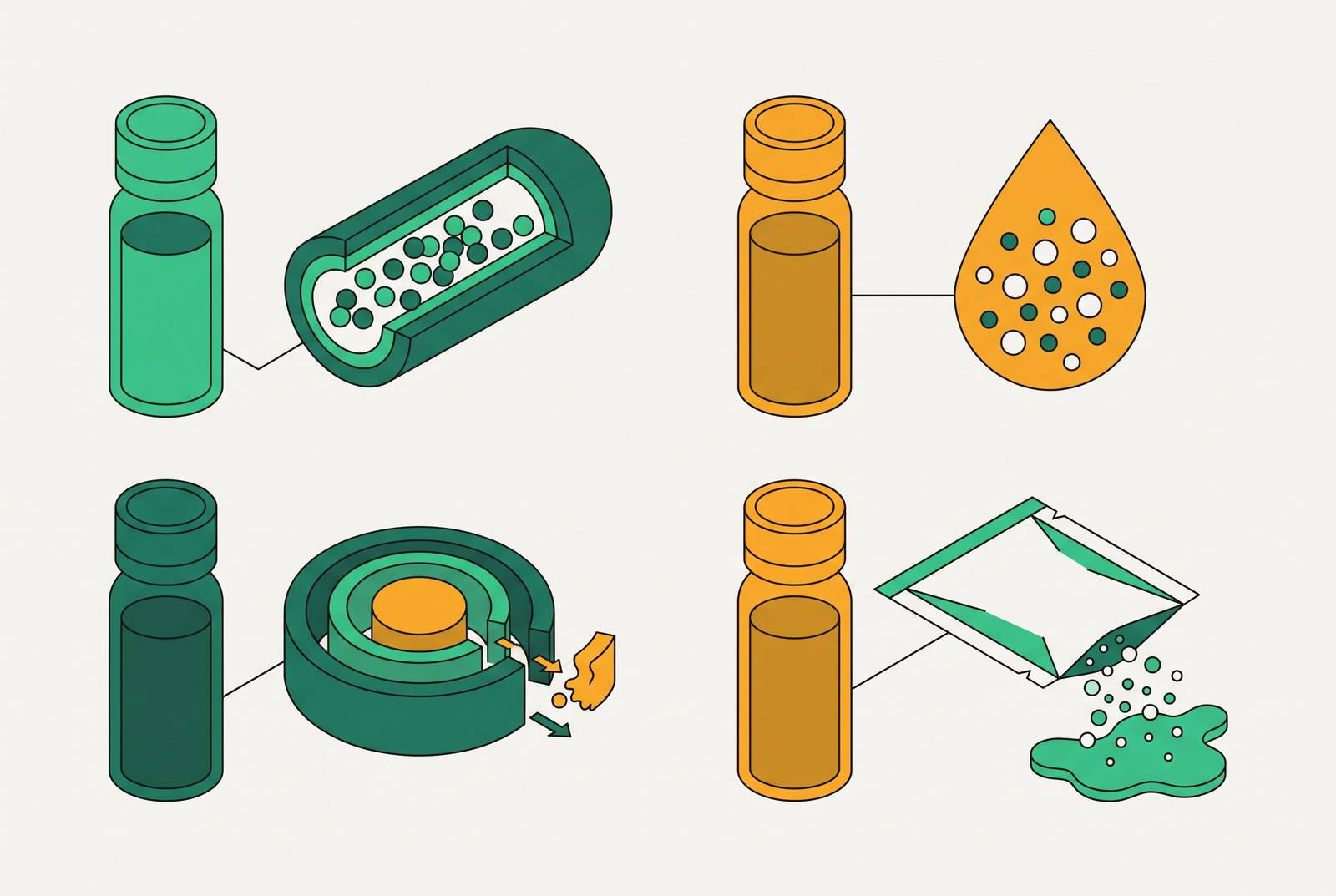
Standard liquid dissolution is the simplest of the three ways to deliver an ingredient. The active dissolves in water, passes through the stomach, and reaches the intestinal routes that absorb it. Compounds cross the intestinal lining through passive movement or with help from transport systems. There is no protective wrapper around the active. That can be adequate for water-soluble ingredients, but it leaves vulnerable compounds exposed to stomach acid and enzymes at the intestinal surface.
Liposomal encapsulation adds a wrapper made from phospholipids. These small lipid-based sacs, called vesicles, surround the active and can protect it from breakdown during digestion. Liposomal and nanoliposomal systems use vesicles in an effective range of 50–200 nm, but size alone is not proof of performance. The proposed uptake route is endocytosis, in which cells take in the vesicle rather than relying only on the usual intestinal transporters. A credible formulation needs measured vesicle size and stability data.
A 2025 trial of 25 healthy adults showed blood iron roughly doubled over six hours with a liposomal multivitamin-mineral compared with the same nutrients in a standard formula. That is evidence about a particular nutrient and formulation. It is not permission to promise the same improvement for every botanical in a cognitive shot. Targeted nanoliposomal systems also have potential to improve stability, absorption, and tissue specificity in neuroprotective applications. The useful distinction is between a demonstrated delivery effect and a technology name borrowed for the label.
Sublingual and buccal delivery take a different route. Liquid held under the tongue or against the mouth’s lining can cross that tissue and bypass first-pass liver metabolism, the processing that occurs before an absorbed compound reaches systemic circulation. However, roughly 70% of the dose is swallowed. That limits the advantage for most actives. All three approaches face biological barriers, and a compound that reaches the bloodstream may still fail to cross the blood–brain barrier.
Why the 2-ounce shot format has a structural bioavailability advantage over larger liquid formats and pills
A dissolved active has one less step to complete. Standard capsules must dissolve before their contents become available for intestinal absorption, while a water-soluble ingredient already dissolved in a shot has cleared that stage. Powder formats also introduce a dissolution step. The concentrated 2-ounce format is therefore well suited to ingredients intended to become available quickly, without requiring the reader to manage a daily pill stack.
A small liquid dose can empty from the stomach faster than a 16-ounce carbonated can, supporting a shorter route to absorption. This is a starting advantage, with faster cognitive effects still requiring proof for each formula. Liquid alone does not protect a botanical that can break down or help a fat-soluble ingredient mix well with water. Encapsulation or another delivery system suited to the ingredients has to solve those problems.
Which core ingredients actually benefit from advanced delivery, and which ones don't need it
For caffeine and L-theanine, the dose determines how much is available for absorption. Both are water-soluble and absorb readily in a liquid shot, so encapsulation is not the central lever. Evidence in healthy adults supports small but statistically significant improvements in visual attention with 100–400 mg of L-theanine, particularly when combined with caffeine. In a 2025 double-blind crossover study at the University of Peradeniya, 37 sleep-deprived healthy adults aged 22–30 took 200 mg of L-theanine with 160 mg of caffeine. The study found that the combination helped with a computerised traffic-scene-related visual stimulus discrimination task, but it did not show that it helped with every form of executive performance.
Ashwagandha and Rhodiola put more pressure on delivery. Some of their components are fat-soluble or can be broken down by enzymes, and simple dissolution does not solve those problems. Ashwagandha trials in stressed adults have demonstrated cortisol reduction beginning around 2008, with later replication. Rhodiola rosea supports cellular energy metabolism through higher ATP and creatine phosphate levels in mitochondria, the cell’s energy-producing structures. Human trials have also reported benefits in exercise endurance and several cognitive tasks, but those findings do not establish the absorption of an unspecified shot.
For these botanicals, more of the dose is lost through first-pass metabolism. A system that demonstrably reduces those losses could increase the fraction of a dose reaching circulation. However, “nanoliposomal” on a bottle is not sufficient evidence that a particular extract bypasses first-pass processing. The useful evidence concerns the botanical, its carrier, and the finished formulation’s performance.
Lion’s Mane needs a realistic calendar. Hericium erinaceus stimulates nerve growth factor production in human neural cells, a mechanism associated with longer-term neural support. In a 16-week Japanese trial, adults aged 50–80 with mild cognitive impairment had better cognitive scores when they took 3 g/day of dried Lion’s Mane. Gains faded within four weeks of stopping. That finding supports attention to sustained use, but it does not prove an acute effect from a drink.
Other human findings make the timing distinction more important. In a study of 41 healthy adults aged 18–45, those who had four weeks of treatment had worse delayed word recall accuracy than those who took placebo. An 8-week trial of 109 adults aged 40–75 found better visual attention, working memory, sleep, and mood than placebo. The evidence is not uniformly positive. A daily shot with proven absorption may work well for regular use, but advanced delivery cannot make these longer studies prove that it helps performance right away.
Bacopa Monnieri presents a similar consistency problem. A trial in 98 healthy adults over 55 found that 300 mg/day of a standardized BacoMind extract improved verbal learning, memory acquisition, and delayed recall. Overall evidence is mixed, with no clear acute benefit from a single dose and inconsistent results over one to three months. A single absorption spike is therefore the wrong selling point. Its delivery case rests on reliable daily exposure rather than a claim that one shot sharpens the next meeting.
Vitamins split along a simpler formulation boundary. Fat-soluble vitamins need an emulsification or encapsulation system suited to a water-based shot. B-complex vitamins and vitamin C dissolve readily and tolerate standard processing, so an expensive wrapper is not the main requirement. For B-vitamins, methylation state, or the chemical form in the shot, also matters. These differences explain why a blanket “enhanced absorption” claim says less than an ingredient-specific account of what the technology solves.
The cortisol-cognition link that makes delivery speed, not just delivery volume, a performance variable
Stress can degrade the prefrontal cortex’s executive capacity through the cortisol pathway. An active that arrives after the demand has passed may miss the intended window, even if total absorption is good. Sleep deprivation also alters inflammatory responses and the neuroendocrine stress system. A useful delivery claim must therefore address both when ingredients become available and how much eventually appears in blood.
Ashwagandha and L-theanine approach this problem through different mechanisms. Ashwagandha acts through the hormonal stress-response system, and trials in stressed adults have shown cortisol reductions of 23 to 30%. L-theanine’s neural mechanism includes alpha-wave induction, while the crossover study measured a cortisol-suppression effect at three hours after dosing. That measurement leaves the onset of effects in another formula unestablished. Nor does it show that encapsulation would automatically compress the same response into an earlier window.
If the intended strategy relies on both actives being available together, staggered absorption could undermine that design. Faster delivery could help synchronize exposure, but “energy without jitters” requires the actual formulation to demonstrate that advantage. Onset is a performance variable only when the claimed timing is connected to measured effects.
How sleep-phase delivery extends the delivery-technology argument beyond daytime shots
A morning formula starts with the previous night’s limits. Sleep deprivation reduces insular activity, impairs memory capacity, and suppresses brain-derived neurotrophic factor, or BDNF, a molecule involved in neural plasticity and cognitive functioning. It also affects the brain’s ability to adjust connections and form new neurons, while influencing oxidative stress and neuroinflammation. These changes can impair memory accuracy, attention, and cognitive flexibility. Faster daytime absorption does not make those upstream problems disappear.
L-theanine may have a use in the evening as well as during the day. Cotter et al.’s 2025 systematic review of dietary supplementation trials included 11 RCTs and concluded that 200–450 mg/day appears to be a safe and effective way to support healthy sleep in adults. The review searched the literature through February 2025. That supports a sleep-focused use of the ingredient, but it is not evidence for every finished evening shot. The dose, formulation, and absence of caffeine remain distinct from the daytime combination.
A daytime formula can combine caffeine, L-theanine, and cortisol modulators, while an evening format supplies L-theanine without caffeine. Both can use the same delivery system if it works for their ingredients, though matching labels alone give no reason to share one. The proposed benefit covers the full 24-hour cycle because how well people perform during the day depends in part on how well they sleep. It does not establish that two products necessarily produce a compounding benefit without testing the combination.
What to actually look for when comparing RTD nootropic shots by delivery architecture
A delivery-transparent formula specifies its encapsulation or other absorption technology, including vesicle size, lipid carrier type, or an equivalent description. “Enhanced absorption” without those details cannot support a meaningful comparison. Ingredient suppliers must also provide compound-specific absorption data. An iron result cannot stand in for evidence about Lion’s Mane or ashwagandha.
Fat-soluble ingredients need an explicit formulation answer. If the shot includes fat-soluble vitamins or lipophilic botanicals, look for a stated emulsification or encapsulation system that accounts for them in water. For B-vitamins, methylcobalamin and methylfolate provide a more specific label signal than a general absorption slogan. These methylated forms are directly usable, while unmethylated forms require conversion that some people cannot complete efficiently. Neither detail on its own proves that the finished shot improves cognition.
When a shot is sold on absorption, check its purity just as closely. Independent testing should cover potency and contaminants, including heavy metals, PFAS, and mycotoxins. Better uptake is not an advantage if unwanted compounds come with it. Finally, look for evidence from the formula that shows roughly when its effects start and how long they last, with a clear distinction between botanicals that take time to work and ingredients meant to have effects soon after a dose. When a brand cannot specify its delivery system, substantiate absorption, or explain its timing, its ingredient list is not enough to make it the credible choice.