Lion's Mane Mushroom for Neuroplasticity and Mental Endurance
The mushroom's two compounds build new neurons and protect existing ones through separate pathways.

Lion's Mane (Hericium erinaceus) holds a distinction no other widely consumed food shares: it contains compounds that directly stimulate the synthesis of nerve growth factor inside the central nervous system. That alone sets it apart from most cognitive ingredients, because they modulate neurotransmitter activity or give antioxidant support but they do not touch the machinery that builds and maintains neurons. NGF is a protein, and the brain needs it throughout life to maintain and repair neural tissue. Its levels decline with age, and that decline carries causal weight in Alzheimer's disease and in the memory loss that accompanies normal aging.
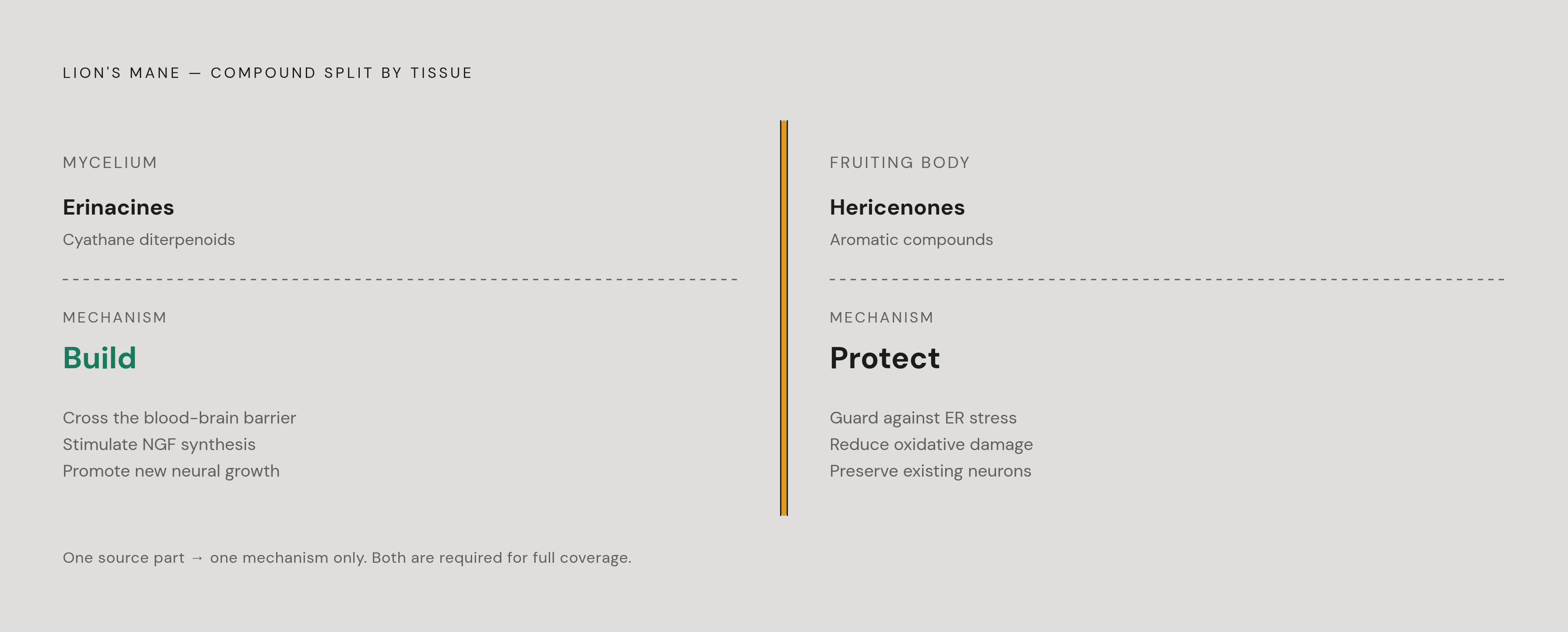
The mushroom's chemistry does not rely on a single compound to produce this effect: Hericium erinaceus contains two structurally distinct classes of bioactive molecules, erinacines, which are cyathane diterpenoids concentrated in the mycelium, and hericenones, isolated from the fruiting body. These are separate compound classes that sit in different parts of the organism and work through different primary mechanisms. That structural separation is the foundation the rest of the dual-mechanism case rests on: one class acts as a growth signal, the other as a protective agent, and the mushroom's value depends on both being present and intact in whatever form reaches the body.
How erinacines drive new neural growth
Erinacines are the more potent NGF stimulators of the two compound classes, and because they can cross the blood-brain barrier, they act directly inside the central nervous system instead of just circulating in the periphery without reaching neural tissue. Erinacine A has shown strong NGF-stimulating activity in both in vitro and in vivo studies, making it the most closely examined member of the class.
NGF's role deserves a precise description, because the term "neuroplasticity" gets used loosely elsewhere. NGF increases the length of nerve cell processes. That is structural adaptation at the level of the neuron itself, not a transient shift in chemical signaling that fades once the compound clears the system.
The erinacine story extends past NGF. Research from the University of Queensland, led by Frederic Meunier's team in 2023, went further still: Lion's Mane extracts were shown to promote neurite outgrowth through a mechanism entirely independent of NGF. So you cannot treat erinacine activity as a single-molecule story. You cannot stop at NGF, because the neuroplastic effects of Lion's Mane run through multiple, only partially mapped pathways, and current research has only begun to describe the rest of that biology.
How hericenones protect existing neurons: the cytoprotective mechanism
Erinacines promote growth. Hericenones defend what already exists, protecting neurons from cell death triggered by endoplasmic reticulum stress and by oxidative damage. The distinction matters because cognitive aging is not a single failure mode. Losing the capacity to build new connections is one problem; losing existing neurons to cellular stress is another, and a compound that addresses only one leaves the other unattended.
Hericenones are confined almost entirely to the fruiting body. They are not detected at meaningful levels in mycelium, regardless of whether the mycelium was grown through submerged culture or any other method. So this fact carries direct consequences for how Lion's Mane products are formulated, and the next sections take up that point in detail.
The mechanistic case for hericenones is strong in preclinical work, built on cellular and animal studies of ER stress and oxidative protection rather than large human trials isolating the fruiting body compound alone. Chronic oxidative stress and ER stress sit among the pathological conditions implicated in both Alzheimer's and Parkinson's disease, so hericenones' protective action targets the same disease landscape that NGF decline contributes to. Erinacines build, hericenones protect, and the combination addresses two separate vulnerabilities in the aging brain. That coordinated structure is what separates Lion's Mane from single-mechanism nootropics that work on one receptor system or one neurotransmitter pathway and stop there.
Clinical trial evidence and its limits
The clinical record for Lion's Mane is encouraging in specific domains and genuinely mixed overall, and the gaps in that record come from the structure of the research itself.
Start with what supports the mechanism. A systematic review published in Frontiers in Nutrition in September 2025, led by Menon and Jalal, analyzed five randomized controlled trials alongside 21 additional studies, including 15 laboratory studies, three pilot clinical trials, one cohort study, and one case report. It concluded that Lion's Mane shows effectiveness across neuroprotection, cognitive function, gut health, and reduction of anxiety and depression symptoms.
The negative and null findings deserve equal attention. In the 16-week mild cognitive impairment trial, cognitive performance declined once supplementation stopped, so you do not seem to keep the benefits without continued use. In a separate trial, 41 healthy adults between 18 and 45 took Lion's Mane for four weeks, and their delayed word recall accuracy came out worse than placebo. An acute-dose study at the University of Surrey, published in April 2025, gave 18 healthy adults between 18 and 35 a single 3-gram dose of a 10:1 fruiting body extract and found no significant improvement in global cognitive function or mood at the 90-minute mark, though fine motor performance on the pegboard test did improve. Two further small trials in healthy young adults found no cognitive improvement.
A pattern runs through this mixed record. None of this invalidates the underlying mechanism. A head-to-head trial from Applied Food Sciences (NCT07405957) wrapped up in 2026 and still awaits publication; it compared fruiting body extract alone against a fruiting body-plus-mycelium combination in 87 healthy adults. The Alzheimer's Drug Discovery Foundation's Cognitive Vitality assessment states that well-designed, larger, and longer clinical trials are still needed before the picture can be considered complete.
Why the fruiting body vs. mycelium distinction matters
Because erinacines and hericenones live in different parts of the organism, the part of the mushroom a supplement is extracted from determines which mechanism that product can actually deliver. A mycelium-only extract can supply erinacines and the NGF-stimulation pathway that comes with them. It cannot supply hericenones, because hericenones are not detected at meaningful levels in mycelium from any culture method. A fruiting-body-only extract can supply hericenones but not erinacines. If you want both bioactive classes, you need a full-spectrum dual extract that draws from both fruiting body and mycelium.
A quality problem compounds this issue across the mass market. When a supplement label reads "mycelium," that ingredient is often mycelium-on-grain: biomass that is majority starch from the growth substrate. A meaningful share of products sold under prominent Lion's Mane branding deliver negligible erinacine content, regardless of how the front of the package reads.
Dosing from the clinical literature provides a useful reference point. Chitin in the mushroom's cell walls blocks absorption, so if extraction does not break those walls down and concentrate the active compounds, most of what you take just passes through your body unused.
Extraction method and absorption technology
An ingredient list describes potential, not delivery. The distance between what a person consumes and what reaches the brain depends on extraction quality, on the bioavailability of the resulting compounds, and on whatever technology a manufacturer uses to improve absorption. Extraction breaks down the chitin barrier and concentrates erinacines and hericenones into forms the digestive system can actually process. Without that step, even a product sourced correctly from both fruiting body and mycelium passes through the body with most of its activity intact but unused.
Erinacines can cross the blood-brain barrier, and that trait is a structural property of the compound class. Bioavailability enhancement technologies, including nanoencapsulation, can raise the fraction of active compound that reaches target tissue by a lot, so you can end up with an effective dose well above what raw powder delivers at the same nominal weight.
This has a direct bearing on how dosing figures should be read. The 1,000 to 3,000 milligram range reported in clinical trials assumes conventional absorption. A product built on a higher-bioavailability delivery format may achieve a comparable biological effect at a lower nominal dose, but that claim needs to be substantiated by the manufacturer.
Chronic stress, neuroplasticity, and adaptogens
Lion's Mane's NGF-mediated neuroplasticity operates largely on the hippocampus, and the hippocampus is the same region that chronic cortisol elevation actively suppresses. Stress is not a separate problem running alongside the neuroplasticity case. It works directly against the mechanism Lion's Mane is meant to support.
The pathway runs through the HPA axis: sustained stress elevates cortisol, cortisol suppresses hippocampal neurogenesis, and that suppression counteracts the growth-promoting work erinacines perform at the exact site where cognitive adaptation takes place. Chronic stress also disrupts cognition through gut-brain axis dysregulation and metabolic imbalance, adding attention and memory deficits on top of whatever damage the cortisol pathway causes directly.
This is where adaptogens enter the picture, not as an additive convenience but as a mechanistically grounded response to a specific antagonist. A 2026 trial published by Gowda, Joshua, and Thomas in Current Research in Complementary and Alternative Medicine evaluated Bacopa specifically for stress management and sleep quality in a randomized, double-blind, placebo-controlled design. Bacopa's bacosides A and B regulate and restore proper synaptic activity in over-stimulated neurons, a mechanism directly relevant to the cognitive profile seen in chronically stressed adults. Rhodiola rosea adds a time dimension to the stack: its benefits for fatigue reduction and cognitive performance under stress appear within the first two weeks, offering faster relief while Ashwagandha's effects build over a longer period, together covering both the acute and chronic phases of a stress response.
Sleep's role in consolidating neuroplastic gains
Sleep works as an active neuroplasticity window, not a passive recovery period. Without it, the structural changes that NGF stimulation sets in motion cannot consolidate into lasting cognitive gains. Sleep deprivation impairs learning, memory formation, working memory, and attentional control, which are the behavioral expressions of the same plasticity Lion's Mane is designed to support.
The consequences run deeper than simple fatigue. Acute and chronic sleep deprivation also bring on anxiety states alongside deficits in attention and memory, and these overlap closely with the cognitive profile Lion's Mane targets, so if you neglect sleep while expecting the supplement to do its work alone, you compound the vulnerability.
The 2026 trial (NCT06870136) adds a finding that closes the loop between the two. Lion's Mane supplementation was associated with significantly faster improvements in subjective sleep quality and morning restedness compared with placebo. The relationship appears to run in both directions: Lion's Mane supports sleep, and sleep in turn enables the consolidation of the neuroplastic gains Lion's Mane initiates.
Sustained energy as the daily context in which neuroplasticity either compounds or collapses
Mental endurance depends on more than avoiding fatigue. It requires an arousal state calm enough to sustain focused attention and alert enough to support encoding, and that dual condition determines how much neuroplasticity translates into usable cognitive output over the course of a day.
Caffeine alone is a blunt tool for reaching that state. The combination of L-theanine and caffeine found in matcha addresses that imbalance directly. Factorial analysis indicates L-theanine and caffeine act synergistically to reduce mind wandering, the attentional failure that disrupts both encoding and neuroplastic consolidation.
A 2025 double-blind, placebo-controlled crossover trial in the British Journal of Nutrition tested this combination in 37 healthy adults between 22 and 30 who had gone without sleep overnight. A dose of 200 milligrams of L-theanine with 160 milligrams of caffeine significantly improved how accurately and how fast you could deploy selective attention to visual traffic scenarios, and reaction time improved significantly more than placebo even though both groups showed some improvement. The effect held even under acute sleep deprivation, because neural processing sped up and attentional circuits got more resources. A narrative review from September 2026 compared matcha against coffee and found that matcha gives a more balanced state of alertness, and it may help sustain attention when psychological and subjective arousal run high.
The L-theanine-caffeine pairing provides a clean arousal baseline, and that baseline is the condition under which Lion's Mane's neuroplastic effects can be productively expressed across a full working day rather than undermined by jitter or crash in the hours when focus matters most.
An evidence-grounded Lion's Mane protocol
The evidence converges on a specific set of conditions under which Lion's Mane is most likely to produce neuroplastic and endurance benefits: the right extract type, an adequate dose sustained over weeks rather than days, and a supporting protocol that manages cortisol and protects sleep.
On extract type, a full-spectrum dual extract covering both fruiting body and mycelium is the only preparation that supplies both hericenones and erinacines. On duration, the acute evidence from single doses and four-week trials is weak, but the stronger positive signals come from eight-week and 16-week protocols, so you need consistent daily use over an extended period if you want the NGF-stimulation pathway to produce measurable structural change.
The supporting protocol the mechanistic case points toward includes Ashwagandha or Rhodiola to prevent cortisol from suppressing the hippocampal neurogenesis Lion's Mane is working to stimulate, Bacopa for synaptic regulation under chronic stress, L-theanine paired with caffeine for a stable, jitter-free arousal state across the working day, and consistent sleep, without which the neuroplastic gains erinacines promote have no opportunity to consolidate.
Individual responses to Lion's Mane vary, larger and longer clinical trials remain necessary before firmer conclusions can be drawn, and Lion's Mane has not been validated as a treatment for any neurological disease. What the current evidence supports is narrower and still substantial: a mechanistically sound cognitive ingredient, best deployed within a protocol built on sound sourcing, adequate dosing, sustained use, and attention to the stress and sleep conditions its own biology depends on.