Matcha vs Coffee for Sustained Morning Focus
L-theanine makes matcha better for sustained focus while coffee excels at urgent tasks.

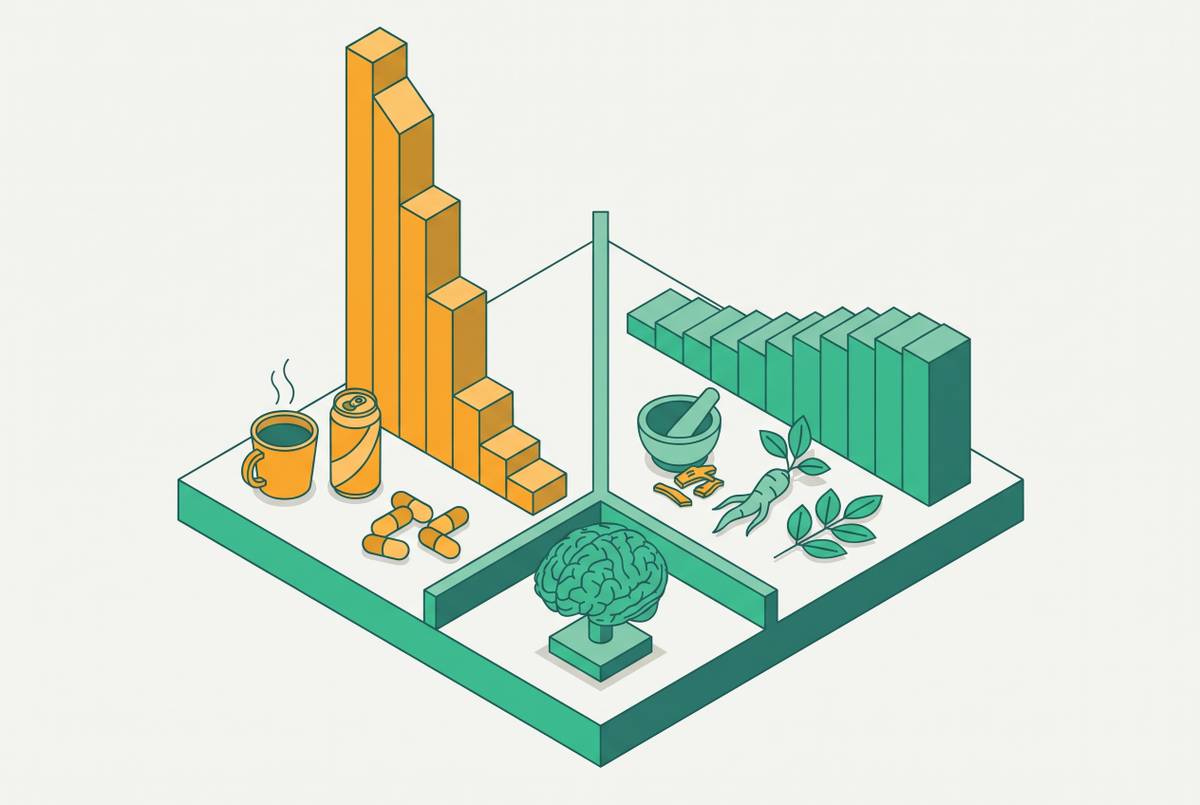
Matcha vs coffee for sustained morning focus comes down to what accompanies the caffeine. Matcha pairs caffeine with L-theanine, making it better suited to calm, distraction-resistant work, while coffee’s faster, stronger hit suits short bursts of urgent output. Controlled trials support benefits from the caffeine–L-theanine combination, but they do not prove that a cup of matcha delivers uninterrupted focus all day.
Why the matcha-vs-coffee question is really a question about caffeine's travel companions
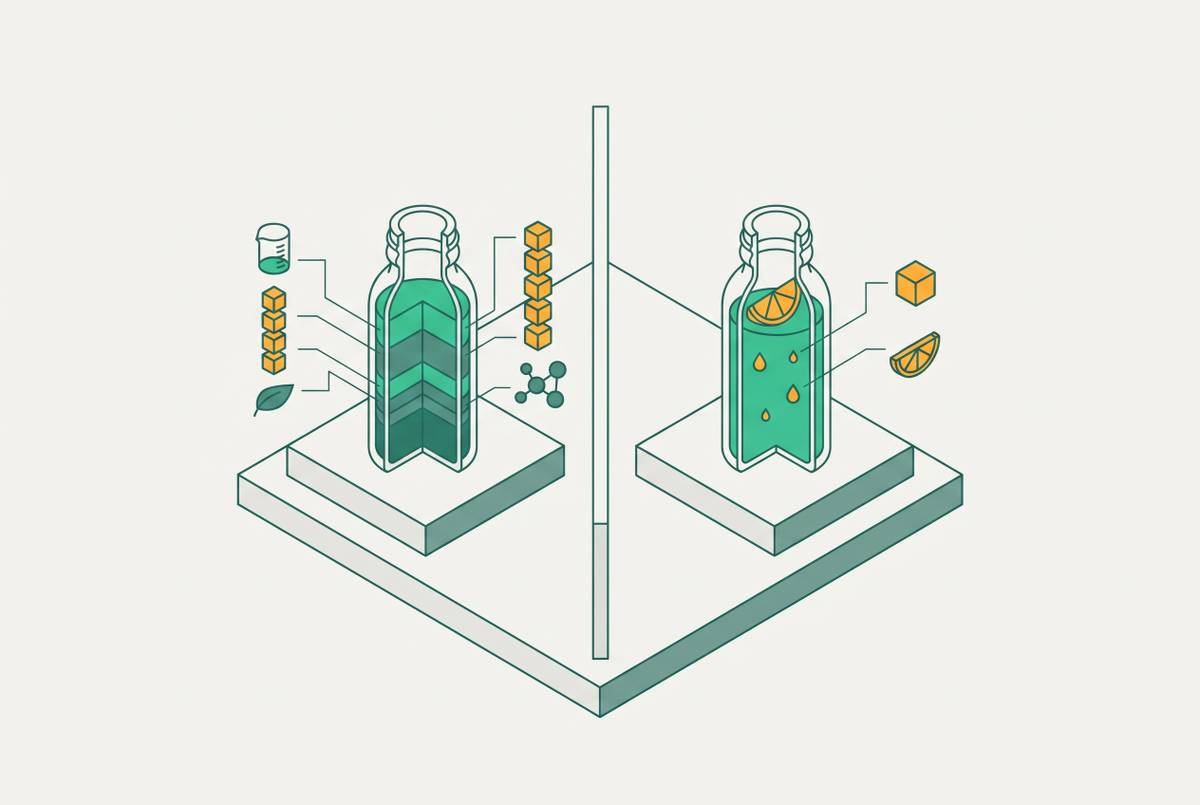
Coffee delivers caffeine without L-theanine, while matcha supplies both. L-theanine is an amino acid made in the tea plant’s roots and concentrated in its leaves during shade-growing. That growing method, used for ceremonial matcha, raises L-theanine levels substantially compared with regular green tea.
A standard ceremonial matcha serving of roughly 2 g of powder typically contains 50–70 mg of caffeine, together with L-theanine. Coffee generally supplies more caffeine, faster, without that companion. The useful comparison is therefore not simply which drink supplies more stimulation, but how each combination shapes attention. Tracing what happens inside the brain makes it possible to match the delivery to the work a morning demands.
How caffeine alone activates the brain — and why that activation has a ceiling
Caffeine blocks adenosine receptors in the brain, temporarily reducing drowsiness. That blockade increases activity in dopamine and acetylcholine pathways, both tied to alertness and focus. At moderate doses, this makes people more alert and gives them faster reaction times. Coffee’s cognitive lift is real and measurable. It is a legitimate tool.
The limit appears when more stimulation stops serving the task. Higher doses and faster delivery also activate the sympathetic nervous system, which can produce jitteriness, a faster heart rate and elevated cortisol. Those effects can be especially noticeable on an empty stomach. Feeling more switched on is not always the same as thinking more clearly. For work that demands precision, the extra stimulation can become an unwanted part of the experience.
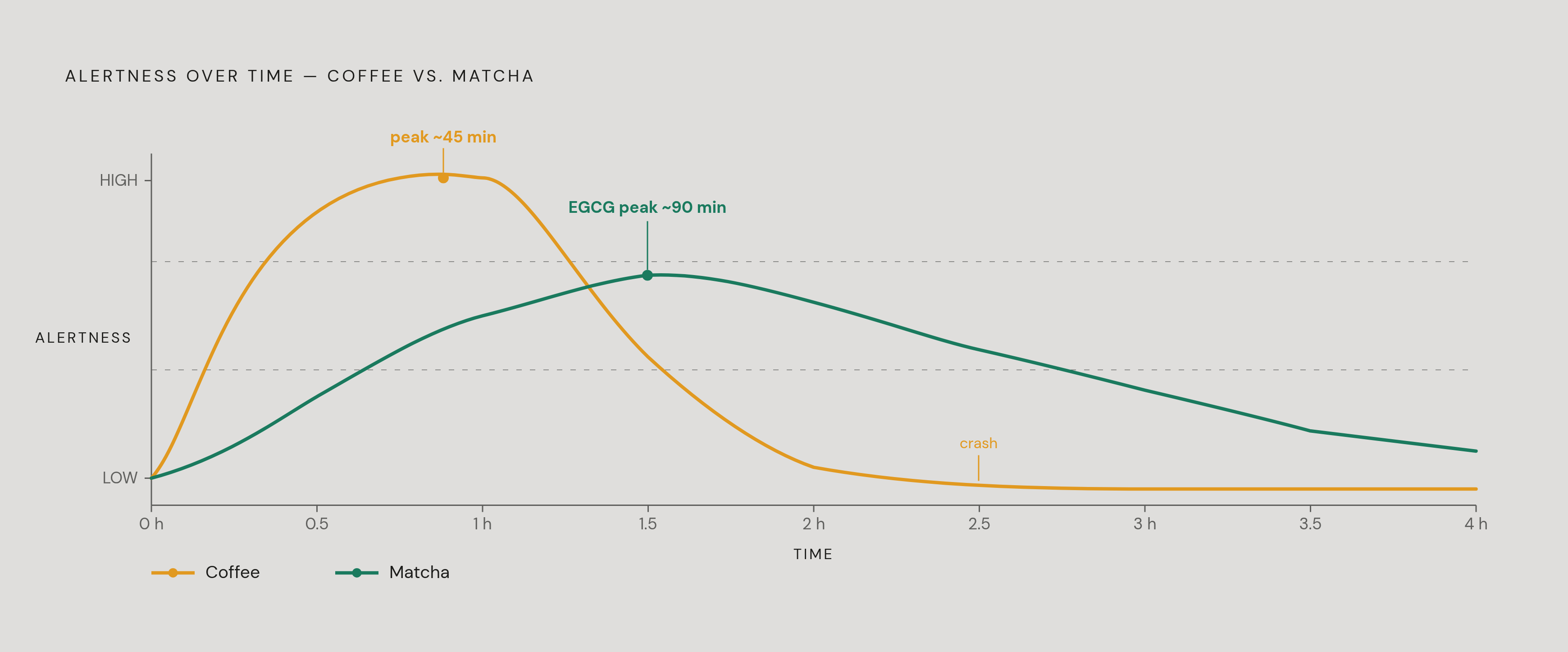
Coffee’s typical energy profile reflects that fast delivery. It produces a sharp early rise, a peak and then a decline that many people experience as a crash as the stimulant effect runs its course. That does not make the peak useless. A rapid morning call or a deadline requiring immediate output may fit it well. The mismatch comes when the work needs steady attention beyond that early peak.
What L-theanine adds to caffeine — the dual mechanism that produces calm alertness
L-theanine changes the experience through pathways distinct from caffeine’s adenosine blockade. After ingestion, it crosses the blood-brain barrier and influences GABA activity, part of the brain’s inhibitory system associated with relaxation without sedation. It also modulates glutamate activity in the hippocampus. This is more than simply weakening the stimulant. Caffeine promotes alertness while L-theanine contributes to a calmer attentional state.
EEG studies suggest that L-theanine also promotes alpha brain wave activity within roughly 40 minutes of ingestion. Alpha activity, in the 8–14 Hz frequency band, is associated with relaxed attentiveness. That finding helps explain the phrase “calm alertness.” It describes a state in which stimulation remains, but some jitteriness and the feeling of being on edge are softened. It does not mean the brain has been sedated.
Kahathuduwa et al. (2020), published in Scientific Reports, found that the combination was associated with decreased task-related reactivity of the default mode network. This network is associated with mind-wandering, so the finding is consistent with fewer resources being drawn away from the task. It is a useful clue. L-theanine can soften caffeine’s rougher edges, but it does not undo caffeine’s effects on sleep, blood pressure or heart rhythm.
What controlled trials show when the combination is tested directly
Owen et al. (2008), published in Nutritional Neuroscience, found that the combination improved both speed and accuracy on an attention-switching task at 60 minutes. The same trial found reduced susceptibility to distracting information during a memory task at both 60 and 90 minutes. These are specific improvements in measured performance. They go beyond participants merely reporting that they felt more awake. They also fit the proposed distinction between stimulation alone and stimulation with better control of attention.
Haskell et al. (2008) found improvements in some attention and working-memory tasks compared with placebo. The difference in the pattern of results between the combination and caffeine alone supports L-theanine’s role as an active contributor. Research published in the Journal of the International Society of Sports Nutrition has also examined the combination’s effects on cognitive performance. Together, controlled human trials provide evidence for gains in attention-switching accuracy, reaction time and subjective alertness.
Effect sizes are modest, and most of the strongest evidence comes from single-session studies in healthy young adults. Matcha-specific evidence is smaller than the broader evidence for coffee and green tea. A full day of sustained focus remains unestablished. Nor is the commonly cited two-to-one L-theanine-to-caffeine ratio a universal formula. The example of 100 mg L-theanine with 50 mg caffeine reflects one experiment’s parameters.
How the two energy curves map onto different kinds of morning cognitive work
An executive facing an early call and rapid decisions may need immediate stimulation more than a long, even stretch of attention. Coffee fits that need because it delivers more caffeine faster, with much of the boost coming in the early peak. The same goes for hard physical work early in the day. Duration is less important if the urgent work is brief.
A morning reserved for writing, programming or deep analysis asks something different of the brain. The goal is to stay with a problem, resist distractions and maintain precision. Matcha’s moderate caffeine and L-theanine are better matched to that profile. Reading and creative problem-solving call for that same steady focus.
Matcha’s caffeine peaks in the bloodstream within the first hour, while EGCG, its primary antioxidant catechin, reaches peak blood levels later, after roughly an hour and a half. Staggered absorption may help explain the gradual focus curve people report, but those timings do not themselves prove longer cognitive performance. Dose adds another qualification. Clinical studies that found significant effects on focus used about 4 grams of matcha, while cafés usually use about 2 grams.
Cortisol, timing, and why when you consume caffeine matters as much as what you consume
Cortisol naturally increases in the first stretch after waking, helping sharpen focus and mental clarity. High-dose caffeine during that period can amplify an already-elevated stress response. Coffee can further elevate cortisol, especially on an empty stomach. For someone who is easily overstimulated, this helps explain why the same caffeine hit can feel less helpful just after waking.
Matcha’s L-theanine content may support a steadier response, but that is not permission to ignore timing. A study published in Current Research in Food Science found lower stress indicators with matcha, together with slight improvements in memory and attention. The finding suggests that the whole-leaf mixture may do more than caffeine alone. It does not show that matcha cancels the hormonal effects of caffeine. Acute stress modulation and lasting cortisol regulation are different claims.
Sleep makes this more than a question of morning comfort. High cortisol can reduce slow-wave, or deep, sleep and delay REM onset, while poor sleep can raise cortisol the next morning. Both parts of that cycle can make it harder to work well during the day. Let the natural cortisol peak pass before consuming caffeine, roughly the first hour or so after waking. This applies to both drinks, especially for people sensitive to stimulation, and provides a foundation before considering additional cognitive-support ingredients.
Why matcha works as a foundation and what the research says about stacking it with other cognitive-support compounds
Matcha’s clearest role is acute alertness and resistance to distraction. That is not the same as directly improving memory consolidation, long-term cortisol regulation or the ability to form new neural connections. Those goals operate on different timescales. Other compounds have research in those areas, which gives a rationale for combining them with matcha. Studies of each ingredient on its own, however, do not prove that a mixture of them will work.
Lion’s Mane, or Hericium erinaceus, contains hericenones and erinacines that stimulate Nerve Growth Factor production. Animal models show that erinacines can cross the blood-brain barrier, while evidence for hericenones crossing it is less conclusive. The University of Queensland identified hericene A as a compound that increases the size of growth cones at the tips of developing neurons, which are important for new neural connections. Findings about developing neurons and animal models are not the same as demonstrated improvements in an executive’s morning work.
Bacopa Monnieri has shown improvements in memory consolidation across multiple randomized controlled trials, with a mechanism involving dendritic branching and communication between synapses. Its onset requires consistent use over weeks to months. It is not a same-morning focus fix. Ashwagandha addresses a different target through the HPA axis, the hormonal system controlling cortisol. Double-blind trials have shown that serum cortisol and related stress biomarkers fell over 60-day periods, so its effects take place over a longer time than matcha’s acute effects.
Rhodiola Rosea targets mental fatigue through a mechanism distinct from ashwagandha, with an onset within one to two weeks. A study of people experiencing stress-related fatigue found that the SHR-5 extract improved attention and reduced fatigue, while also reducing the salivary cortisol awakening response compared with the control group. Cognizin® is a clinically studied form of citicoline that supports brain phospholipid synthesis and has been examined for attention and mental energy. These are different jobs.
How to match your morning beverage to your actual cognitive demands
For mornings dominated by urgent calls, rapid decisions or brief demanding output, coffee is the better fit when immediate arousal takes priority. For writing blocks, programming, reading or sustained analysis, matcha’s L-theanine-moderated caffeine profile is better aligned with the task. Neither choice wins every morning.
Preparation and timing then narrow the choice. Allowing the natural cortisol peak to pass applies to either beverage, while ceremonial-grade, shade-grown matcha offers higher L-theanine content than culinary-grade or lower-quality powders. Nor should a smoother feeling be treated as proof that sleep will be unaffected.
For knowledge workers whose work demands a lot of them over long stretches and has high stakes, matcha can also be the base of a daily stack for memory consolidation, cortisol management and neural health. A bioavailable daily format can bring those goals together, but format alone is not evidence that the combination works. The useful criteria remain the ingredients, the amounts and the outcomes actually studied. Choose for the work ahead, and keep the promise no larger than the evidence.