Light Exposure Timing for Circadian Rhythm Optimization
Blue light exposure timing determines sleep disruption more precisely than brightness alone.
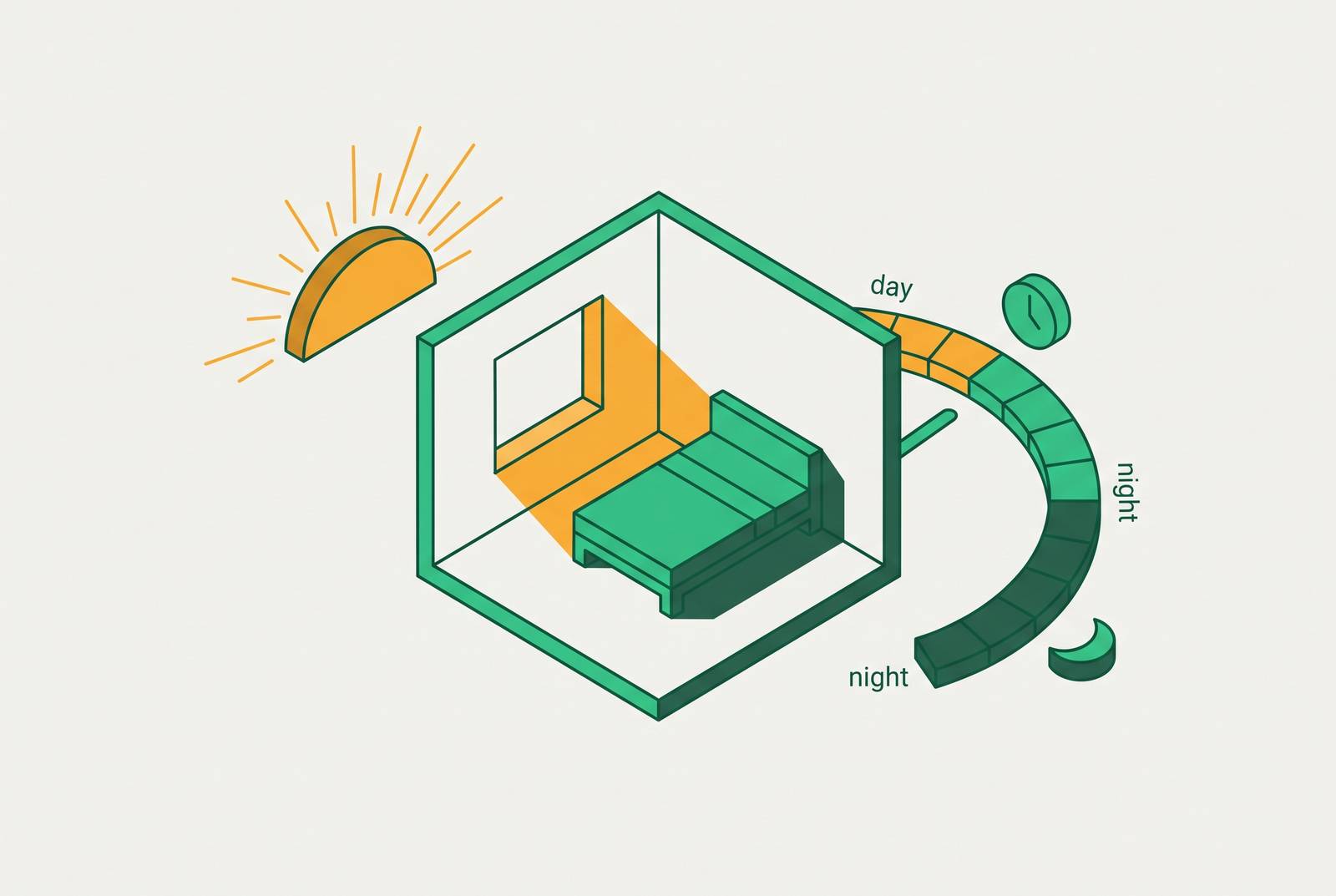
Light timing works because the body has a specific, measurable way of reading it, not because morning walks are generally good for you. The master clock sits in the suprachiasmatic nucleus, a small cluster of neurons that takes its cues almost entirely from a set of retinal cells called intrinsically photosensitive retinal ganglion cells, or ipRGCs, which carry a light-sensitive protein called melanopsin. These cells are not tuned to brightness in general. A 2025 study found that blue light exposure between 9:00 PM and 10:30 PM significantly reduced total sleep duration compared to earlier exposure and the control condition, establishing a definable critical window for melatonin suppression.
Two separate systems jointly decide how alert or foggy someone feels at any given hour. One is homeostatic: sleep pressure that builds the longer a person stays awake, the way hunger builds between meals. The other is circadian, set by the timing of light hitting those ipRGCs, according to the 2025 Handbook of Clinical Neurology chapter by Renske Lok. Alertness at any moment is the product of both clocks running in the same direction. When they fall out of sync, the same source is explicit that attention, sustained focus, and higher-order cognitive tasks all degrade, not gradually but in a way that's measurable in reaction-time and working-memory testing. That's the mechanism the rest of the protocol exploits: the two-process model gives light exposure at the right time an outsized effect on cognition, and light exposure at the wrong time an outsized cost.
None of this is guesswork at this point. Lighting science now has standardized units for how much circadian effect a given light dose produces, including Equivalent Melanopic Lux, Circadian Stimulus, and the CIE's melanopic Equivalent Daylight Illuminance, or mel-EDI, the last of which has been folded into the updated ISO/CIE 8995-1:2025 lighting standard and into WELL v2 building certification. Architects and lighting designers are already building to these numbers. The rest of this piece asks what happens when a person, not a building, applies the same logic to their own day. ipRGCs are most sensitive to blue-range light (~460–480 nm), and this spectral sensitivity is why the color temperature of light, not just its brightness, determines circadian impact.
Morning light: the protocol's highest-leverage window
Morning light isn't just about resetting the clock, it's a performance lever. In healthy adults, the bulk of the day's cortisol release happens in a narrow band around waking, with a sharp spike in the first half hour or so known as the cortisol awakening response, or CAR. That spike isn't the stress hormone showing up to cause trouble. It's the signal that primes the brain for sustained attention, and short-wavelength light exposure in the morning measurably sharpens it compared with staying in dim light. A flat or blunted CAR, by contrast, tracks with fatigue, weaker cognitive performance, and a sluggish immune response, so the target isn't suppressing cortisol, it's making sure the morning spike actually happens on schedule.
Morning light does double duty beyond cortisol. It stabilizes circadian phase and pulls nocturnal melatonin onset earlier, which tightens up sleep-wake regularity night after night, according to a synthesis published by News Medical. One of the more striking proof points comes from an extreme setting: in Antarctic winter, where natural light nearly disappears, a single hour of intense morning white light was enough to improve cognitive performance and advance circadian rhythms. If the effect holds under those conditions, it's not a placebo story.
The pattern appears in ordinary life too. In the same study, later sleep timing and greater day-to-day variability in wake schedules were associated with poorer mental and cardiometabolic health outcomes. A fixed wake time isn't just a scheduling preference, then. It's the anchor the rest of the day's light exposure builds from.
Not every researcher agrees the CAR is purely light-driven. One line of work found robust cortisol spikes even under dim morning light, which suggests the internal clock, not light alone, is doing a lot of the driving. That's a fair objection that deserves to be taken seriously rather than waved off. But it doesn't undercut the protocol so much as clarify what morning light is actually doing: it reinforces and sharpens a rhythm the internal clock is already trying to produce, rather than manufacturing that rhythm from nothing when the clock is badly misaligned. The two levers, internal and external, work together. Neither substitutes for the other. A 2026 Nature npj Biological Timing and Sleep study using real-world wearable data (n = 89 UK adults, 500+ days) found that earlier sleep/wake timing was associated with longer-duration daytime light exposure and more regular, less fragmented light patterns, connecting the morning anchor to the full day's rhythm.
Effects of daytime light patterns on sustained alertness and working memory
The morning anchor doesn't run on autopilot for the rest of the day. A 2025 study in Nature Communications Psychology followed 58 UK adults for a week, measuring their real-world light exposure alongside cognitive testing, and found that recent light exposure predicted both subjective sleepiness and reaction times on psychomotor vigilance and working-memory tasks. It's about a running signal the brain keeps checking.
The same study adds a detail that complicates the simple "more light is better" reading. It wasn't just the amount of daytime light exposure that predicted better performance on visual search, vigilance, and working-memory tasks, it was how continuous that exposure was. Fragmented light, brief bright spells broken up by long dim stretches, performed worse than steady bright exposure at similar total doses. That fragmentation effect turns out to matter overnight as well: the 2026 npj study found that higher day-to-day stability and lower within-day variability in light exposure were linked to more intense deep sleep in the first part of the night, so the daytime pattern is shaping not just tomorrow's alertness but tonight's sleep architecture.
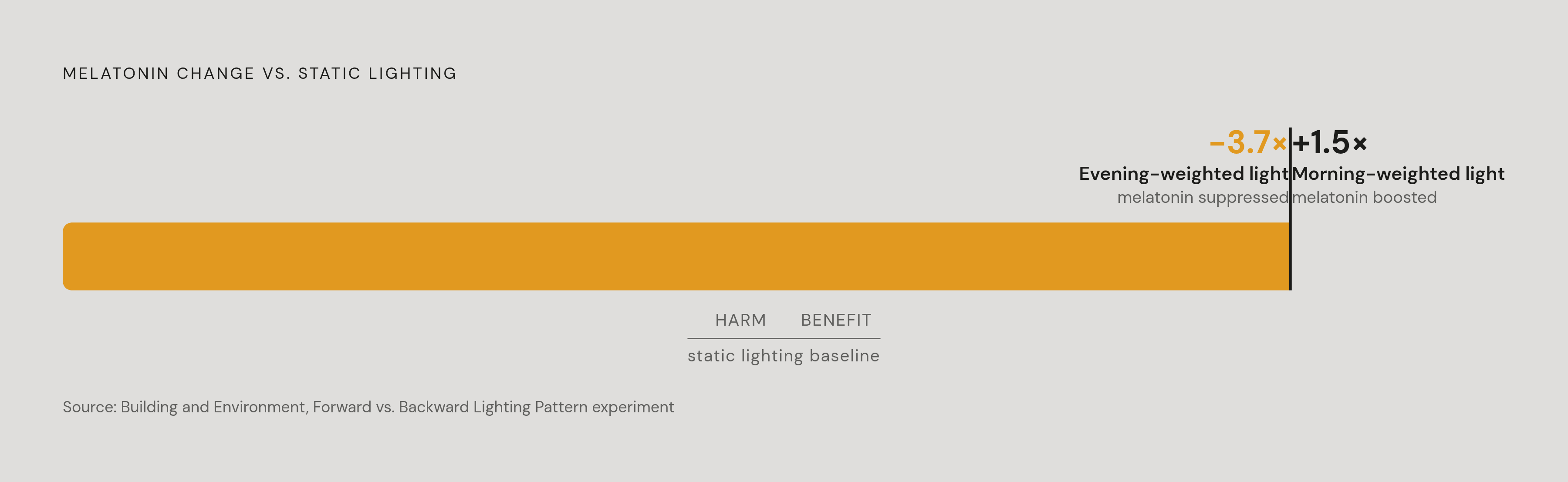
A study published in Building and Environment found that static high-color-temperature, high-illuminance office lighting, common in enclosed offices and sufficient to meet visual task requirements, still suppresses melatonin, delays circadian phase, and adversely affects sleep quality and metabolic health when it doesn't vary across the day. The same experiment tested a Dynamic Lighting Pattern that shifted spectrum and intensity to track natural daylight, and a Forward Lighting Pattern that front-loaded stimulation earlier in the day. The dynamic pattern improved sleep quality; the forward pattern produced roughly a 1.5-fold increase in average melatonin secretion compared with static lighting. Raw brightness wasn't the variable that moved the needle. Timing and pattern were.
None of this argues for redesigning office ceilings. It argues that sporadic exposure, a bright commute followed by ten hours under static fluorescents followed by a dim scroll on the couch, doesn't replicate what sustained, patterned daytime light does for the brain. The gap between those two experiences is exactly the gap the data is measuring.
Evening light exposure: where the protocol is most frequently broken
Evening is where the discipline built over the rest of the day tends to fall apart, and there's a specific window where the damage concentrates. A 2025 study found that blue light exposure between 9:00 and 10:30 PM cut total sleep duration significantly compared with earlier exposure or no exposure at all, which establishes something researchers had suspected for years but hadn't pinned down this precisely: there's a definable critical window, not just a vague "avoid screens at night" rule. And the damage doesn't end when the screen goes dark. The alerting effects of blue light in the evening persist for several hours after lights are turned off, so the damage is not reversed by simply switching off a screen at bedtime.
The stakes go beyond a rough night's sleep. A 2025 review in BMJ Mental Health named excess light at night, alongside shift work, as one of the primary drivers of circadian desynchronization tied to a broad range of mental health problems. That's a heavier claim than "you'll feel tired tomorrow," and it deserves attention rather than a rush past it.
The clearest causal evidence for how bad evening light can get comes from the same Building and Environment office study cited earlier. Its Backward Lighting Pattern, which concentrated high-stimulation light into the late part of the day, cut melatonin secretion by roughly 3.7-fold compared with static lighting and pushed circadian phase later, directly hurting sleep quality. Compare that 3.7-fold suppression against the 1.5-fold melatonin boost from the forward-loaded pattern in the same experiment, and the asymmetry is hard to miss: evening light does more damage than morning light does good, at least in raw magnitude.
That damage doesn't stay contained to sleep. The precision of circadian timing governs how restorative sleep actually is, down to the cellular repair and neuroplasticity that happen overnight, so poor evening light habits function as a tax on the next morning's cortisol awakening response, not a one-night inconvenience. In healthy individuals, the majority of cortisol secretion occurs within several hours surrounding morning awakening, with the cortisol awakening response (CAR) being the rapid rise in the first several tens of minutes after waking; separately, a 2025 study found that blue light exposure between 9:00 PM and 10:30 PM significantly reduced total sleep duration compared to earlier exposure and the control condition. It compounds.
Sensitivity to evening light isn't uniform. Individual sensitivity to evening light varies considerably, according to a Journal of Biological Rhythms paper by Stone and colleagues. Some people will need a wider buffer. Few will need less than that.
How circadian-disrupted populations show what misalignment costs cognitively
Abstract mechanisms are easier to trust once you've seen what happens when they go wrong at scale, and a few populations make that case with unusual clarity. World Trade Center rescue and recovery workers carry documented rates of cognitive impairment and poor sleep tied to years of chronic stress and circadian disruption. A 12-week light-based intervention in 23 of these workers, all aged 50 or older with mild cognitive impairment and sleep disturbance, produced significant improvements in both sleep quality and cognitive performance, according to a paper in Archives of Environmental and Occupational Health. Twenty-three people is a small sample, and the paper doesn't pretend otherwise, but the direction of the result lines up with everything the mechanism predicts.
A separate case comes from submarine crews, whose shift schedules make circadian alignment almost impossible to maintain naturally. Research published in the journal SLEEP by Oxford University Press, out of Flinders University, tested a circadian-informed lighting protocol that used bright, blue-enriched white light above 300 lux at times chosen to produce a deliberate, predictable circadian delay, paired with dim lighting at other points in the schedule. A 12-week light-based intervention in 23 World Trade Center rescue and recovery workers aged 50 and older with mild cognitive impairment and sleep disturbances showed significant improvements in both sleep quality and cognitive performance. Lok's 2025 chapter states the mechanism directly, that strategic light exposure can offset the cognitive costs of misalignment by realigning circadian rhythms, boosting wakefulness during the hours it's wanted, and easing sleep onset when it's not.
Athletes offer a related, if less dramatic, illustration. A review in Clocks and Sleep found that circadian disruption from crossing time zones degrades neuromuscular performance, and that circadian-informed strategies, light timing included, produce measurable advantages. Two interacting processes govern alertness across the day: the homeostatic process, in which sleep pressure builds during wakefulness, and the circadian process, which is aligned by light cues.
The LumEnColor study, run out of University Hospital Strasbourg and registered as NCT05232383, wrapped in July 2026 and is examining artificial light's effects on alertness, sleep, cognitive performance, mood, and biological rhythms. It's the most recent completed trial squarely on this subject. Its results haven't appeared in the literature yet, so it belongs on the list of things to watch, not the list of evidence already banked.
The practical three-phase protocol: morning anchor, daytime maintenance, evening dimming
Strip away the mechanism and the case studies, and the research settles into three distinct phases across the day, each with one biological target and one behavior that serves it. That's the entire protocol. It doesn't need to be more complicated than this.
Phase one is the morning anchor, and it operates in the first few minutes after waking. The target is the cortisol awakening response: get bright, ideally blue-enriched, light into the eyes as early as possible after getting out of bed, because that's the window where light exposure most reliably sharpens the CAR rather than just suppressing residual melatonin.
Phase two is daytime maintenance, running from morning through mid-afternoon. Sustaining the circadian alerting signal and avoiding the fragmentation that erodes vigilance and working memory later in the day affects how consistently alert someone stays through the afternoon. The behavior is straightforward, get as much bright, continuous light as the day allows, natural light where possible, and treat long stretches in dim indoor rooms as something to interrupt, not something to accept. The dynamic lighting research shows that spectrum and intensity should track natural daylight progression rather than staying static at peak settings all day. Chronotype adds a real wrinkle here. Forcing a strong evening-type person into aggressive early-morning bright light without regard to where their internal clock actually sits can produce misalignment instead of benefit, so the protocol has to work with someone's biological timing rather than against it.
Phase three is evening dimming, and by this point the target has flipped entirely: protect melatonin onset instead of chasing alertness. That means treating the 9 to 10:30 PM window as the one where blue-heavy light does the most damage, and dimming or shifting light spectrum well before it.
None of this comes with a guarantee stamped on it. Per a Journal of Biological Rhythms paper by Stone and colleagues, interindividual differences in light sensitivity are large and not yet well mapped, so the protocol provides evidence-based starting points rather than universal prescriptions. A 2025 study found that blue light exposure between 9:00 PM and 10:30 PM significantly reduced total sleep duration compared to earlier exposure and the control condition, establishing a definable critical window for melatonin suppression. The phases hold. The exact edges are personal.
Where cognitive ingredients fit alongside a light-timing protocol
Light timing sets the schedule the brain runs on, but it doesn't supply the raw materials the brain burns through while running it. None of that is competing with the light protocol. It's running underneath it.
Think of it as two separate levers on the same system. Morning light sharpens the cortisol spike that primes the day's attention through a photic mechanism, not a chemical one, so a supplement taken with breakfast doesn't help or replace that process. But the sustained-attention and working-memory gains that daytime light patterning produces still depend on a brain that has the nutritional inputs on hand to execute those cognitive tasks once the signal arrives. A well-timed light schedule can prime the system to perform, but it can't substitute for the biochemical inputs that performance actually consumes. The two are complements, and both are necessary if the goal is consistent, high-quality cognitive output rather than an occasional good morning.
Sources
- A long-term evidence-based study of circadian rhythm-oriented control strategies for office luminous environments - ScienceDirect
- Rhythms of light: Understanding the role of circadian timing in alertness and cognitive performance - ScienceDirect
- How Morning Routines Influence Cognitive Performance, Mood, and Circadian Rhythm
- Circadian Regulation for Optimizing Sport and Exercise Performance - PMC
- Tailored light intervention for sleep and cognition in World Trade Center (WTC) cohort: Archives of Environmental & Occupational Health: Vol 80 , No 9 - Get Access
- Relationships between light exposure and aspects of cognitive function in everyday life | Communications Psychology
- Circadian-informed lighting improves vigilance, sleep, and subjective sleepiness during simulated night-shift work | SLEEP | Oxford Academic
- Recommendations for daytime, evening, and nighttime indoor light exposure to best support physiology, sleep, and wakefulness in healthy adults | PLOS Biology