Afternoon Energy Crash Mechanisms in Caffeine-Dependent Professionals
Caffeine blocks fatigue signals while adenosine piles up behind the blockade.
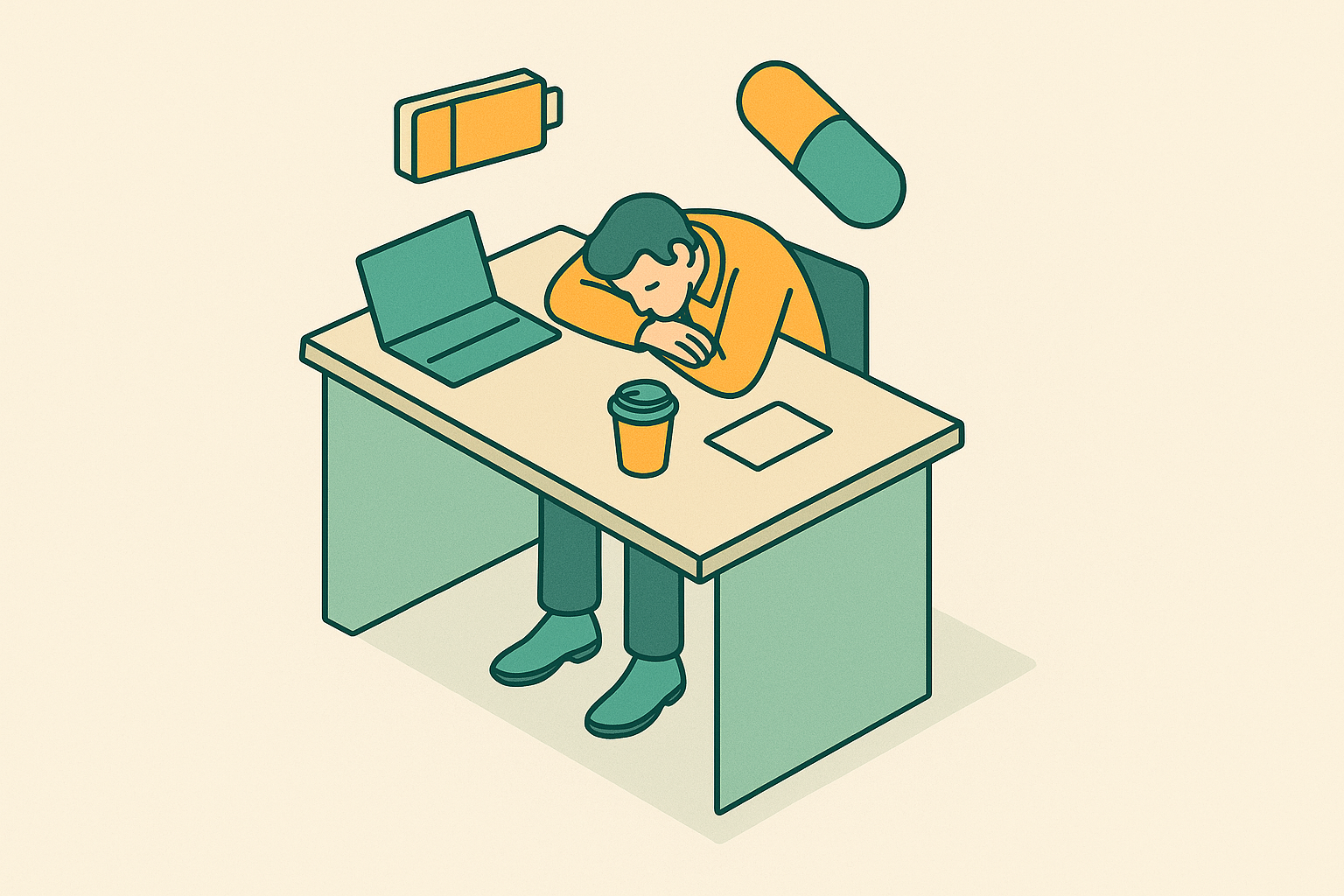
Most professionals who rely on caffeine can predict the exact hour fatigue will hit them, often to within thirty minutes. That precision is the clue. The 2:30 fog, the glazed stretch of a 3 PM meeting, the sudden pull toward a second or third cup of coffee: none of it is random. It is the output of a biological clock that caffeine itself winds tighter every morning, and the timing is so consistent across so many people that it has become a fixture of office culture rather than a question anyone bothers to ask.
The standard response treats the crash as an inconvenience to be managed: another espresso, a candy bar from the vending machine, a burst of willpower to push through the last few hours of the workday. That response assumes the crash is a dip in effort or attention that a person can simply decide to overcome. It is instead a structural event with a traceable cause, and it follows a shape precise enough to set a clock by: a surge in alertness within 30 to 60 minutes of caffeine hitting the system, a peak shortly after, and then a decline that tracks caffeine's half-life with remarkable fidelity. The average adult clears caffeine with a half-life of about five hours, so a large coffee finished at 7:30 AM has lost half its strength by 12:30 PM. The drop that follows is a separate molecule, suppressed all morning, finally getting through.
How adenosine accumulates while caffeine masks the signal
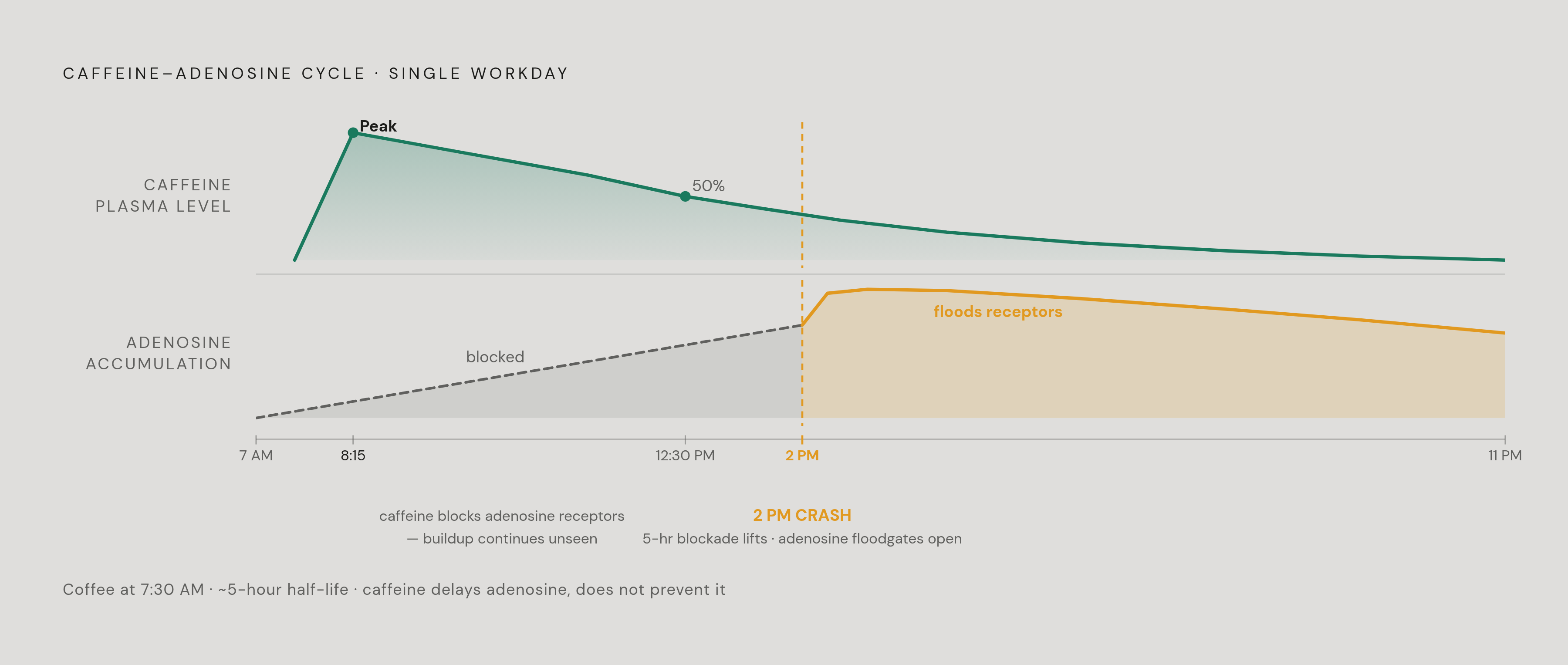
Caffeine doesn't generate energy. It borrows the appearance of energy by interfering with the brain's own signal for fatigue, and the bill for that loan comes due in the early afternoon. The sleep-pressure signal in question comes from adenosine, a byproduct of ordinary brain metabolism that builds up steadily from the moment a person wakes. As cells burn through ATP for fuel, adenosine accumulates in the spaces around neurons, and the longer someone has been awake, the thicker that accumulation gets. Adenosine's job, once enough of it has gathered, is to bind to receptors in the brain and tell the nervous system to slow down and prepare for rest.
Caffeine interferes with that process at the exact point where adenosine would normally dock. Its molecular shape happens to fit the same receptors adenosine uses, so it moves in, occupies the site, and blocks adenosine from binding there, without activating the receptor itself. Picture a bouncer standing at a door, turning away the signal that's supposed to get through while a crowd of it builds up in the hallway outside. The brain feels alert because the tiredness message has been intercepted; the underlying fatigue hasn't gone anywhere. Adenosine keeps accumulating the entire time caffeine is doing this job, and it keeps accumulating in direct proportion to how long the blockade holds and how large the dose behind it was. A large, infrequent dose creates a steep buildup behind the dam. Smaller, more distributed doses blunt the eventual rebound, though they don't eliminate it.
The timing of the crash follows caffeine's own metabolism rather than any choice about when to start drinking it. Plasma concentration peaks within the first hour after ingestion, and the energy drop arrives as that concentration declines back down, the inevitable consequence of the blockade loosening its grip while the backed-up adenosine is still waiting. This is why a popular fix, delaying the first cup of coffee by an hour or two, doesn't touch the underlying problem. Research published in the Journal of the International Society of Sports Nutrition found no evidence that caffeine consumed immediately upon waking causes the afternoon crash, and no evidence that delaying that first dose prevents it. The driver sits in how the body processes caffeine and regulates energy across the full day, not in the clock time stamped on the first cup.
How chronic use upregulates adenosine receptors
Daily caffeine use changes the brain's hardware. Chronic blockade of adenosine receptors prompts the brain to build more of them, so the same cup of coffee that once produced a clean lift now has a larger rebound waiting on the other side of it. More receptors means more docking sites for adenosine to occupy the moment caffeine clears, and that flood hits with more force than it did before the brain adapted. This is the feedback loop behind a complaint common among habitual coffee drinkers: that the morning cup no longer makes them sharper, it only gets them back to a baseline they used to start the day at naturally. Tolerance here means the crash still happens, but the floor of accumulated sleep pressure that caffeine has to overcome each morning keeps rising.
Genetics decide a good deal of how this plays out for any given person. Nearly all caffeine metabolism runs through a single liver enzyme, CYP1A2. Fast metabolizers clear caffeine from their system in roughly three to five hours, while slow metabolizers can carry it for eight to twelve hours or longer. Fast metabolizers hit the adenosine rebound sooner and feel it more sharply, since the blockade lifts quickly and the backed-up signal has nowhere left to wait. Slow metabolizers push the rebound later in the day, but they pay for it overnight, carrying caffeine into the hours meant for sleep and compounding the next morning's deficit before it even starts.
The professional trying to out-drink the crash is adding to a debt rather than paying one down. The day tends to run the same course regardless of the person: strong and clear for a few hours, a fade that prompts a second cup, a harder crash around 2 PM that prompts the thought of a third, an afternoon spent in a fog that neither cup quite lifts, and a night spent tired but too wired to sleep well, setting up the identical sequence the next morning. Caffeine never resolves the adenosine buildup in that cycle; it defers the reckoning, and defers it on worse terms each time, because the receptor architecture built up overnight guarantees the next crash lands harder. That structural escalation is what sets up cortisol as the second mechanism working against the professional under pressure, not alongside caffeine's effects but tangled directly into them.
Cortisol and the afternoon crash as a cognitive double-bind
Cortisol adds a second, independent clock to this picture, and it runs on a schedule that converges with caffeine's at precisely the worst moment. Cortisol is the hormone most responsible for how well the brain performs under pressure, produced by the HPA axis and built to sharpen focus and memory at moderate levels while degrading both once chronic stress keeps it elevated for too long. Caffeine amplifies this hormone's output specifically in people under mental stress. A professional reaching for coffee to manage a deadline is reinforcing, at the chemical level, the exact stress response they're trying to push through. Caffeine raises cortisol secretion in people at rest and in people under mental strain alike. Habitual users still show a cortisol response after drinking it, a smaller one than non-habitual users show, but under stressful conditions that response can climb significantly higher than it does in people who don't use caffeine regularly.
That isn't a contradiction so much as a trap with two jaws. The tool a professional reaches for to sustain performance under pressure is actively feeding the same physiological stress response that erodes the performance it's meant to protect. Layered onto this is a second clock problem: cortisol follows its own daily rhythm, rising sharply in the morning and declining through the day, and that mid-morning decline lands in the early afternoon at roughly the same hour caffeine's blockade is loosening its hold on adenosine. Two separate alertness systems drop at the same time, and the resulting crash runs deeper than either system would produce running alone. A professional caught in a high-stakes, deadline-driven stretch of work experiences this convergence as a wall that neither more caffeine nor more effort explains, because two hormonal systems are failing in sync rather than one substance wearing off.
Caffeine's suppression of melatonin and its effect on next-day adenosine debt
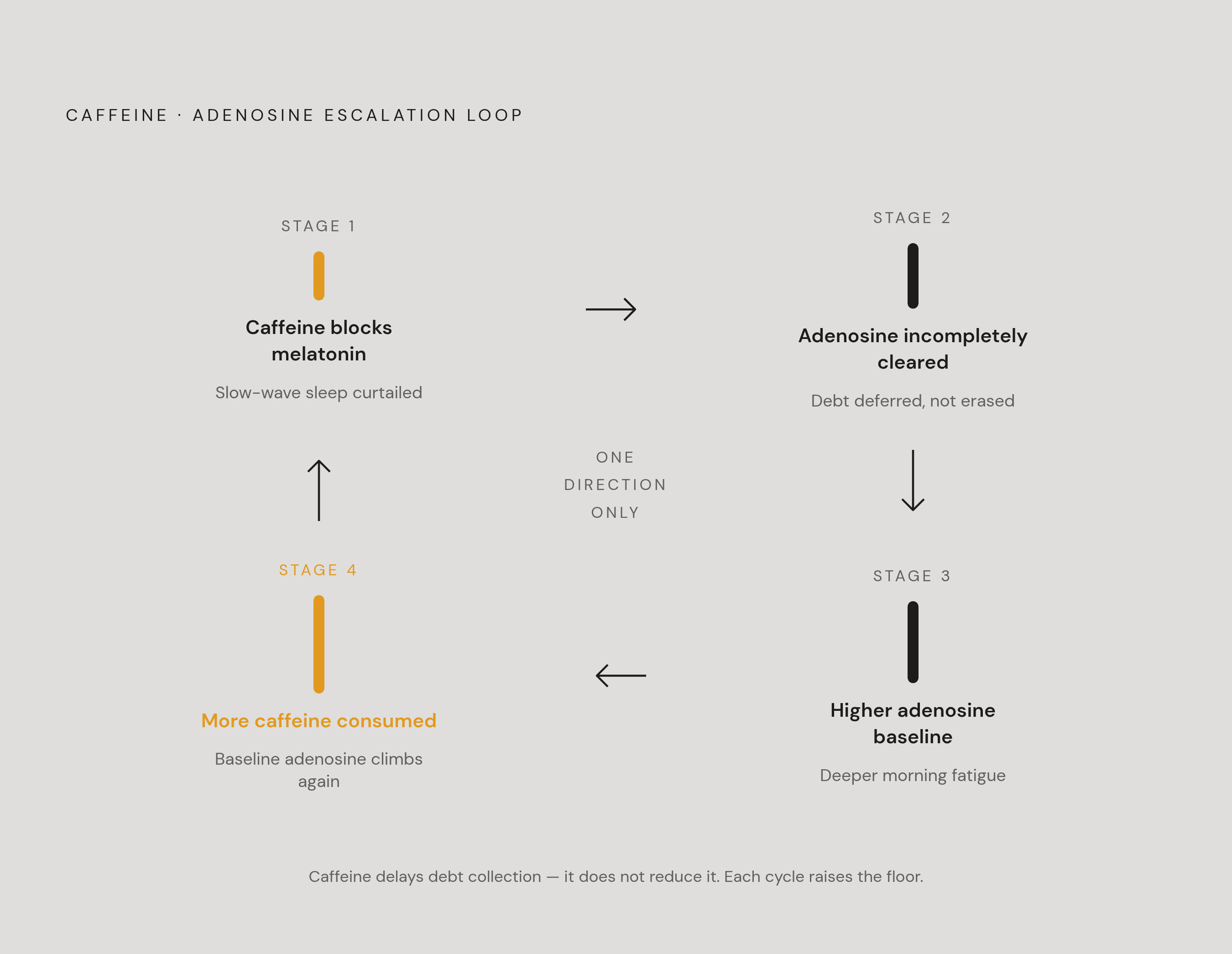
The crash doesn't end when the workday does. It degrades the sleep that follows, which raises the adenosine level the next day begins with, and that is what turns a single rough afternoon into a cycle that gets worse on a schedule. Caffeine suppresses melatonin production, and daytime consumption produces a measurable reduction in 6-sulfatoxymelatonin, the primary metabolite the body excretes in urine as a marker of melatonin activity, on the very next night. That suppression happens even in people who feel fine that evening and notice nothing wrong with their sleep. The hormone responsible for sleep onset has been chemically dampened regardless of how the person perceives their own rest.
The downstream effect lands in sleep architecture itself: slow-wave and other restorative stages of sleep get curtailed. Adenosine doesn't fully clear overnight the way it would in an unaffected system. The brain starts the next day already carrying sleep pressure forward from the day before. Sleep deprivation at this level is tied to attentional lapses, weakened working memory, and impaired executive function, the precise mental capacities a professional under deadline pressure depends on most. Sustained across a workweek, that deprivation compounds further, deepening cognitive deficits, destabilizing mood, and raising error rates day over day.
The cycle that results runs in one direction only, each stage feeding the next: poor sleep raises the adenosine baseline, a higher baseline produces deeper morning fatigue, deeper fatigue prompts more caffeine, more caffeine further disrupts sleep, and the baseline climbs again. The adenosine debt accumulated through a week of this is substantial, and caffeine's only real function in the cycle is to delay when that debt gets collected, not to reduce it. Understanding this cycle makes clear why caffeine alone can never resolve the problem it appears to be solving. It is structurally positioned to make the debt larger, not smaller, which raises the question of what, short of simply using less of it, might change the shape of the curve rather than just repeating it.
Why the caffeine-plus-L-theanine combination produces a different energy curve
L-theanine doesn't block caffeine's effect on alertness, and it isn't trying to. L-theanine is an amino acid found almost exclusively in tea plants, Camellia sinensis, and its role in this combination is to modulate the nervous system's reaction to caffeine rather than to compete with caffeine for the same receptors. Research published in Nutritional Neuroscience, along with later studies building on those findings, shows that L-theanine promotes alpha wave activity in the brain, a state linked to calm, focused attention rather than the jittery overstimulation that caffeine alone can produce.
The two compounds appear to work together rather than simply stacking their separate effects. L-theanine smooths the caffeine curve instead of amplifying its peaks, so the onset feels slower and the duration of alertness feels more even across the hours that follow, in contrast to the sharp rise and hard drop that caffeine produces by itself. Matcha delivers both compounds in a single vehicle: it contains caffeine at a moderate level per serving, depending on preparation, alongside a naturally occurring dose of L-theanine, producing a slower, more sustained caffeine curve that reduces how much adenosine piles up behind the receptor blockade before it eventually breaks through.
The evidence behind this combination supports real optimism, and it stops short of being settled science. A 2025 review in Nutrition Research found that while L-theanine shows promise for reducing stress, and the caffeine-L-theanine combination may improve cognitive performance and alertness, the evidence behind many of the health claims attached to it remains limited by a shortage of rigorous human clinical trials. The honest account of this combination is that it addresses the actual mechanism of the crash with more precision than caffeine taken alone, smoothing the receptor dynamics and stress response rather than ignoring them. It cannot substitute for sleep, and the adenosine debt that poor sleep built up remains after it wears off. No supplement does that work.
Adaptogens and the HPA axis
Everything above describes a problem stimulants are poorly equipped to solve on their own, because caffeine and L-theanine both operate downstream of the adenosine and cortisol systems rather than correcting how those systems respond to stress over time. Adaptogens work on a different axis entirely: the HPA axis itself, the same hormonal chain responsible for cortisol's daily rhythm and its exaggerated response under chronic pressure. Where caffeine amplifies cortisol output in a stressed professional, compounds that target the HPA axis are studied for the opposite effect, helping regulate how much cortisol gets released and how quickly the system returns to baseline once a stressor has passed.
This distinction matters because the double-bind described earlier has no stimulant-based exit. A professional cannot drink their way out of a feedback loop where the substance meant to sustain focus under pressure is also amplifying the stress hormone eroding that same focus. Addressing the HPA axis directly, rather than layering another receptor-blocking compound on top of an already taxed system, targets the hormonal rhythm itself rather than masking its symptoms for another few hours. That is a meaningfully different strategy than anything caffeine, with or without L-theanine, is built to provide, and it reflects a shift in how crash prevention has to be understood: not as a search for a better stimulant, but as an effort to repair the stress-response system that stimulants have spent years quietly overworking.
Sources
- Caffeine Stimulation of Cortisol Secretion Across the Waking Hours in Relation to Caffeine Intake Levels
- Brain Hijack: The Neurobiology of Caffeine Crash
- A review of caffeine’s effects on cognitive, physical and occupational performance - ScienceDirect
- Neurobiology of chronic caffeine use and withdrawal: Mechanisms, effects and implications - ScienceDirect
- Caffeine Withdrawal - StatPearls - NCBI Bookshelf - NIH
- Chronic caffeine alters the density of adenosine, adrenergic, cholinergic, GABA, and serotonin receptors and calcium channels in mouse brain
- The effects of coffee consumption on sleep and melatonin secretion
- Frontiers