What Separates a Mental Clarity Shot That Performs From One That Just Tastes Like It Should
Proven ingredients at tested doses matter more than taste or packaging.

A mental clarity shot needs human evidence to back its claims, ingredients the body can absorb, and a body rested enough to respond. A daily shot with nanoencapsulation may address absorption problems that ordinary capsules or powders leave unresolved, but the technology alone does not prove better brain performance. The strongest choice is a transparently dosed formula with a delivery system suited to its ingredients.
Why most mental clarity shots fail before they reach your brain
A sharp taste and a polished bottle can make a shot seem to work before it has done anything. Neither shows that it improves attention, memory, or mental endurance. The gap is between what a product suggests and what its formula can deliver. An ingredient list can be accurate while the amounts are too small to support the promised effect.
That gap creates three tests, in order. First, the ingredients need credible human evidence at relevant doses. Next, the delivery system must make those ingredients available for absorption. Finally, sleep debt and sustained stress can limit what even a sound formula contributes. Passing one test does not excuse failing another, and the first requires more than the words “clinically validated.”
What "clinically validated" actually means — and why the evidence bar varies by ingredient
“Clinically validated” is useful only when the underlying research supports the claim being made. Animal studies and a plausible biological mechanism can justify further research, but they do not establish a cognitive benefit in people. The meaningful standard is randomized, placebo-controlled human trials measuring cognitive outcomes, with independent replication.
A practical way to read an ingredient claim is to ask about four things. Those are the number of human randomized controlled trials, the total participants studied, independent replication, and support from a systematic review or meta-analysis. Together, they distinguish a promising finding from a dependable body of evidence. A small trial gives a narrower basis for a claim than repeated results across research groups.
Using that lens puts creatine and caffeine plus L-theanine at the strong end, with Lion’s Mane, Rhodiola rosea, and Ashwagandha in a more moderate tier. Claims should be only as strong as the evidence behind them. Dose disclosure is part of the same test, because a proprietary blend can name well-studied compounds without revealing whether any is present in a studied amount.
How the strongest-evidence ingredients actually work — and where their limits are
Of these combinations, Caffeine plus L-theanine has the clearest evidence that it helps attention right away. L-theanine promotes alpha brain wave activity associated with calm, focused attention, while the pairing improves speed and accuracy during attention-switching tasks and reduces distractibility during memory tasks. There is still a trade-off. Caffeine can raise cortisol acutely, and L-theanine partially reduces that effect. Chronic high caffeine intake can also erode the benefit, so both individual doses and their ratio deserve disclosure.
Theacrine is used to make focus last longer, with less emphasis on a sharper lift at the start. It acts through adenosine and dopamine receptor modulation, similar to caffeine, with a slower tolerance curve. Its proposed role is an endurance layer. However, an endurance claim still needs human trial support at the disclosed dose, and it should not inherit the evidence strength of caffeine plus L-theanine merely because their mechanisms overlap. More compounds acting on similar pathways do not guarantee proportionally greater gains.
Lion’s Mane has a credible mechanism involving nerve growth factor, or NGF, but its human evidence remains moderate and conditional. A randomized placebo-controlled trial of 30 people with mild cognitive impairment reported improvement after 16 weeks, followed by declining performance after treatment ended. A 2025 RCT published in Frontiers in Nutrition tested acute effects in healthy adults and found improvements in some motor dexterity measures but null results for other cognitive outcomes. The dose and duration behind a claim therefore need to match its evidence, rather than treating a long-term result as proof of an immediate benefit in healthy younger adults.
Bacopa monnieri has stronger support for slow-build memory benefits, including meta-analysis support, but it is not an acute focus ingredient. It works through acetylcholinesterase suppression, which helps support attention, cognitive processing, and working memory. Consistent use over several weeks is part of the proposition. A relevant daily dose cannot be separated from that timescale, and low solubility can constrain how much becomes available to the body. This is where ingredient evidence begins to run into delivery design.
Ashwagandha works more on the conditions for cognition than on an immediate burst of mental speed. KSM-66 at 300–600 mg/day is associated with measurable cortisol reduction after four to eight weeks. Its cognitive-support case is therefore moderate and indirect. Poor solubility of key bioactive components adds another constraint. Rhodiola rosea also sits in the moderate tier, but its anti-fatigue effects can appear within days to one to two weeks, making it a faster complement to a slower cortisol-focused ingredient. Its dose still needs to correspond to the human research supporting the claim, and both compounds depend on what the delivery system does next.
Why a dose on the label and a dose in your bloodstream are not the same thing
A label states what goes into a serving. Ingredients taken by mouth must survive digestion, cross the intestinal wall, and go through first-pass liver metabolism. Some material is broken down or never taken up. A clinical trial backs the dose and formulation it tested, without showing that every format gets the same amount into the bloodstream. Matching the printed dose is necessary, but it does not establish how much reaches the bloodstream.
Solubility is one reason formats can behave differently. Ashwagandha’s withanolide aglycones, for example, have poor water solubility, while its glycosides are more water-soluble. That distinction prevents a blanket claim about the whole extract. Dietary fat can improve uptake of fat-soluble components, but a shot consumed without food cannot rely on that help. A water-based formula containing poorly water-soluble ingredients therefore needs a delivery design that addresses the mismatch.
With liquids, there is no capsule to dissolve, so water-soluble ingredients can reach the intestinal lining sooner. Faster contact is not automatically greater total absorption. Being liquid also does not prove that a formula works better than every powder preparation. Piperine can improve absorption of certain polyphenols by inhibiting P-glycoprotein and CYP3A4, but those same effects can alter exposure to medications. An absorption enhancer is not an uncomplicated bonus.
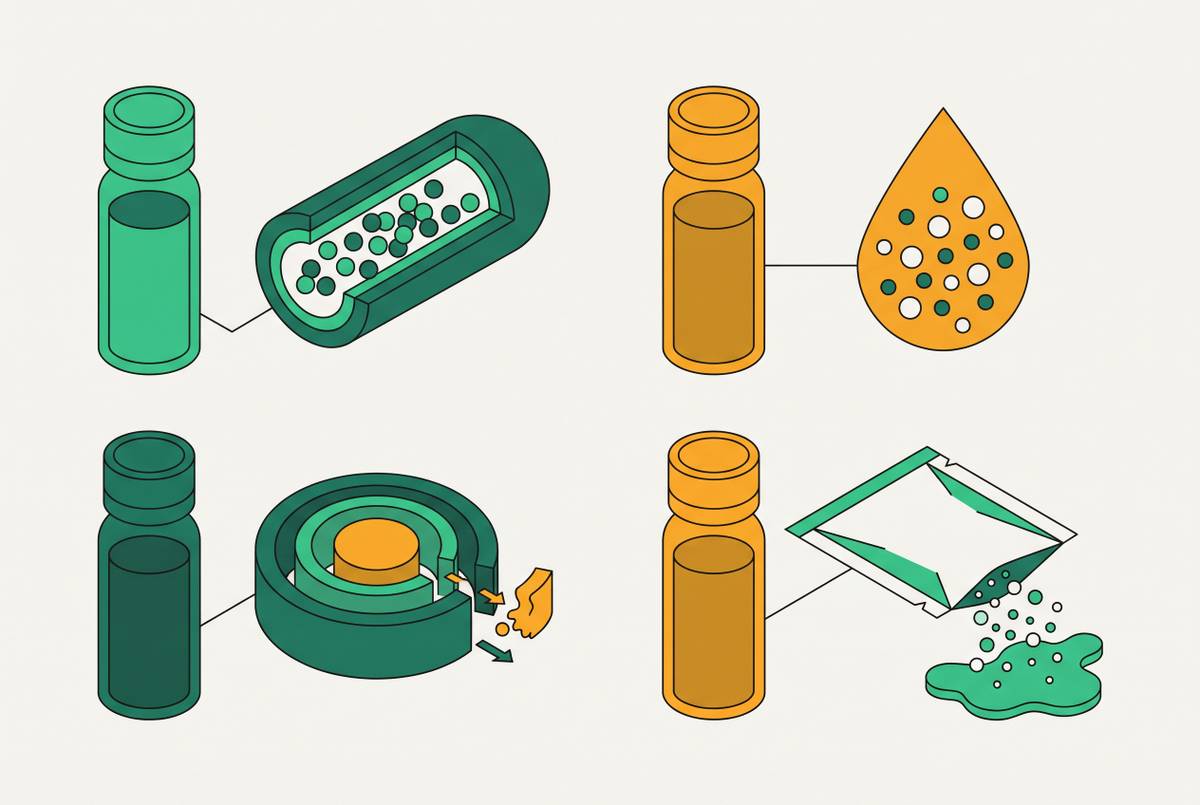
Lipid nanoencapsulation takes a different approach by wrapping active compounds in a protective carrier. The intended benefit is protection through digestion and release closer to the absorption site. That is a specific engineering rationale. It is not, by itself, proof that a finished shot avoids first-pass loss or delivers better cognitive outcomes. The buyer’s test is whether the carrier suits the ingredients and whether evidence supports the claimed improvement.
What a daily shot with nanoencapsulation for better absorption should look like in practice
A delivery-first formula puts a lipid-compatible carrier inside the product when its ingredients need one. It does not leave absorption dependent on what the user happens to eat. The design should also protect ingredients as they pass through the stomach’s low-pH environment, especially polyphenols that can break down before they reach the small intestine. “Advanced absorption” explains none of this. A credible description names the obstacle and how the formula is intended to address it.
Caffeine plus L-theanine is used for acute focus, so it makes sense for the body to have access to it quickly. A cortisol-focused ingredient such as Ashwagandha has a different timescale, and sustained release may help maintain blood levels. These are not interchangeable design goals. One blanket claim of “fast-acting” cannot explain why every ingredient in a mixed formula is delivered appropriately.
A 2oz nano-encapsulated liquid shot combines two distinct features, namely avoiding capsule disintegration and providing a lipid carrier. That makes it a plausible format for addressing both onset and poor water solubility. It does not establish superiority on its own. Without comparative absorption evidence for the finished formula, the defensible claim is that the design targets known delivery problems. Transparent individual doses remain essential, because sophisticated delivery cannot compensate for an undisclosed amount of active ingredient.
The physiological floor every ingredient has to clear — sleep, cortisol, and the BDNF problem
A well-dosed, well-absorbed formula can still be working against poor sleep and sustained stress. That changes how underperformance should be interpreted.
BDNF, or brain-derived neurotrophic factor, helps explain why those conditions are so influential. It supports neural plasticity, the brain’s ability to change, which contributes to cognitive functioning and mood regulation. Sleep and BDNF have a two-way relationship. BDNF is expressed primarily during wakefulness and influences subsequent slow-wave sleep, while chronic poor sleep can reduce BDNF levels. Sleep supports memory consolidation, but it is not accurate to say that BDNF itself is “consolidated” during sleep.
That distinction also sharpens the case for ingredients such as Lion’s Mane. Its NGF-related mechanism concerns support for nerve growth, while BDNF connects plasticity with the wider conditions of sleep and cognitive functioning. Neither provides a reason to ignore sleep restriction, which can impair reaction time and working memory even over short periods. For someone regularly sleeping fewer than seven hours, the room for a supplement to help may already be constrained.
Cortisol creates a similar distinction between short-term usefulness and long-term cost. Acute cortisol supports short-burst alertness, whereas chronically elevated cortisol can erode prefrontal cortex function involved in working memory and executive control. Another stimulant cannot fully resolve that background load. Ashwagandha’s slower cortisol-focused role and Rhodiola’s faster fatigue-related role are therefore different from simply adding more immediate stimulation. They work on conditions that can hold back performance, but sleep and sustained stress still need attention.
For the reader, the practical shift is to examine those conditions before assuming that a stronger formula is the answer. Sleep support is part of helping the brain work well. A product positioned for sleep reflects that connection only if its own ingredients and claims withstand scrutiny. The name of a variant is not evidence of benefit. A sound formula supports the work of improving the baseline.
Applying all three filters: what to actually look for on a product label
The first label check is individual ingredients and amounts. Look for named cognitive-support compounds with doses that correspond to human trials and claims that respect the studied population and timescale. Caffeine and L-theanine should be disclosed separately, while Ashwagandha claims should identify the studied extract, such as KSM-66 or Sensoril. Bacopa should not be sold as instant memory support. A “brain blend” with one combined weight prevents a buyer from judging whether its individual ingredients reach relevant doses.
The next check is whether delivery matches the formula. Fat-soluble components need a suitable carrier, and a claimed absorption technology should come with an explanation more specific than “fast-absorbing.” A liquid format, lipid encapsulation, and a bioavailability enhancer solve different problems and should not be treated as synonyms. The product also needs third-party purity testing with results on record. Better delivery is no advantage if the identity and purity of what is being delivered remain uncertain.
Before blaming weak results entirely on a product, look at average sleep and sustained stress load, because improving those may help more than changing formulas. A blend addressing acute focus as well as the cortisol-sleep connection has a broader rationale than one built only around stimulants. It still has to pass the evidence and delivery tests first.