Why the Daily Mental Performance Shot You Actually Use Must Have Patented Delivery Technology Built In
Patents prove novelty, not absorption, so demand evidence of delivery.
A daily mental performance shot should be judged by what its delivery system can get into circulation. Patented delivery technology deserves attention because it can address losses that ordinary formats leave unresolved. But a patent is not proof that ingredients reach the brain, or that a shot works better. The strongest product makes its delivery claims as accountable as its ingredient doses.
Why what's on a mental performance label rarely matches what reaches your brain
Stomach acid and digestive enzymes meet a swallowed ingredient before the brain ever gets a chance to use it. The compound must survive there, dissolve enough and pass through the intestinal lining. Each step can cut how much the body has to use. For botanical extracts, poor absorption can leave a substantial gap between the amount swallowed and the amount that enters circulation.
The label records the starting dose. It does not show how much survives digestion, how much the liver metabolizes or how much ultimately reaches neural tissue. Those are separate questions, even when the ingredient has good clinical evidence. So a formula can have the dose used in a study without proof that its finished format gives the body the exposure needed for the same effect.
That distinction is easy to miss when comparing shots. A longer ingredient list or a larger dose is easy to see, while absorption stays out of sight. Yet capsules, powders and ordinary liquids all send their contents through the digestive process. Their labels cannot, by themselves, account for the losses along that route.
How first-pass metabolism strips cognitive ingredients before they can work
First-pass metabolism can cause more losses after intestinal absorption. Compounds absorbed through the usual intestinal route go through the portal vein to the liver before they enter systemic circulation, the bloodstream that serves the rest of the body. The liver metabolizes a fraction of what arrives. As a result, less of the original compound may reach general circulation than crossed the intestinal lining.
This is distinct from poor dissolution in the gut. Bacopa Monnieri’s bacosides, for example, have poor water solubility, which limits their oral availability before liver processing enters the picture. Ashwagandha’s withanolides also face bioavailability constraints, although the supplied research describes differing absorption properties. Treating every botanical as poorly absorbed for exactly the same reason would blur the problem.
For a daily formula, these obstacles can stack up. A compound may dissolve poorly, go through metabolism after absorption and still have to reach neural tissue. Evidence about one step does not settle the others. A clinically informed starting dose is useful, but an ordinary oral format does not itself protect that dose throughout the journey or remove the liver’s initial processing.
Why conventional formats — capsules, powders, and plain liquids — cannot solve this structurally
Changing an ingredient from a capsule to a powder does not, on its own, change its absorption pathway. Nor does putting it into a plain liquid create a protective barrier around it. A liquid may leave the stomach faster than a capsule, but faster stomach emptying is not the same as avoiding first-pass metabolism. The route still sets the constraint.
Why not simply take more of the ingredient? A higher dose can make up for some losses, and conventional oral formulas can have benefits in clinical trials. Increasing the dose leaves the source of variation in place and can raise the cost of obtaining an effective amount and move intake closer to tolerability limits.
Trials use set doses and study conditions, while day-to-day use changes with food intake, gut pH and transit time. So the same dose on the label can lead to different systemic exposure as those conditions change. Capsules or powders can work, but changing the basic format does not address protection and routing without an added delivery mechanism.
What lipid-based nanoencapsulation does that conventional formats cannot
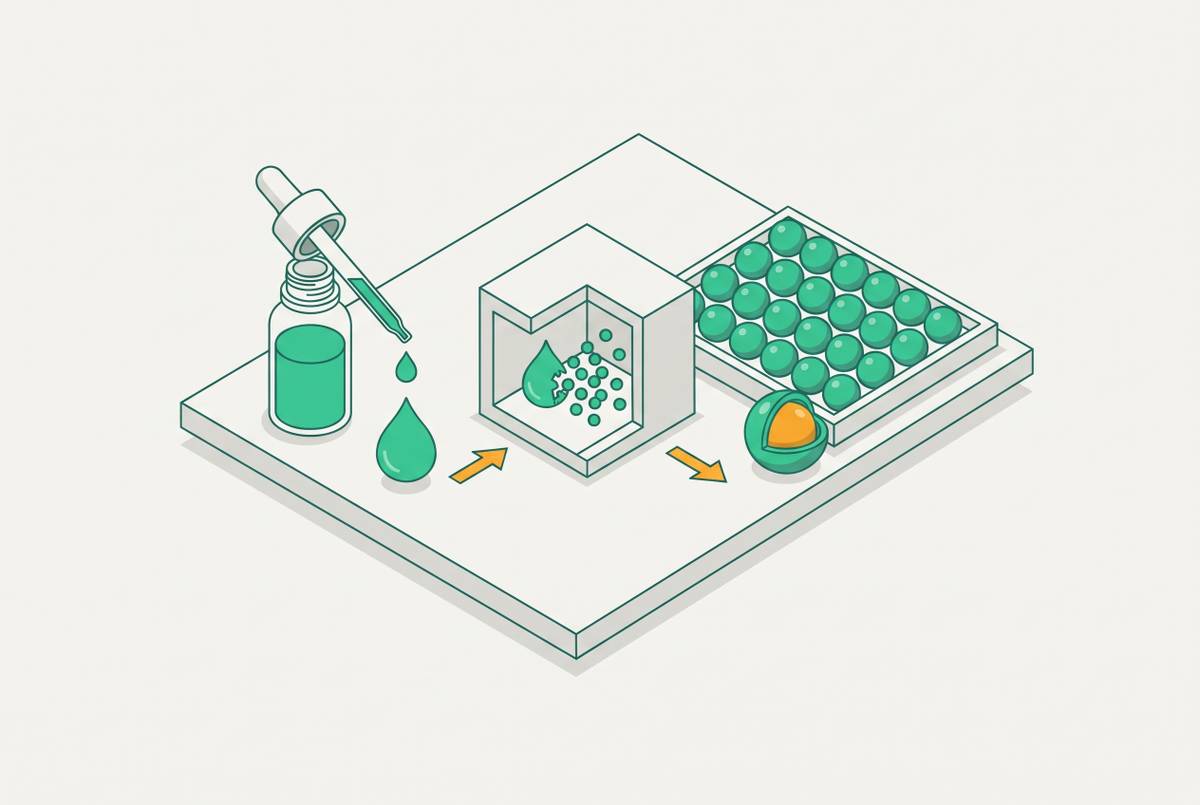
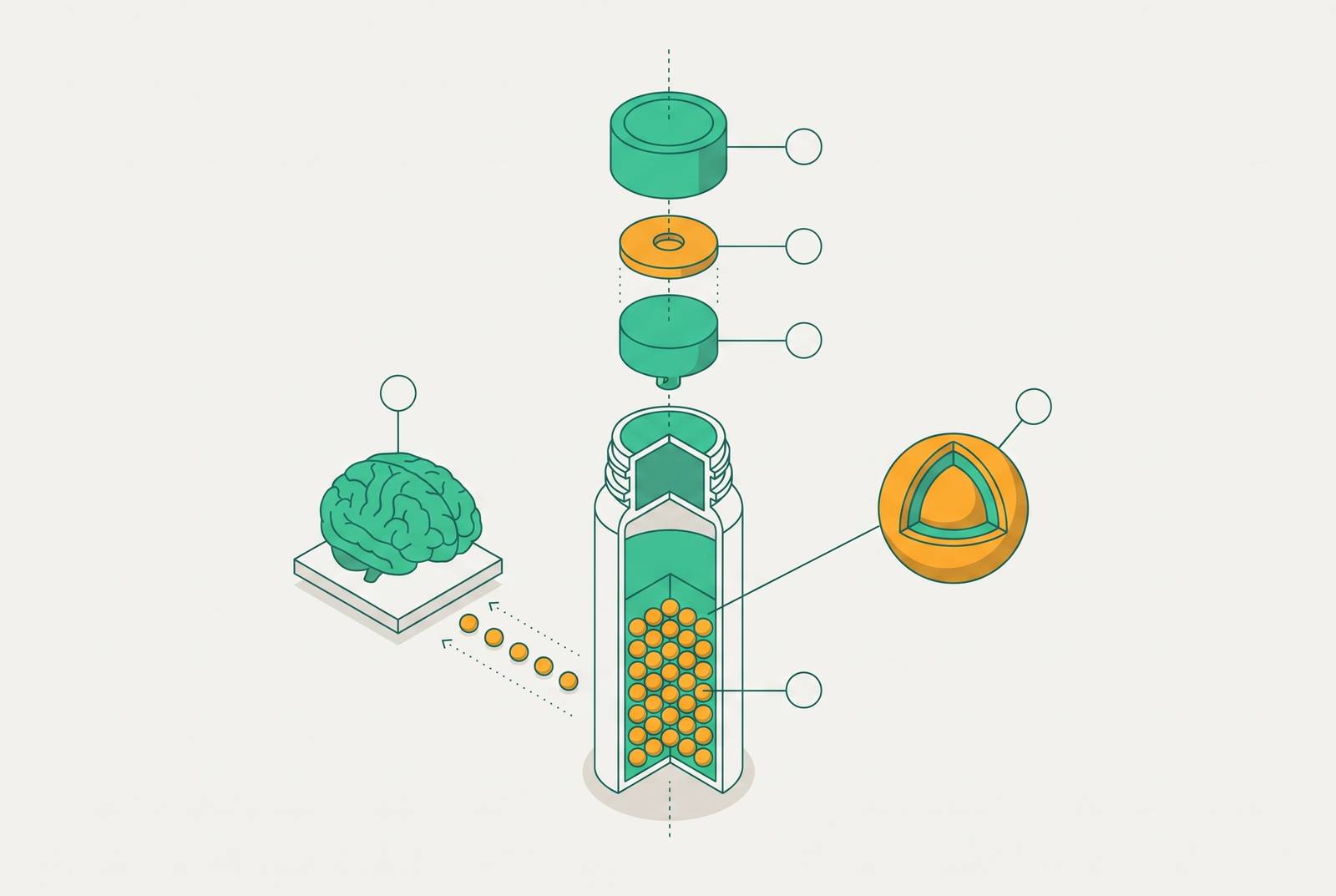
Lipid-based nanoencapsulation puts active compounds inside microscopic structures made with fats or related materials. That adds a physical barrier between the compound and its surroundings. The intended benefit is protection during digestive transit, rather than simply placing more unprotected material into the gut.
Lipid delivery can also make a different absorption route possible. The lymphatic pathway takes absorbed material through intestinal lacteals and onward through the thoracic duct into systemic circulation. Material entering by that route can avoid the liver’s initial pass. However, a description of this pathway does not establish that every encapsulated ingredient uses it, or that a particular formula largely bypasses first-pass metabolism.
The details of the particle also need precision. An olive-oil-based system is not automatically an olive-oil-derived lipid shell. The characterization study identified as PMC3292030 describes olive oil as the hydrophobic core, with a shell whose composition was varied. That distinction prevents one particle design from being used as evidence for another. Nanoencapsulation offers a plausible way to address protection and routing, but the finished system still needs evidence showing what it actually delivers.
What the patent record establishes about delivery technology as a formal innovation
US12472188B1, granted on 2025-11-18, covers a method and composition for an improved bioavailability delivery system. Its description includes encapsulated micronized material with a phytosomal delivery system, using phospholipids complexed with botanical extracts, vitamins and other actives. This establishes a concrete subject for scrutiny. It is more specific than an unexplained claim of “enhanced absorption.”
That specificity does not make different delivery systems interchangeable. A phospholipid-complex system does not, by itself, establish an olive-oil-shell mechanism, lymphatic routing or improved brain delivery for a separate shot. US12697339 addresses composition and methods for synergistically-enhanced supplementation. Its subject likewise shows that delivery and compound combinations can be formal areas of invention.
Patent status is a starting point for credibility. Patent review addresses legal requirements such as novelty, non-obviousness and utility. A grant should not be presented as independent clinical validation or proof of reproducible benefits in daily users. The patent needs to cover the delivery technology actually used in the product. Only then can its claims be compared with evidence about absorption and outcomes.
How the delivery gap compounds across the specific ingredients a daily cognitive shot must carry
Poor water solubility limits the oral availability of Bacopa’s bacosides. Its evidence for working memory and delayed recall does not erase that constraint. A formula using Bacopa therefore needs more than a familiar ingredient name. It needs a dose and formulation that can reasonably connect the product to the evidence.
Ashwagandha introduces another set of absorption questions. Its cortisol-modulating, stress-resilience and calm mood support effects depend on exposure to its active compounds, including withanolides. Lion’s Mane adds erinacines and hericenones, which are associated with nerve growth factor and BDNF pathways. Their chemistry makes lipid-mediated delivery relevant, but biological activity is not proof that a finished shot produces those effects in people.
Ceremonial-grade Matcha pairs L-theanine with caffeine, so a claim about balanced focus needs to account for how they work together as well as their presence. An inconsistent absorption pattern could complicate that balance, but a label cannot establish their ratio at the neural level. B-vitamins also have absorption variability and cannot be treated as an afterthought.
A system that improves delivery of one botanical has not automatically demonstrated the same benefit for every compound mixed with it. Stack-wide claims need stack-wide support.
Why daily use specifically raises the stakes for delivery consistency
Food intake, pH and transit time can change even when the serving stays the same. For a knowledge worker trying to judge a routine, that creates a practical problem. A change in how the day feels does not reveal whether the cause was the product, absorption or something else.
Benefits associated with repeated Bacopa and Lion’s Mane use are also different from an immediate feeling of stimulation. The hoped-for gains come with continued use and include effects on memory and pathways involved in neuroplasticity. However, a variable day of absorption does not by itself establish that cumulative benefits have been lost.
The 2026 RCT of sustained-release ashwagandha reported significant cortisol reduction at day 60 with 300 mg. That finding gives delivery format a place in the discussion of repeated dosing. It does not prove that nanoencapsulation produces the same result, because sustained release and nanoencapsulation are not interchangeable descriptions.
Protection and alternative routing may help address sources of variability, but neither a mechanism diagram nor patent status guarantees consistent systemic concentrations. Evidence from the actual formulation is what connects the design to that promise.
The honest objection — strong ingredient evidence does not automatically validate the delivery argument
If randomized controlled trials already find benefits from Bacopa, Ashwagandha, Lion’s Mane or Rhodiola Rosea, why assume that conventional delivery is inadequate? Those results show that oral ingredients can work in the conditions used in the studies.
At the same time, ingredient evidence does not validate every finished product. The tested dose, formulation and conditions define what a trial can support. Effects can be small, and studies can find different results. A claim about delivery thus needs its own review, apart from the evidence for the ingredient itself.
The 2025 Australian RCT found no objective cognitive improvement with Bacopa at 300 mg/day. That result does not identify poor absorption as the cause. An insufficient dose or insufficient exposure could be possible explanations, but the finding alone cannot distinguish them or establish that nanoencapsulation would have changed the outcome.
Better delivery is worth evaluating precisely because the benefits are not guaranteed and the margin for a meaningful effect may be modest. The honest case is for demonstrated improvement in exposure. Patent protection alone cannot establish that patented systems are the only way to achieve it.
What to actually evaluate when a product claims superior bioavailability
The first criterion is whether the patent matches the claim. A buyer should be able to identify the patent and see how it relates to the product’s delivery system. A patent for a different formulation is not a substitute. Equally, the absence of a patent does not automatically turn valid absorption research into marketing.
The second criterion is a specific, testable mechanism. Terms such as lipid shell, nanoparticle scale and lymphatic routing should describe what the system does. Evidence should distinguish protection in the gut from increased systemic exposure, and increased exposure from delivery to neural tissue. Those are different claims requiring different support.
Third-party testing checks the quality of the product separately. Relevant testing includes PFAS, heavy metals, mycotoxins and plastic chemicals. It does not establish absorption or cognitive benefit. Its role is to address contaminants, including concerns about the finished formulation, without being stretched into an efficacy credential.
Transparent dosing is the fourth criterion for evaluation. Even with a patented delivery system, a buyer still cannot link an underdosed proprietary blend to clinical evidence. A daily shot should have a patented mechanism that fits its claims, clearly stated amounts of each ingredient, third-party testing that checks for contaminants and evidence for its bioavailability claims. Better absorption and faster onset require demonstration even for a system described with the word “nano.
That leaves a sharper question at the point of purchase. A supplement needs good ingredients that actually arrive in useful amounts. A patent gives the answer something to examine.