How Nanoencapsulation Turns Liquid Nootropics Into a Different Category of Tool
Nanoencapsulation protects nootropic ingredients through four distinct absorption barriers.
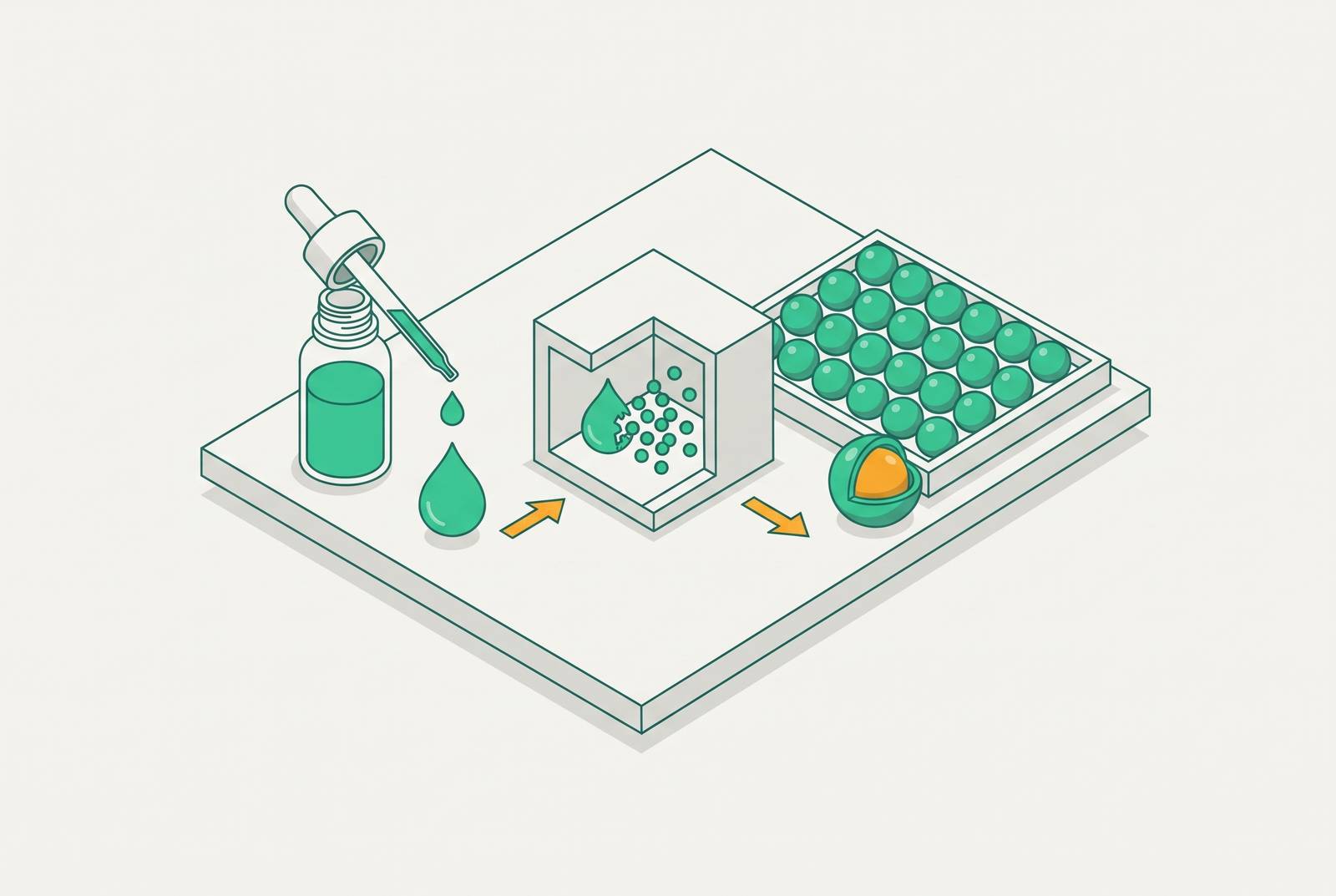
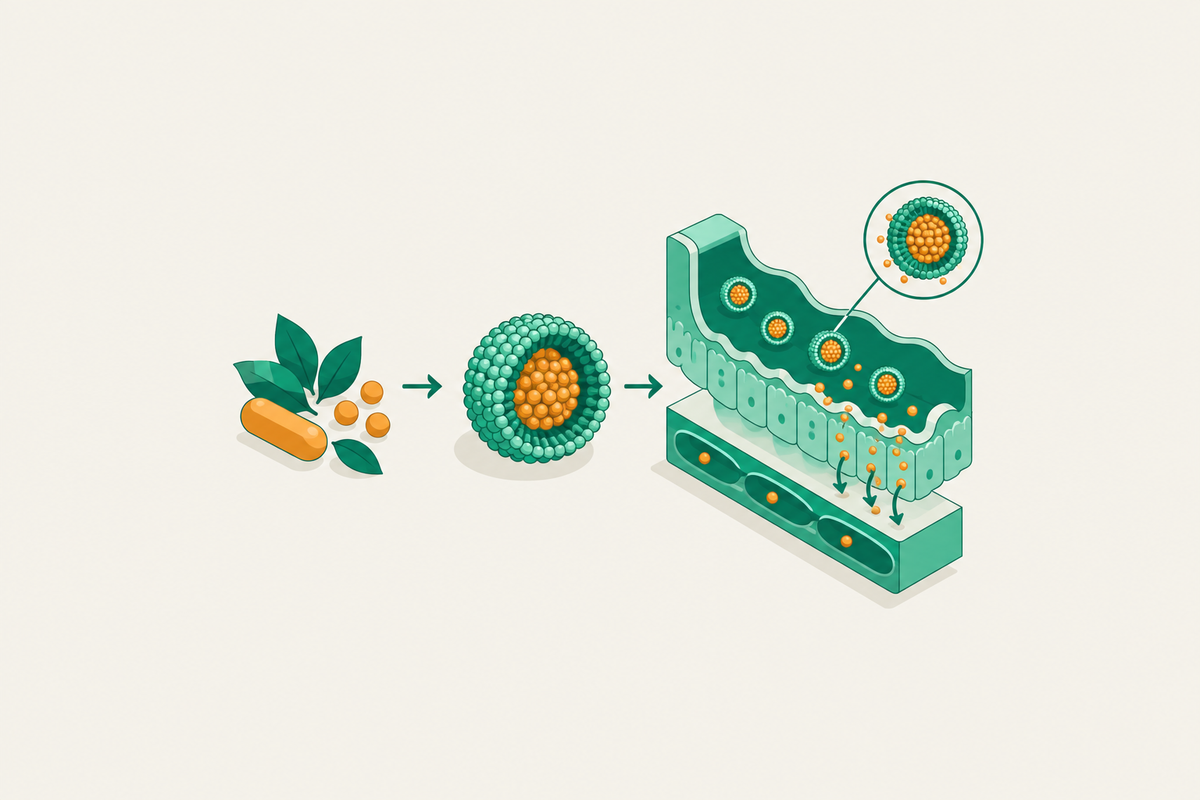
A daily nootropic shot with genuine nanoencapsulation can improve absorption by protecting ingredients and helping them pass barriers that ordinary liquids, capsules and powders leave unresolved. That makes delivery technology a real category distinction. But the advantage claimed by “nanoencapsulated” on a label depends on evidence that the carriers remain intact through consumption.
Why most liquid nootropics fail before they can work
A compelling ingredient list describes what goes into a bottle, leaving what reaches target tissue unspecified. Those are different things. A compound may work in a lab yet do little when swallowed because too little reaches circulation in an active form. This is a structural delivery problem that can occur even with good-quality ingredients.
Surviving manufacture and storage is only the beginning. After ingestion, molecular size, difficulty crossing the intestinal wall and processing by the liver can reduce the available dose. This creates a gap between in vitro efficacy, meaning activity in a lab, and in vivo performance, meaning what happens inside the body. Suspending a powder in water can put the same absorption problem in a more convenient bottle.
The four physicochemical barriers nanoencapsulation is engineered to overcome
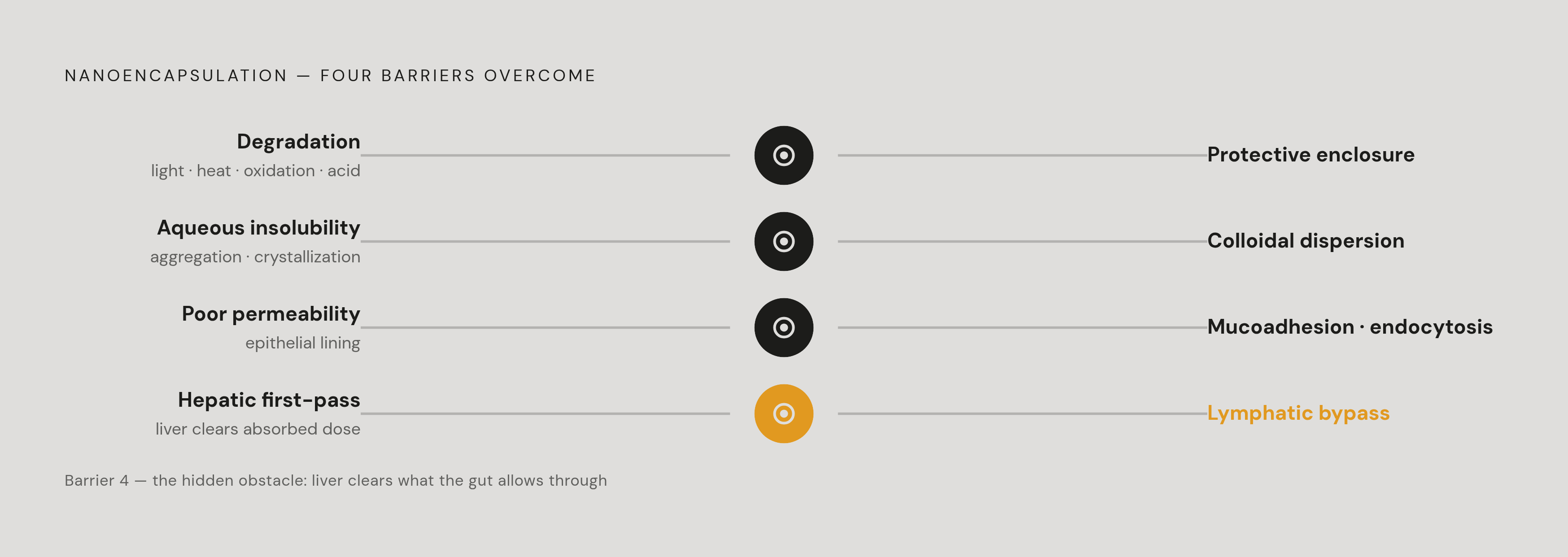
The first barrier is breakdown before absorption, or degradation. Light, heat, oxidation and extremes of acidity can damage sensitive bioactive compounds before they have a chance to work. Some of the dose can be lost before ingestion, and more can be lost as it passes through the digestive tract. What remains intact must then overcome a separate problem, which is whether it can dissolve.
The second barrier is poor dissolution in water, or aqueous insolubility. Many plant compounds favor fats over water, while the gastrointestinal environment is largely watery. Instead of dispersing into a form available for absorption, poorly soluble molecules can aggregate and crystallize. Being present is not the same as being available. A liquid containing those particles has not necessarily solved their insolubility.
The third barrier is difficulty crossing the intestinal lining, or poor intestinal permeability. A molecule can survive digestion and dissolve yet still struggle to pass through the intestinal epithelium, the layer separating intestinal contents from the body. Unfavorable molecular size and limited ability to cross that layer restrict uptake. Dissolution alone does not finish the job.
The fourth barrier is processing by the liver before wider circulation, called hepatic first-pass metabolism. After intestinal absorption, this processing can substantially reduce the fraction available in an active form. A compound that survives the stomach still faces the intestinal wall and the liver. Conventional liquid, capsule or powder formats do not, by their format alone, solve these four problems.
How nanoencapsulation resolves each barrier as a distinct additive lever
To guard against degradation, nanoencapsulation puts sensitive compounds inside carriers that protect them. That enclosure can shield them from light, heat, oxidation and changes in acidity. Protection preserves the material available for later absorption. It can prevent a useful ingredient from being lost before its biological properties become relevant.
Against insolubility, nanocarriers hold water-avoiding compounds in a dispersed form. Entrapping those molecules at the molecular or colloidal level helps prevent the aggregation and crystallization that obstruct absorption. A colloidal dispersion contains tiny particles distributed in an undissolved form. The carrier can keep a poorly soluble ingredient available without requiring that ingredient to become naturally water-soluble.
Against poor permeability, the carriers’ small dimensions and high surface-area-to-volume ratio can support intestinal uptake. Mucoadhesion helps carriers stay in contact with the intestinal mucus, while endocytosis-mediated uptake provides a route through which cells take material in. These are separate from keeping an ingredient dispersed. One mechanism improves availability at the intestinal surface, while another can help it cross the lining. That is why nanoencapsulation is more than a smaller-particle claim.
Some carriers can help absorbed material travel through intestinal lymphatics, so part of it bypasses the liver’s initial processing and avoids first-pass metabolism. Metabolism still takes place, and some of a swallowed dose may still be lost. It can reduce an important early loss. Controlled release adds another lever by pacing the release of active compounds. Together, these mechanisms can change the absorption profile structurally, although their performance depends on the carrier and formulation.
Why do nanoencapsulated nootropic shots use a liquid format rather than capsules or powder?
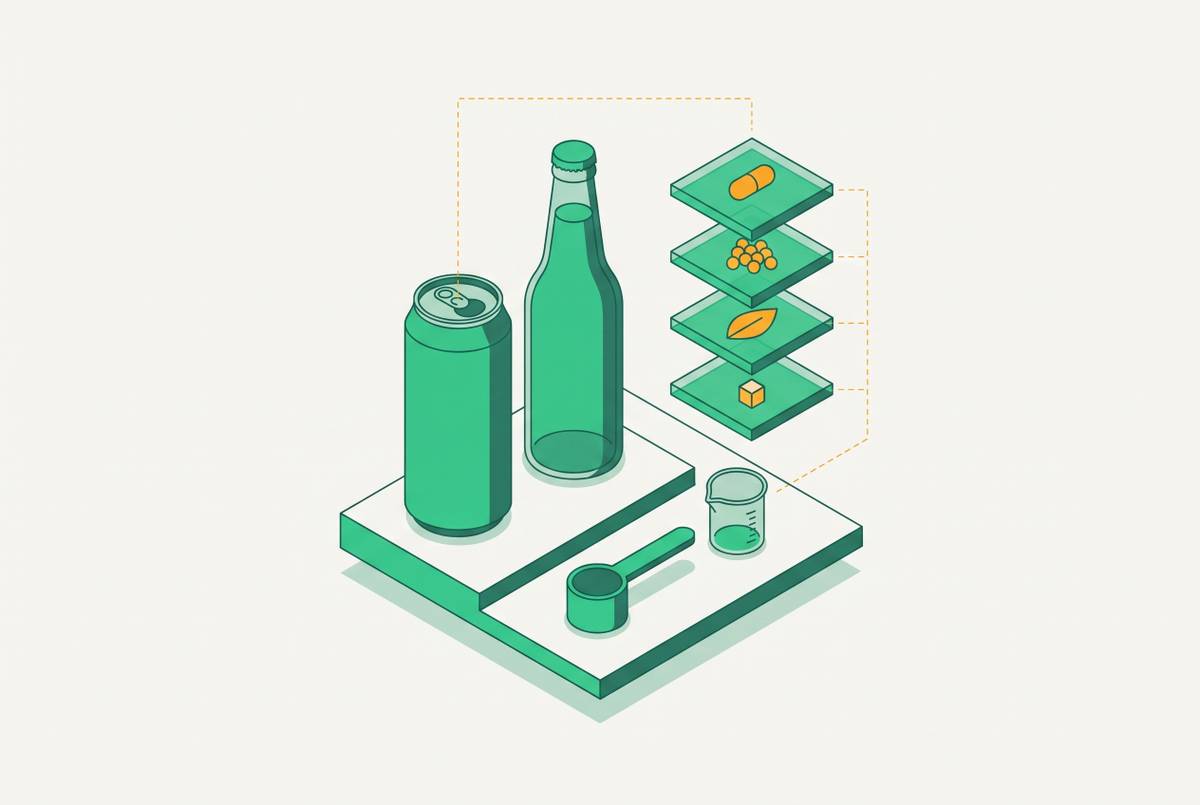
Nanocarriers need their organized structures to work, so their small size alone is not enough. A liquid suspension can keep them in their colloidal state from manufacture through ingestion, so their delivery architecture stays in place without having to be rebuilt from a compressed solid. This gives the medium a functional role. The liquid is not merely there to make the dose easier to swallow.
Compression and the other forces used in processing can damage vesicles, the small enclosed structures used by some carriers. If that structure collapses, the ingredient may still be there even though the architecture that helps with uptake is damaged. This explains why preserving carrier integrity is central to the comparison. A liquid also avoids waiting for a capsule shell to dissolve before its carriers become available in the gastrointestinal tract. Earlier availability, however, is not proof of an earlier felt cognitive effect.
What the delivery science means for the specific compounds that cognitive performance depends on
The ingredient-level case is strongest where a compound has both a useful evidence profile and a known delivery obstacle. Bacopa bacosides, for example, are poorly soluble in water, giving nanoencapsulation a clear problem to address. Other ingredients require more careful distinctions between proposed mechanisms, human outcomes and formulation performance. Evidence for one of those things does not by itself prove the others. Cognizin® can belong in the same cognitive-support stack as Lion’s Mane, Bacopa Monnieri, Ashwagandha and matcha, but its inclusion alone does not establish a delivery advantage.
Lion’s Mane contains hericenones and erinacines, compounds associated with proposed nerve growth factor stimulation. Animal and cell studies also support effects involving BDNF production and hippocampal neurogenesis, mechanisms relevant to claims about neuroplasticity. Human evidence is more limited. It is stronger in older populations than in healthy younger adults, so those findings do not justify a universal promise of better cognition. The reported benefits also take weeks of daily supplementation to develop, so they do not support a claim of an instant effect.
If less active material from each dose reaches the body, the amount on the label tells less about how much the body is exposed to. For Bacopa, too, benefits build over time, with the strongest evidence for working memory and delayed recall coming after weeks of daily use. Its bacosides also supply a concrete solubility problem for nanocarriers to address. Still, a formula that might improve absorption has yet to show how much sooner it will bring benefits.
Ashwagandha connects delivery to stress regulation. Its withanolides, alkaloids and saponins are associated with modulation of the HPA axis, the body’s stress-response system. The 2025 meta-analysis in BJPsych Open concluded that supplementation was safe and effective for reducing stress and found a statistically significant reduction in cortisol. Chronic high cortisol can impair working memory and hippocampal function, making that pathway relevant to cognition. But a separate meta-analysis in 2025 SAGE Journals found no significant effect on perceived stress scores. A biomarker can improve without a matching subjective change.
Matcha’s L-theanine and caffeine pair brings attention and release timing into the discussion. The 2025 double-blind, placebo-controlled crossover study in British Journal of Nutrition found that the combination improved the speed and accuracy of deploying selective attention in sleep-deprived individuals compared with placebo. It did not include individual-compound arms. The result therefore does not establish superiority over caffeine or L-theanine alone. Controlled release could help pace their delivery together across the absorption window, but that formulation mechanism must not be mistaken for an outcome demonstrated by the attention study.
The verification problem and why “nanoencapsulated” on a label is not self-proving
“Nanoencapsulated” describes a claimed mechanism. It is not a regulated label term. A manufacturer can use the description while offering little evidence that the formulation behaves differently from an ordinary liquid. Without particle-size verification and stability data, the central claim remains unresolved. The buyer cannot infer intact carriers from the ingredient list, appearance or liquid format.
What evidence shows that the carrier structure remains intact and within its functional size range at the time of consumption? Particle-size data addresses one part of that question, while stability data addresses whether the structure survives storage. Third-party testing for formulation integrity can add evidence beyond contaminant testing. A clean product and a functioning delivery system are different achievements, and proof of one does not establish the other.
The same scrutiny applies to claims of superiority over capsules and powders. Large-scale production, cost-effectiveness, regulatory guidance and inconsistent gastrointestinal performance are real constraints. Evidence about nanoencapsulation as a technology cannot establish that every product using the term absorbs better. No named finished-product recommendation is supported by the information here, and inventing one would undercut the distinction between a credible mechanism and a demonstrated result.
What a verified nanoencapsulated liquid formula actually delivers in daily practice
When particle size, lipid-based carrier structure and stability through consumption are supported by evidence, a liquid formula has a credible basis for a different absorption profile. Its carriers can protect active compounds, keep poorly soluble material dispersed, support intestinal uptake and partially reduce losses to first-pass metabolism. These are distinct advantages with different jobs. Together, they can support earlier circulatory availability and higher systemic exposure than a conventional formulation, although the size of that improvement requires evidence for the finished product.
Avoiding a capsule shell’s dissolution step can shorten the route to gastrointestinal availability, while carriers can reduce the need for the active compound itself to dissolve. Neither process means that Lion’s Mane or Bacopa suddenly becomes an instant nootropic. Better delivery may improve the exposure achieved with each daily dose, but it does not remove the time required for longer-term effects.
For a knowledge worker building a daily ritual, that distinction prevents the first dose from becoming the entire test. An immediate sensation cannot establish reliable delivery, and the absence of one cannot settle whether a cumulative ingredient will help. The eight-to-sixteen-week timeline for Lion’s Mane and Bacopa makes a 100-day proof window a fitting way to assess daily use. It provides room for effects expected to develop over time, supporting a fairer assessment.
Stress and sleep also shape what daily cognitive support can accomplish. Ashwagandha’s cortisol-modulating effects and L-theanine’s support for alpha-wave activity and sleep quality address conditions that can limit daytime performance. Reliable delivery of those ingredients could connect stress and recovery support with the more direct attention-focused parts of a formula. The defensible promise of a genuinely supported nanoencapsulated shot is better delivery of its ingredients.
Sources
- Frontiers
- (PDF) Nanoencapsulation of nutraceuticals: enhancing stability and bioavailability in functional foods
- (PDF) Nanoencapsulation in Functional Foods: Improving Delivery, Stability, and Sustainability of Bioactive Compounds
- Nanoencapsulation and Nanocoating of Bioactives of Application Interest in Food, Nutraceuticals and Pharma
- Lion's Mane Mushroom