The 5x Absorption Claim Decoded What Patented Nanoencapsulation Actually Does to Ingredient Biokinetics
A "5x" claim holds up only if you know which problem it solves.
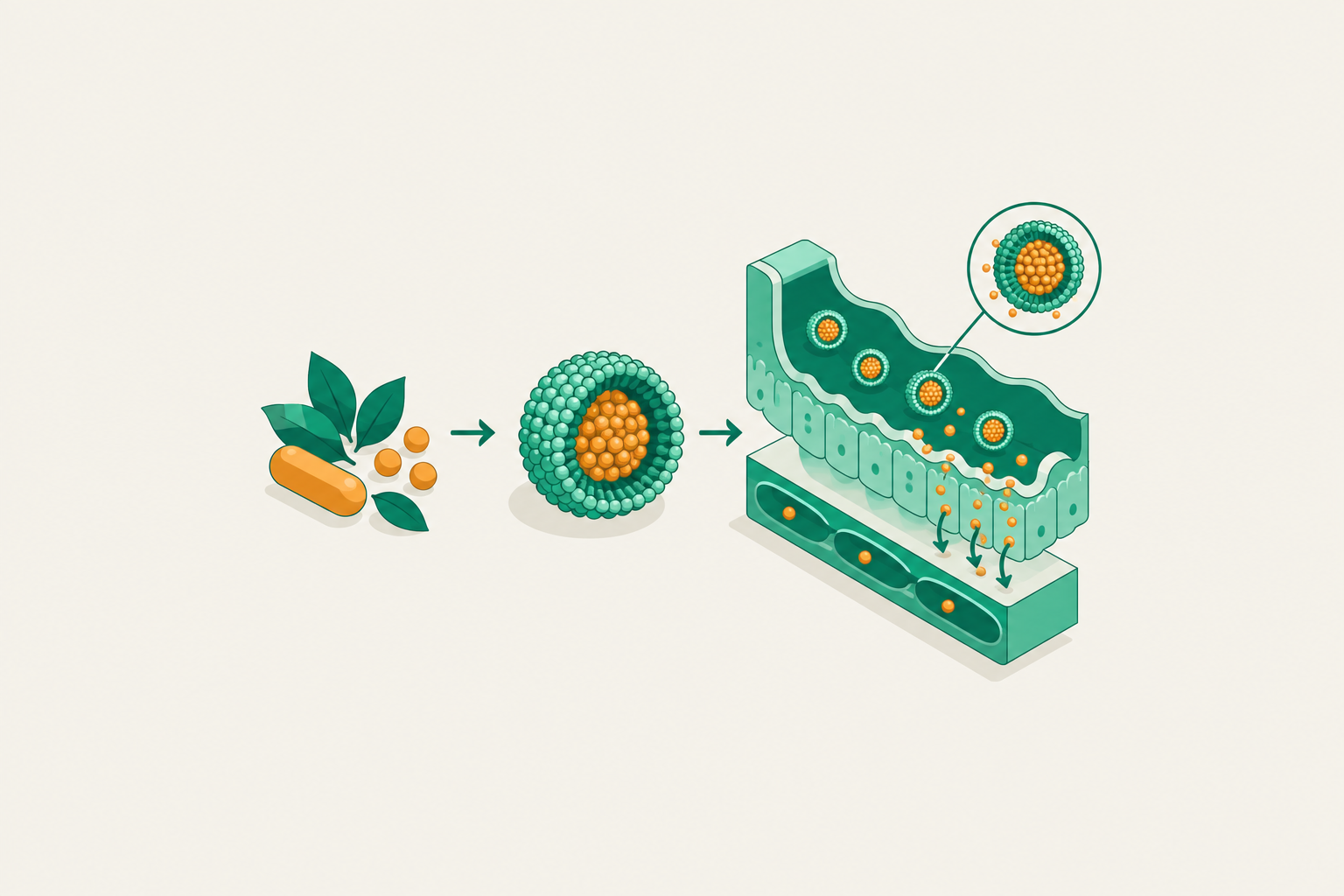
Nanoencapsulation is a way to get more of a cognitive ingredient into the bloodstream. Its “5x absorption” claim makes sense only when tied to three problems it can address, namely degradation, poor solubility and first-pass liver metabolism. Understanding those mechanisms separates a credible delivery claim from a number on a label.
Why most cognitive ingredients fail before they can work
An ingredient can have strong effects in a controlled lab setting yet do almost nothing when swallowed in a standard capsule. In a lab, the compound can reach its target directly, while an oral dose must survive digestion, cross the intestinal wall and reach general circulation in an active form. The amount printed on the bottle does not tell you how much completes that trip.
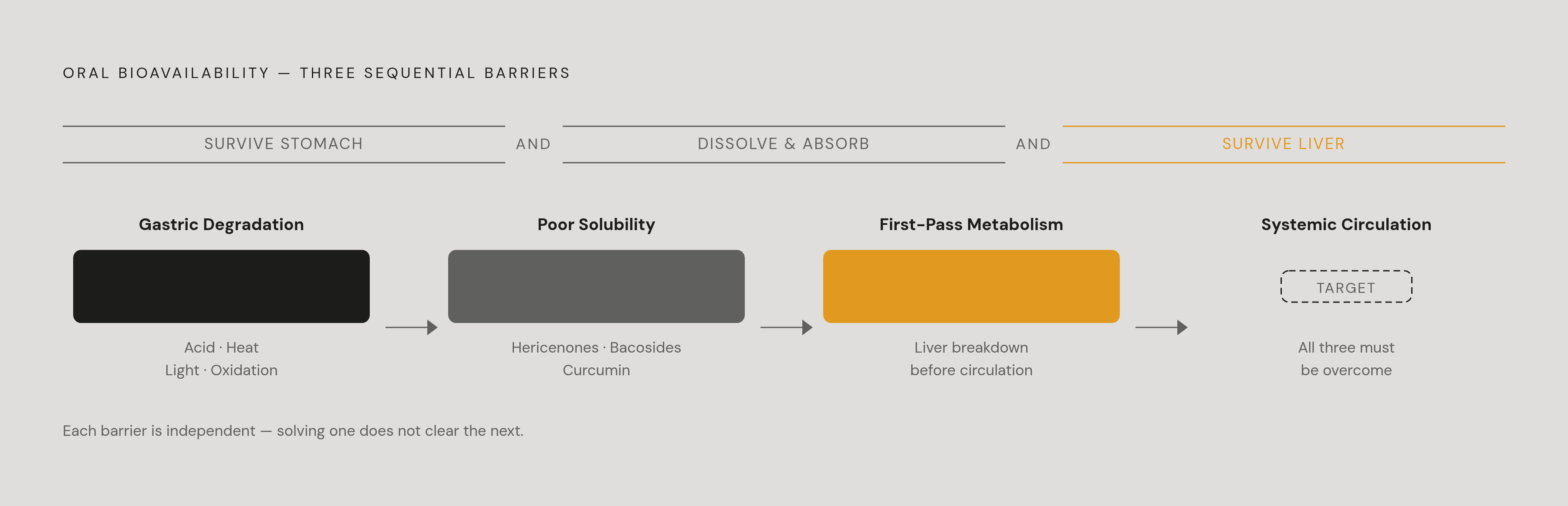
Three separate obstacles stand between swallowing and systemic exposure. First, chemical degradation can damage the ingredient before absorption. Next, compounds such as Lion’s Mane’s hericenones, Bacopa’s bacosides and curcumin dissolve poorly in the watery environment of the gut, limiting their passage across the intestinal membrane. Finally, the liver can metabolize molecules that have been absorbed before they reach general circulation, a process called first-pass metabolism. Surviving one obstacle does not clear the next.
Bioavailability is the fraction of an ingested compound that reaches systemic circulation in an active form. That is the relevant measure of delivery. A standard capsule may therefore work poorly because the ingredient is lost on the way, even if the ingredient itself can work, though better delivery alone does not prove that it does.
What nanoencapsulation physically does to a nutrient in transit
Nanoencapsulation places a bioactive ingredient inside a tiny carrier, such as a nanoscale lipid shell typically measuring 1–100 nanometers. The shell provides a physical barrier against damaging conditions. It can protect against light, heat and oxidation, as well as stomach acid and changes in pH during gastrointestinal transit. This addresses the first failure mode before the ingredient reaches the absorption stage. Protection is only the beginning of the mechanism.
A smaller carrier has a greater surface-area-to-volume ratio, helping it disperse in watery gut fluid instead of leaving a poorly soluble ingredient poorly distributed. Mucoadhesion keeps the carrier near the absorption site so that movement in the intestine does not sweep it away. The term sounds complicated, but the function is straightforward. It gives the delivery system more contact with the place where uptake happens.
Lipid nanocarriers can enter intestinal lymphatic vessels through lymphatic transport, reaching circulation without passing through the liver first. Other uptake mechanisms include endocytosis, through which cells take in the carrier, while lecithin-based liposomes can also fuse directly with cellular membranes. Controlled release adds a way to manage when the enclosed ingredient becomes available.
These mechanisms explain why lipid-based carriers suit poorly water-soluble compounds. Liposomes, nanoemulsions and structured lipid particles can improve both solubility and gastrointestinal stability, rather than fixing one problem while leaving the other untouched. An olive-oil-derived lipid shell is a food-grade version of this architecture. Its material is biologically familiar, but the choice of shell alone does not establish how well a finished formula performs.
What the scientific literature actually says about the magnitude of absorption gains
The literature described in the research brief reports bioavailability gains between two- and tenfold over free, unencapsulated forms. A “5x” figure falls within that range. It is not an implausible outlier, but neither is it a universal property of anything described as nanoencapsulated. The range establishes that substantial gains are possible under particular conditions.
The actual multiplier depends on the compound, the encapsulation method and the reference formulation. A compound that is poorly absorbed in conventional form has more room to benefit than one that already reaches circulation efficiently. That distinction is especially important in a formula containing ingredients with different solubility and uptake characteristics. One number for the whole formula can hide differences in the results for each ingredient.
The research brief describes improved oral bioavailability from curcumin-loaded nanostructured lipid carriers through intestinal lymphatic absorption. That example supports a specific route of improvement for a specific compound, rather than treating “nano” as an explanation in itself. It also shows why the carrier and the ingredient must be considered together.
The defensible reading of “5x” is therefore a generalization consistent with the reported evidence range. A claim for a specific product still needs to say what it was compared with and have evidence for the delivery system being sold. Without that distinction, findings about one encapsulated compound can be stretched into promises about an entire blend.
Why these specific ingredients benefit most from lipid-based nanoencapsulation
Lion’s Mane offers a direct fit with lipid-based delivery. Its hericenones and erinacines, associated with Nerve Growth Factor stimulation and cognitive effects, are lipophilic, so poor aqueous solubility creates a clear delivery obstacle. Bacopa Monnieri’s bacosides have a related but distinct structure, combining a lipophilic core with water-attracting sugar groups, which still leaves them with limited water solubility. Lopresti and Smith’s Australian RCT in 2025 used 300 mg/day in adults aged 40–70 with self-reported memory complaints, making the relationship between the administered dose and actual exposure relevant to any comparison with that trial.
For other ingredients, the argument centers on reliable exposure. Ashwagandha’s active withanolides must reach circulation to support modulation of the body’s stress-response system and cortisol reduction, with multiple RCTs documenting cortisol reductions at 300 mg twice daily. Rhodiola Rosea’s rosavin likewise depends on bioavailability, but most positive mental-fatigue trials have high or unclear risk of bias. Better delivery can only reduce uncertainty about whether the ingredient reaches circulation.
Cognizin® provides an important contrast to the poorly soluble compounds. Citicoline is water-soluble and already has established oral bioavailability, so it does not present the same solubility problem. Encapsulation may instead contribute controlled release and protection during transit. The ingredient-to-carrier fit is therefore not identical across the formula. An explanation that can be trusted names how the carrier helps each ingredient, since they do not all need the same help.
The biomarker-vs.-experience gap and what it means for evaluating absorption claims
More ingredient in the blood does not automatically mean a proportionally better experience. Fivefold absorption does not establish fivefold focus or calm. Blood exposure is a delivery measure, while a biomarker change and a felt benefit are different endpoints. Does the change help in a way the person can notice?
Albalawi’s 2025 meta-analysis in Nutrition and Health pooled seven RCTs on cortisol and six on perceived stress. It found measurable reductions in cortisol without a change in Perceived Stress Scale scores. This challenges the assumption that a biological change must translate into feeling better. It is not an objection to measuring that change accurately.
A separate pooled analysis of 12 ashwagandha RCTs on anxiety and stress, involving 1,002 participants, found high heterogeneity and rated the evidence low certainty. In plain terms, the findings varied substantially across studies. That makes even positive results difficult to generalize. Differences in response remain relevant after a delivery problem has been addressed, as do questions about dose-response and the endpoint being measured.
The narrower claim is the stronger one. Systemic exposure is a prerequisite for the systemic effects being discussed, and nanoencapsulation can close a specific delivery gap by reducing losses before circulation. That can make a delivered dose more relevant to the exposure behind a successful clinical trial. It does not establish that matching the label dose reproduces trial conditions, because the trial’s formulation also affects exposure. Nor does it guarantee a particular result for every person.
How faster onset compounds the value of better absorption for a daily cognitive routine
The amount absorbed is only part of daily usefulness. An effect must start in time to help with the task. Mucoadhesion can keep a carrier at the uptake site, while lymphatic transport can avoid the initial liver passage, giving a mechanistic basis for changes in how an ingredient reaches circulation. Those mechanisms make an onset advantage plausible. They do not, by themselves, prove the specific claim of onset 1.5 hours faster for every ingredient or finished formula.
Caffeine blocks adenosine to sharpen alertness, while L-theanine supports alpha brain wave activity and calming pathways. For them to work together, both must reach effective exposure at a time when their effects can help with the task. Faster delivery could help that overlap, but an absorption multiplier alone does not establish synchronized peak plasma concentrations. The speed claim needs its own support.
The 2025 British Journal of Nutrition study found that 200 mg of L-theanine with 160 mg of caffeine improved selective attention in sleep-deprived adults compared with placebo. The measured improvements included hit rate and reaction time. That finding supports the pairing under the study’s conditions. It does not establish an onset advantage from nanoencapsulation, although it explains the practical appeal of having an effect arrive near the start of a cognitive task.
The Lion’s Mane trial identified as PMID 18844328 documented cognitive improvement at 3 g/day over 16 weeks, while Bacopa’s memory evidence also involves weeks of consistent dosing. For these ingredients, steady daily exposure fits the pattern of use over time that the trials tested, with no promise of an effect that can be felt right away. Predictable onset and sustained delivery serve different purposes. A daily formula can benefit from both, but they should not be collapsed into one claim.
What to look for when evaluating any nanoencapsulation claim
A useful evaluation starts with the carrier architecture, including whether it uses liposomes, solid lipid nanoparticles or nanoemulsions made from food-grade materials. “Nanoencapsulation” alone leaves too much unspecified. Lipid-based systems have a large body of evidence behind them, but how well each architecture works depends on the compound. A patent does not answer those performance questions on its own.
A “5x absorption” claim should identify the conventional pill, powder or other reference formulation against which it was measured. Individual ingredient doses must also be visible, because a proprietary blend prevents a meaningful comparison with doses used in clinical trials. Transparent dosing makes that comparison possible. It does not replace the need to examine how the reference and encapsulated forms differ.
Purity is a separate test of credibility. Third-party testing for PFAS, heavy metals and mycotoxins addresses a question that better absorption cannot answer. A delivery system designed to improve uptake makes contaminant control more important. A food-grade olive-oil lipid shell, disclosed ingredient doses and third-party contaminant testing therefore form a more useful set of criteria than the word “nano” alone. Each answers a different question about the product.
Jupiter Neurosciences’ Nugevia™ MND, announced in 2025, illustrates the move from research into named commercial applications. Its existence does not establish that every evaluation criterion has been met. For ingredients studied over weeks of steady dosing, a 100-day window gives more room to assess cumulative effects than a standard 30-day return policy.
For an immediate check, ask whether the carrier is named and food-grade, and whether the absorption comparison is specified. Then ask whether the dose of every ingredient is given and whether there is third-party contaminant testing. Finally, check whether the trial window fits the time the ingredients need. These questions turn an impressive number into an assessable claim. If the answers are missing, “5x” remains a number without enough context to guide a decision.