The Bioavailability Gap That Makes Most Nootropic Capsules and Powders Clinically Irrelevant
Absorption varies by compound, and better blood levels don't prove better cognition.

The bioavailability gap between a nootropic’s ingredient list and how much of its dose reaches the brain can separate a useful supplement from one that delivers little beyond its label promise. Delivery deserves as much scrutiny as ingredient choice. But the gap is compound-specific, and better absorption is not, by itself, proof of better cognition.
Why the label dose and the neuronal dose are almost never the same number
More milligrams looks like more effect. It often is not. The number on a supplement label describes what goes into the product before digestion, absorption into the bloodstream and delivery to neurons. Comparing two products by ingredient weight alone therefore leaves out the steps that determine how much of either dose becomes available.
Those losses can be severe for some compounds. Peptide-based nootropics, for example, can have effectively zero oral bioavailability because digestion dismantles them before absorption. Adding more of the same vulnerable material does not solve that delivery problem. Other ingredients absorb readily, so the size of the gap cannot be inferred from the capsule shell alone.
That distinction also limits the claim that standard capsules and powders lose 70–80% of their active compounds. The supplied evidence does not establish that as a universal loss rate, or as a figure attributable entirely to stomach acid. What blocks this compound, and does this formulation address that block?
Four mechanisms that strip active compounds before they reach the brain
The first barrier is dissolution lag. A capsule has to break down before its contents are ready for absorption, but ingredients already dissolved in a liquid skip that wait. The gap starts before the liver gets involved. Faster dissolution establishes a possible advantage in onset, with any increase in active material ultimately reaching the brain still unproven.
Release can be difficult even after the shell dissolves. Raw Lion’s Mane powder contains fungal cell walls made with chitin, which human digestive enzymes cannot break down efficiently. That limits the release of hericenones and erinacines. Extraction helps release those compounds, so what is inside the capsule tells more than the capsule format alone.
The second barrier is breakdown in the digestive tract. Stomach acid threatens compounds that are unstable at low pH, while digestive enzymes dismantle peptide chains before they can be absorbed. These are related losses, but not identical mechanisms. For most peptide nootropics, oral bioavailability is effectively zero, making digestion a much greater obstacle than a slow-dissolving shell.
Absorption also depends on what a compound dissolves in. Phosphatidylserine, Bacopa’s bacosides and some curcuminoids are fat-soluble, so a water-based drink does not automatically solve their delivery problems. Dietary fat or a lipid carrier can help. A formulation that skips this requirement can lose its apparent advantage over a capsule taken with food.
The third barrier is first-pass liver metabolism. After absorption from the gut, compounds travel to the liver before entering general circulation. Curcumin is a clear example of the cost. The liver converts much of an oral dose into inactive conjugates, leaving very little unchanged compound available. Piperine can raise systemic exposure by inhibiting intestinal and hepatic glucuronidation, the process involved in this conversion.
The fourth barrier stands between the bloodstream and the brain. The blood-brain barrier is a selective membrane that restricts passage of compounds absorbed from the gut. For standard oral curcumin, less than a tenth of a percent of the dose reaches brain tissue. Better blood levels are therefore only an intermediate result. A formulation can improve absorption without resolving the final obstacle to neuronal delivery.
What the bioavailability gap means for specific ingredients consumers already trust
Lion’s Mane shows why preparation and evidence must stay connected. Mori et al. (2009) found that cognitive function scores in adults with mild cognitive impairment rose over 16 weeks, then fell after they stopped taking the supplement. The landmark trial used dry powder. Studies using hot-water and dual extraction have found benefits, but successful trials do not all use the same extraction method. Human data also do not yet establish when Lion’s Mane bioactives reach peak concentration in the brain.
That uncertainty does not make extraction information irrelevant. Raw powder’s chitin content limits the release of active compounds, so an unspecified “Lion’s Mane powder” leaves an important question unanswered. But extraction is not a clinical result. A well-described extract is easier to assess than an unspecified powder, without proving that it reproduces a particular trial’s benefits or timing.
Bacopa Monnieri presents a different mismatch between expectations and evidence. A meta-analysis of hundreds of subjects who met the study requirements found chronic improvements in scores on the Trail B test, but choice reaction time fell only in the subgroup of studies using 300 mg/day. Because bacosides are fat-soluble, a fasted tablet and a lipid-containing formulation are not equivalent delivery conditions. A drink can address this requirement, but only if its formulation does more than add water.
Curcumin makes the distinction between blood and brain especially sharp. Standard formulations have negligible absolute oral bioavailability and virtually no brain accumulation. Meriva, a curcumin phytosome, has human head-to-head evidence showing much higher plasma curcuminoid levels than standard curcumin. That is a genuine delivery improvement. It does not establish an equivalent increase in brain exposure or a cognitive benefit.
Ashwagandha adds another distinction, between a measurable biological change and a felt outcome. The Chandrasekhar KSM-66 trial used 300 mg twice daily for eight weeks and found a meaningful reduction in serum cortisol in chronically stressed adults. Cortisol, however, is a biomarker that measures perceived stress only indirectly. A product cannot turn a hormonal finding into proof of clearer thinking simply by using the same ingredient name.
L-theanine and caffeine differ from these compounds that are hard to deliver. Several randomized controlled trials show that the combination helps with attention, reaction time and accuracy. A 2025 double-blind crossover trial found that selective attention was faster and more accurate even in adults who had been kept awake through the previous night. L-theanine is water-soluble and absorbs rapidly through the small intestine. Its delivery gap is narrower, leaving less reason to assume that a standard capsule is inadequate.
Rhodiola Rosea shifts attention toward standardization. Multiple randomized controlled trials report benefits for fatigue and cognitive performance under stress. Rosavin content is one useful quality signal, although salidroside is also an influential bioactive. The ingredient name alone does not say how much of either compound it contains. What unites these cases is not a winning ingredient but the formulation decision that connects the product to its evidence.
Delivery innovations that actually close the gap, and what the evidence says about each
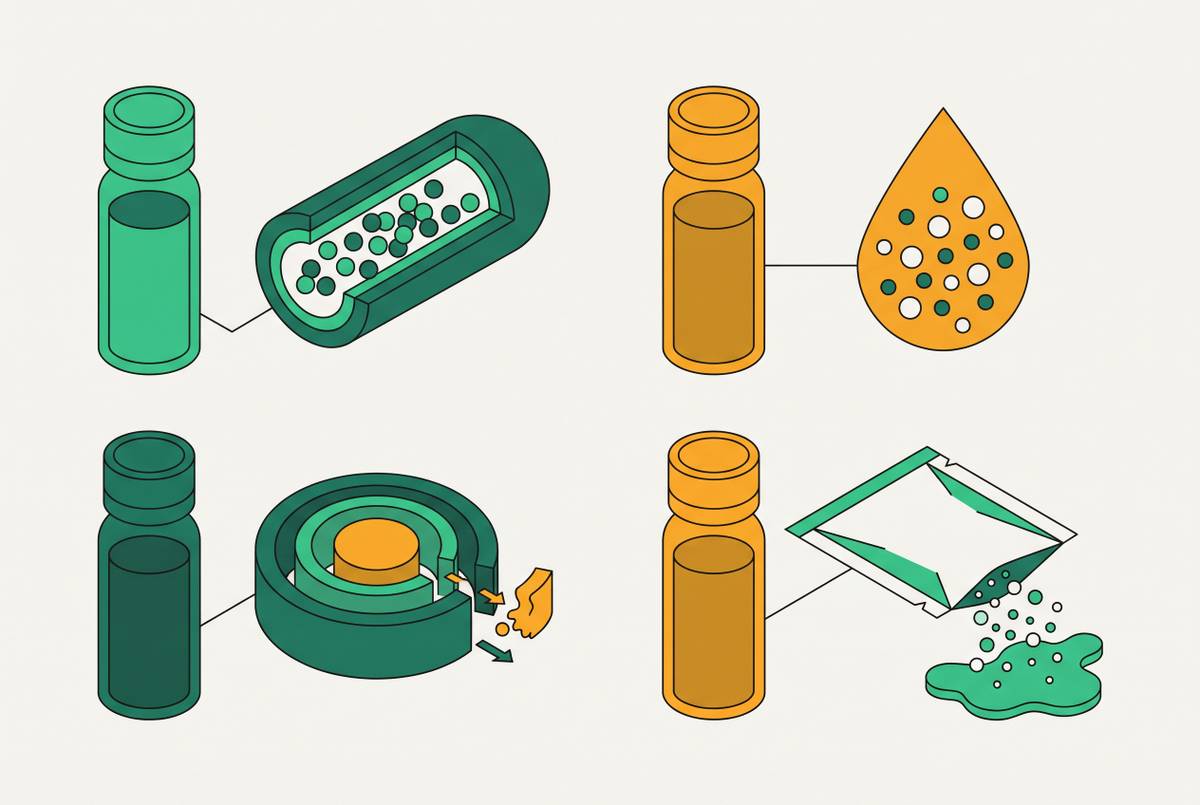
Liposomal delivery surrounds active ingredients with a lipid shell to protect them and aid absorption. For some formulations, it can also improve passage into the brain. Human curcumin trials support enhanced plasma exposure from liposomal and phytosome formulations, but these formats should not be treated as interchangeable technologies. Their shared purpose does not make their results interchangeable either. The useful evidence concerns the particular formulation and compound.
Nanoencapsulation extends this approach through systems including PLGA nanoparticles, self-nanoemulsifying delivery systems and solid-lipid carriers. These approaches show promise in research. The unresolved step is translating that promise into consistent clinical outcomes. Naming a delivery mechanism shows what a manufacturer is trying to solve, but data on outcomes in humans show whether that solution helps.
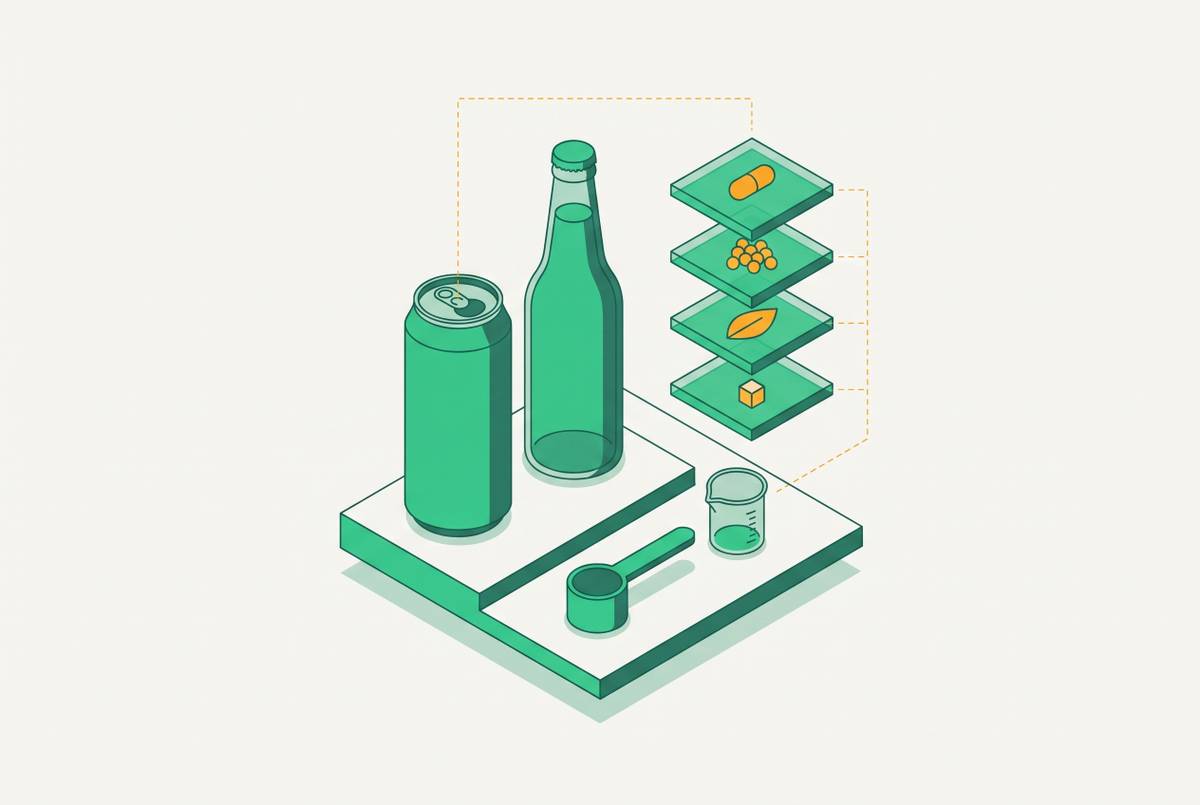
Liquids remove dissolution lag when the ingredients are already in solution. They can also pair fat-soluble compounds with lipid carriers, so there is no need to time a separate meal. But liquid alone is not enough. Bacopa in water still presents a fat-solubility problem, while a capsule with a suitable lipid carrier can address it. The comparison is between complete formulations.
Sublingual liquids, strips and pouches take a different route. Compounds that pass through tissue under the tongue or lip reach the bloodstream without going through the gut and liver first. This can bypass first-pass metabolism for the absorbed portion. This route works best for small, lipophilic molecules, but it is harder to use for large polar molecules and compounds that need gut-mediated conversion.
Evidence for a pouch’s ingredients is not necessarily evidence for the pouch. A 2021 study in Cureus found cognitive and reaction-time benefits from caffeine, theacrine and methylliberine combined. A 2023 follow-up found improvements in neurophysiological and performance measures in e-gamers. Those findings support the studied combination. They do not, on their own, establish the absorption or effectiveness of every product delivering it through oral tissue.
Nasal delivery targets a narrower problem, particularly for peptide compounds destroyed during digestion. The nasal mucosa provides olfactory and trigeminal pathways to brain tissue that can bypass the blood-brain barrier. Research on drugs shows that compounds delivered intranasally can reach deep brain structures within 30–60 minutes. That does not make nasal delivery a universal answer. Its relevance is mainly to a narrow class of compounds, rather than the full range of natural cognitive ingredients.
Sustained release addresses the duration of absorption. The 2026 AshwaSR trial randomized 135 subjects and found significantly reduced serum cortisol at day 60 in the 300 mg sustained-release group. It used placebo as the comparator for the formulation. That distinction limits the conclusion. The trial supports the tested product’s result, but does not isolate sustained release as the reason it worked.
The strongest objection remains that delivery science has outrun clinical validation. Relative-bioavailability results depend on the formulation and how the study was done, and more plasma exposure does not always mean more cognitive benefit. Neurological effects have limits on how fast they can happen and points at which receptors become saturated. Demand compound-specific clinical outcomes to assess delivery and whether an advanced format earns its price.
How to read a supplement label for delivery quality, not just ingredient weight
For a purchasing decision, start with what the botanical preparation actually contains. For Lion’s Mane, look for hot-water or dual hot-water-and-ethanol extraction information, with beta-glucan standardization as a key quality signal. Treat unspecified powder as a reason for closer scrutiny. For Bacopa, look for a stated bacoside percentage. With an unstandardized extract, the ingredient weight does not tell how much active material is in it.
“Liposomal” and “phytosome” identify formulation choices, while “enhanced bioavailability” alone explains little. Specificity helps, but it is not proof. A named lipid shell or carrier gives a claim more substance, yet still needs evidence for the compound involved. Cognizin® identifies a clinically studied branded form of Citicoline, rather than establishing that every branded ingredient is a delivery technology.
For fat-soluble ingredients, check how the product handles fat. A lipid carrier or an instruction to take the supplement with food addresses a known absorption requirement. Without either, taking it while fasted or with little fat can make delivery less effective. For curcumin, look for a specified enhancer such as piperine, a phytosome or a liposomal matrix. These signal work on absorption, with brain accumulation still requiring evidence.
Then check whether individual doses are disclosed. A proprietary blend can prevent comparison with the amounts used in trials, regardless of how impressive its delivery claims sound. A 300 mg Bacopa study cannot validate an undisclosed sub-100 mg dose. Transparent contaminant testing is a separate requirement, including testing for heavy metals, mycotoxins and PFAS. Better absorption is not a substitute for purity.
A stated onset time, peak concentration window and duration can show attention to pharmacokinetics, but those numbers still need support. Faster absorption does not turn a chronic effect into an acute one. Nor does a vague “supports cognitive function” claim establish that delivery has been studied. The bioavailability gap is compound-specific and addressable, but only when formulation treats delivery as seriously as ingredient selection.