Energy Stacking Protocols for Founders and Executives
A layered protocol pairs schedule, sleep, and compounds to protect executive judgment.

Sustainable cognitive energy for founders and executives comes from a layered protocol. Energy stacking means sequencing work habits, compounds, and recovery across the day to protect judgment. The foundation is a schedule that protects attention and sleep that restores it. Supplements have a narrower role, and their value depends on evidence, timing, and individual response.
Why executive cognitive energy is a finite resource, not a personal failing
Executive work calls for interpretation, coordination, and judgment as well as access to information. The prefrontal cortex, or PFC, governs focus, planning, self-regulation, and judgment, but it is sensitive to overload, distraction, and stress. A workday built around constant availability puts the brain’s executive functions under precisely the conditions that make them less reliable.
Wharton neuroscientist Michael Platt describes the leadership advantage as “communication, creativity, perspective taking, and judgment under pressure” as AI absorbs routine analysis. Yet back-to-back meetings, too little sleep, and no time for recovery put those same capacities under strain. Treating cognitive energy as unlimited therefore undermines the work an executive is being paid to do. A maintenance protocol begins by accepting that constraint.
How the prefrontal cortex actually depletes across a founder's day
Attentional fragmentation turns a busy day into repeated demands on executive control. Moving reactively between messages, meetings, and complex work is not a neutral change of activity. Each switch adds to the cognitive burden. Steady work and work that keeps getting interrupted can take the same number of hours but leave very different amounts of attention to draw on.
That burden also meets the brain’s natural fluctuations. Cognitive performance rises and falls in ultradian rhythms, with periods suited to complex problem-solving followed by troughs that signal a need for recovery. By mid-afternoon, a founder may be making a high-stakes decision after hours of reactive switching, just as capacity dips. The calendar does not show how much that has cost the brain. Nor does every change of task have the same effect, because a planned attention shift at a natural stopping point allows recovery, while an involuntary interruption adds fragmentation.
The sleep-cortisol loop that makes everything else harder
It is harder to recover from daytime depletion when stress and poor sleep feed each other. The HPA axis, the body’s stress-response system, links sleep with cortisol regulation. Chronic stress can upset cortisol’s normal daily rhythm and make it harder to stay in deep sleep. Sleep deprivation can then raise cortisol further. This loop weakens working memory and cognitive flexibility, making difficult decisions more stressful and the next night less restorative.
Brain-Derived Neurotrophic Factor, or BDNF, supports neuronal survival and neuroplasticity, the brain’s ability to change through experience. Sleep loss can reduce BDNF and disrupt the recovery processes that depend on it. Caffeine that compromises sleep can therefore work against the recovery a cognitive protocol is meant to protect, even when its timing seems reasonable. Feeling more awake does not mean that recovery has occurred.
Why layering inputs across the day beats any single intervention
Caffeine can support alertness without fixing a fragmented calendar. Mindfulness cannot substitute for adequate recovery. Exercise, sleep optimization, and targeted compound support address different parts of the problem. Combining them offers a more coherent approach than pushing one lever harder.
The layers also operate on different clocks. Changes to the schedule change how work gets done, while Bacopa Monnieri needs to be used over time before any benefit can fairly be judged. Rhodiola Rosea is positioned toward nearer-term fatigue support. People still respond in different ways, so the framework must be built around how the compounds work. Sequencing is as important as selection.
Layer 1: Structuring the day around how the PFC actually works
The first prescription is to organize work around attention. Protect meeting-free deep-work blocks in the late morning where that matches your peak period, and place complex decisions in your strongest windows. Use the times when you have less capacity for administrative work or recovery. Batch communication into defined windows. Team-level “focus contracts” can make that possible by setting response-time expectations, so protecting concentration does not create uncertainty for everyone else.
Meeting preparation deserves a more measured claim. Microsoft’s 2026 preregistered field experiment with hundreds of employees did not find that thinking about goals before a meeting significantly improved how effective employees said their meetings were. Its mixed-methods findings did show better self-reported awareness and behaviour, largely driven by post-meeting surveys that unintentionally acted as an intervention for both groups. Reflection may help, but that result does not establish a dependable meeting-performance boost.
A 2024 study found that a 10-minute practice before complex tasks improved cognitive-test performance and self-efficacy. The operational aim is to protect decision quality before demanding work.
Layer 2: Compounds that address the cortisol-cognition problem without trading off energy
Ashwagandha works in the slower cortisol-regulation layer rather than as a tool to improve performance that same day. Studied forms include KSM-66 and the sustained-release formulation AshwaSR. A 2026 randomized controlled trial using AshwaSR at 300 mg reported a 19.15% reduction in serum cortisol from baseline. Multiple 2025 meta-analyses also found statistically significant cortisol reductions, although differences between studies limit how uniformly those results can be applied.
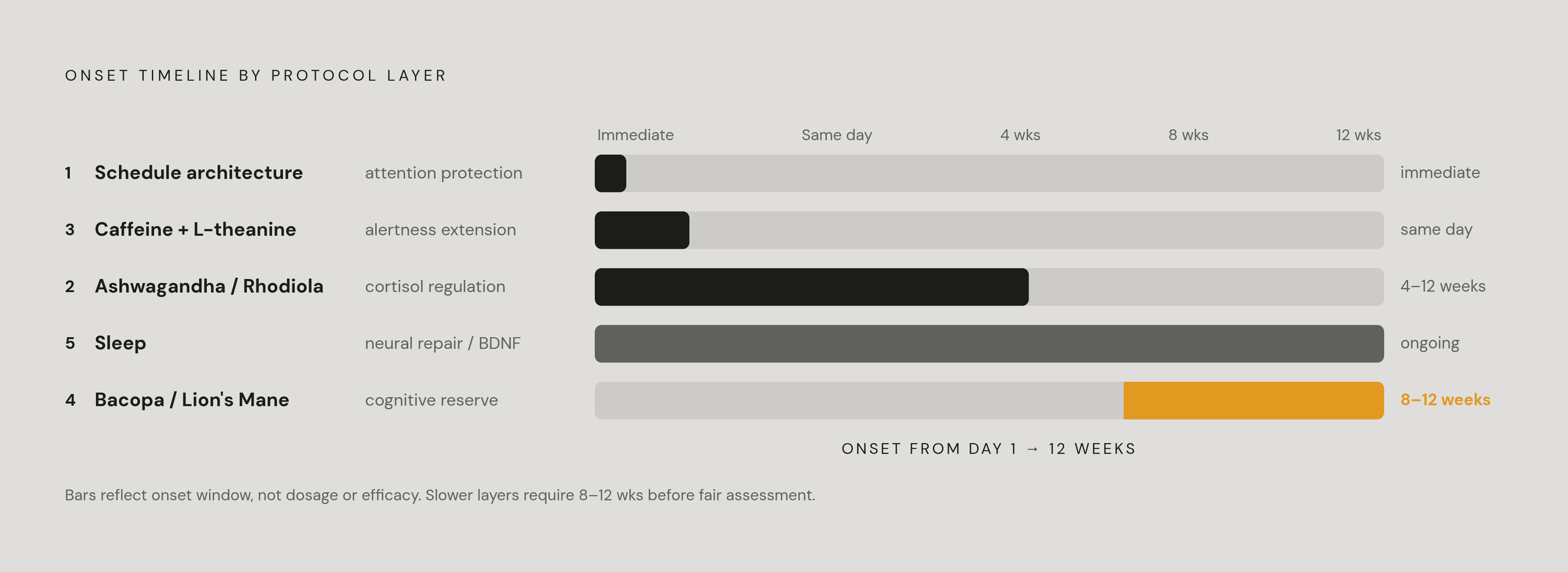
The expected timeline is 4–12 weeks for full effect. Gaps remain in long-term safety, optimal dosing, and effectiveness across diverse populations, so this is an input that requires ongoing monitoring and reassessment. Rhodiola serves a different proposed role, addressing nearer-term fatigue while Ashwagandha builds toward sustained stress-hormone regulation. However, the energy-metabolism mechanism needs restraint. Abidov et al.’s animal research found support for effects on energy production, but a human study did not find matching gains in exercise performance or muscle phosphate kinetics.
The pairing has a rationale, though its effectiveness remains uncertain. Its purpose is to address fatigue and the hormonal background without automatically increasing stimulants.
Layer 3: The caffeine stack that extends focus without the crash
Caffeine has strong, consistent human evidence for alertness, attention, and reaction time. That makes it a useful anchor, but not an unrestricted one. Pairing it with L-theanine aims for “calm alertness,” often using roughly twice as much L-theanine as caffeine. A 2025 study found that a high-dose combination improved the accuracy and speed of selective visual attention in acutely sleep-deprived young adults. That finding supports a specific benefit under specific conditions.
Matcha offers both compounds in one drink. Ceremonial-grade matcha provides approximately 70 mg caffeine and 28–50 mg L-theanine per serving. Those amounts do not give the roughly 2-to-1 theanine-to-caffeine pairing. Matcha offers a whole-food way to take both compounds, but it cannot be assumed to match the stack and has not been proved to prevent a crash.
Timing remains part of the intervention. The protocol needs a caffeine cutoff because feeling more alert today can come at the cost of recovery tonight. If sleep quality worsens despite deliberate timing, the stimulant layer is working against the rest of the system.
Layer 4: Compounds that build cognitive reserve over weeks and months
Bacopa and Lion’s Mane belong on a longer horizon than caffeine. Neither is a credible last-minute answer to a demanding afternoon. Bacopa requires consistent use before its effects can be assessed, and the findings are mixed. Kongkeaw et al.’s 2014 meta-analysis found that it might help cognition, especially speed of attention, while a 2021 meta-analysis found very little effect on memory and attention in healthy people. The evidence supports patience and modest expectations.
Lion’s Mane has a distinct proposed mechanism involving Nerve Growth Factor, or NGF, which supports neuronal survival. That makes it interesting for longer-term neuroprotection. Its clinical trial base is smaller than Bacopa’s or caffeine-with-theanine’s, however, so its position remains promising.
For executives over 40, maintaining cognitive reserve is a relevant long-term concern. These compounds address that ambition more directly than a same-day stimulant does, but relevance is not proof of benefit for every person in that age group.
Why bioavailability determines whether the compound layer actually works
An ingredient list does not establish how much of a compound reaches circulation. Bioavailability describes that gap between the amount swallowed and the amount available to act. Conventional pills and powders can lose part of their effective dose through digestion and first-pass metabolism, when the liver processes a compound before it reaches systemic circulation. Delivery is therefore a functional variable. It helps explain why a studied formulation cannot automatically be treated as interchangeable with any product bearing the same ingredient name.
Lipid-based encapsulation can improve absorption and, for some formulations, reduce first-pass losses. But the delivery claim needs its own evidence. Curcumin illustrates the problem, with piperine, liposomal complexing, and phytosome complexes used to improve otherwise poor absorption. That example does not establish that every encapsulated cognitive supplement reaches an effective dose.
To assess a product, the questions to ask are how its delivery system works, what absorption data are available, and whether it has had independent contaminant testing. Heavy metals, mycotoxins, and PFAS are not secondary details in a product intended to support health. Absorption and purity must be considered together.
Layer 5: Sleep as the protocol's recovery engine, not a separate concern
Sleep is listed last among the layers, but it starts with the protocol. It is the recovery phase that supports neural repair and the consolidation of learning. Both non-rapid-eye-movement and rapid-eye-movement sleep are associated with BDNF-related processes, so recovery should not be reduced to deep sleep alone. Chronic restriction disrupts this system. No daytime input can fully offset the resulting deficit.
Sleep deprivation also weakens working memory and creative problem-solving, both of which are key to executive work. Subjective alertness is an unreliable safeguard because a founder can feel functional while judgment is already impaired. This makes sleep consistency a performance measure. It also reconnects recovery with the HPA axis, since restoring sleep helps interrupt the stress-cortisol loop that makes subsequent nights harder.
The practical implication is to design evenings as deliberately as mornings. A steady wind-down routine, caffeine cutoffs, and evening compound support that has been carefully assessed need to run alongside the daytime plan from the start. Ashwagandha and L-theanine may help create conditions for sleep through stress regulation or calm, but they do not replace sleep itself.
How to audit and sequence your own protocol rather than copy someone else's
Individual variation is the strongest objection to a universal stack. It is a valid objection. A combination that helps one founder may do little for another, and a plausible mechanism does not guarantee a useful personal result. The audit should check how fragmented attention is, how stress-hormone regulation is working, how consistent sleep is, and what evidence supports each formulation. Ingredients are adjustable inputs within that framework.
Begin with schedule architecture while treating sleep support as a parallel requirement. If caffeine and theanine are part of the plan, establish their timing and cutoffs from day 1. The proposed sequence places cortisol-regulation compounds in week 1–2, with an 8–12 week window before fully assessing the slower Ashwagandha layer. Rhodiola’s nearer-term role should not be confused with that timeline. Bacopa and Lion’s Mane belong in the long-horizon layer, where assessment over 8–12 weeks is more reasonable than expecting an immediate lift, without assuming that either will deliver a benefit.
The test is whether decision quality, cognitive endurance, and sleep consistency improve over the assessment window. A 100-day proof window gives the slower layers time to be judged, although duration alone cannot rule out placebo effects.