Phosphatidylserine and Cognitive Endurance Under Sustained Load
Phosphatidylserine may sustain mental performance when stress and age tax the brain.

Phosphatidylserine and cognitive endurance under sustained load concern staying sharp through the end of a task. Phosphatidylserine, or PS, provides nonstimulant support for neuronal membranes and may blunt cortisol responses when stress load is already high. For readers seeking all-day focus without jitters, that is a relevant distinction, but evidence for an ingredient is not proof that a caffeine-free shot will deliver all-day clarity.
Why cognitive performance degrades under sustained load, not just intense demand
Hours into a coding sprint, the work may be no harder than it was at the start, yet keeping track of it takes more effort. The difficulty can come from the decline in performance across a long stretch of decisions. Cognitive load describes how demanding the task is, while cognitive fatigability describes the measurable loss of performance as it continues.
Linnhoff & Zaehle 2025 in Journal of Neurology describe prolonged sustained-attention paradigms as sensitive ways to detect cognitive fatigability. Continuous Performance Tasks require vigilance over extended periods and reveal performance decline that correlates with self-reported fatigue. A short test can miss that drop because it ends before people struggle to keep going. The relevant benchmark for a demanding workday is therefore not just how well the brain performs at the outset. It is how much of that performance remains after prolonged work.
This separates the job of a stimulant from the broader demands of cognitive endurance. An initial lift does not, by itself, address the structures and stress responses involved in maintaining output. Formulas aimed at knowledge workers, including Magic Mind, reflect that distinction by combining compounds for brain support and stress modulation.
What phosphatidylserine actually is and where it lives in the brain
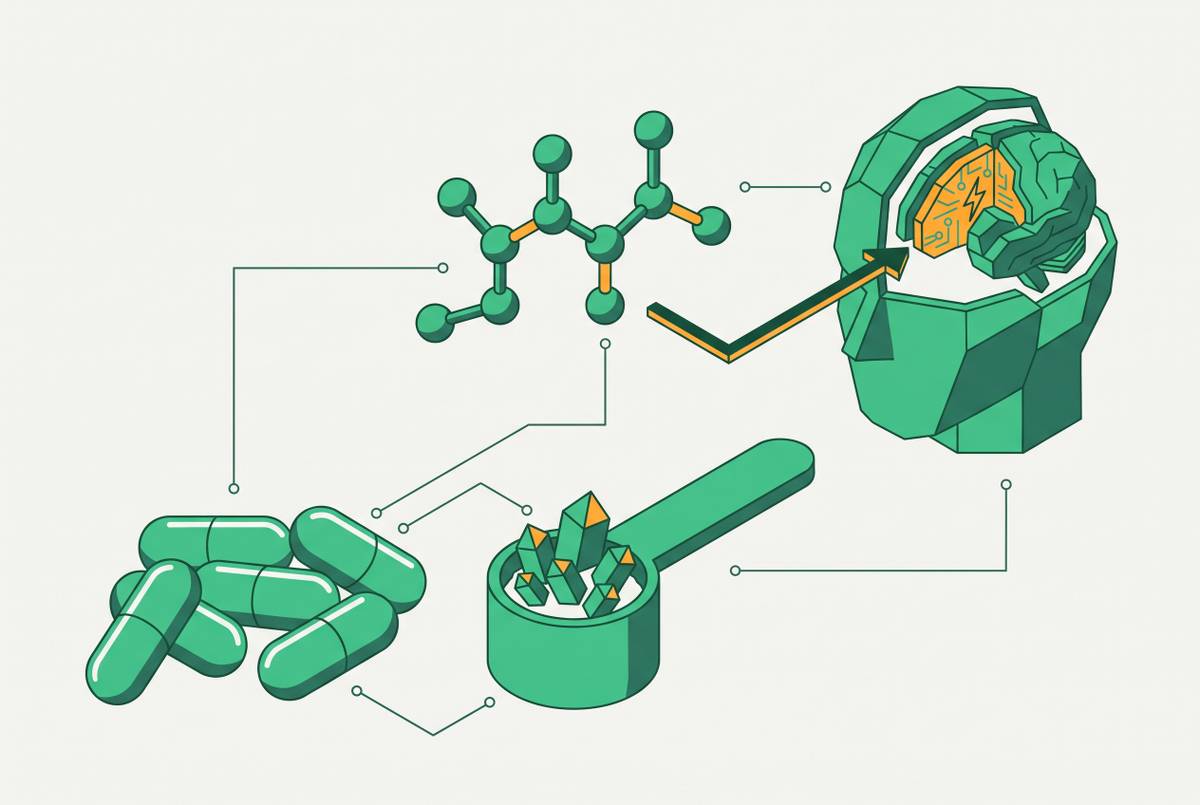
PS is a phospholipid, a structural component of neuronal membranes. It is enriched in neuronal tissue and accounts for a significant portion of the brain’s phospholipid content. Its importance comes from what those membranes must do. A membrane is part of the machinery that lets a neuron release, receive, and respond to signals.
One of PS’s roles is synaptic vesicle fusion, the process that allows neurotransmitters to be released. Inadequate PS can reduce release efficiency across acetylcholine, dopamine, and serotonin systems. PS also supports the shape and function of receptors and ion channels. Protein Kinase C, or PKC, needs PS for activation and is involved in memory consolidation and synaptic plasticity.
Receptors need to move, cluster, and signal, and PS helps keep the membrane fluid enough for them to move. Brain PS content declines with age, and that decline correlates with cognitive impairment as membranes stiffen and signaling degrades. Supplementation is therefore best understood as an attempt at structural replenishment. The analogy is replacing worn brake pads rather than adding a turbocharger, although the analogy does not establish how much supplemental PS reaches neuronal membranes.
How sustained cognitive work generates a cortisol load that compounds the structural problem
Long stretches of mental work also put stress on the body. Sustained demand activates the HPA axis, the stress-response pathway that raises ACTH and cortisol. The same pathway responds to physical and psychological threats. A deadline and a predator can both recruit that stress machinery, linking a demanding workday to the membrane-level argument.
Acute cortisol is adaptive. The response can become harmful when it stays high after the demand has passed. Chronically elevated cortisol can damage memory consolidation, synaptic signaling, and membrane integrity. As the brain loses PS with age, cortisol may also put stress on the systems it uses to send signals.
PS’s relevance to cortisol lies in its potential to modulate that response. The strongest signal in the evidence described here appears when stress activation is already high. That makes cortisol blunting a proposed way to reduce an existing burden, rather than a reason to suppress every normal stress response. It also explains the logic of pairing membrane support with stress-modulating ingredients such as Ashwagandha. The target is the interaction between prolonged demand and the systems that must withstand it.
What the evidence shows about PS, cortisol blunting, and cognitive performance under load
The combined PS + phosphatidic acid trial, using PAS 400, found normalized ACTH, salivary cortisol, and serum cortisol responses to the Trier Social Stress Test in chronically high-stressed subjects. The different response in people with low stress supports a stress-dependent effect, with the trial limited to combined PS and phosphatidic acid and lacking direct measures of performance across a full workday. It provides evidence for the stress-response part of the endurance argument.
A study of brain electrical activity also found that chronic PS supplementation decreased Beta-1 power in right hemispheric frontal regions before and after induced stress. That is a measured neurophysiological change rather than a self-reported feeling. It is not, on its own, proof of better work output. The cognitive trials address a different part of the question. Crook et al. 1991 in Neurology found that 300 mg/day over 12 weeks helped patients with age-associated memory impairment do better at name-face association and telephone number recall.
A randomized, double-blind trial in healthy Japanese adults with self-reported cognitive decline used 300 mg/day PS, as DHAPS®, for 12 weeks and measured psychomotor speed through computerized finger tapping. The supplied findings do not establish its outcome, so that trial cannot carry a claim of improvement here. The children’s trial provides a clearer boundary. In neurotypical children, 100 mg/day for 12 weeks produced no difference in the total cohort on primary or secondary cognitive outcomes. A pre-defined subgroup whose baseline performance was consistently below the median did better only on visuospatial memory. The pattern favors people whose baseline resources are already under pressure.
Why the chronically loaded knowledge worker is the profile where PS works
For a knowledge worker, that population specificity is the useful part of the evidence. The relevant match is not the job title but the sustained stress load behind it. A demanding schedule may bring the kind of high stress in which cortisol responses changed, especially when there is little time to recover. That makes PS relevant to the problem, but it does not turn a laboratory stress test into a workplace trial. Occupational benefit remains an inference from the mechanisms and populations studied.
Mid-life adds another point of overlap. Age-related PS decline can coincide with a period of high professional demand. The structures that support cognition may face more pressure just as work calls for long stretches of attention and decision after decision. This is a more plausible setting for support than an already well-resourced brain facing a brief task. It also explains why an immediate sensation is a poor measure of whether the approach is useful.
Research designs are beginning to address endurance more directly. Vizja University’s trial, completed 2026, investigated neurocognitive fatigue resistance, visual search efficiency, and tactical decision-making in professional male football players using a PS-containing taurine-caffeine multi-ingredient supplement. Lindenwood University’s completed randomized, double-blind, placebo-controlled trial evaluated daily PS over 6 weeks through gaming performance, cognitive function, stress-related outcomes, and sleep quality. Both settings call for people to pay attention and make decisions over time, which makes them useful ways to study endurance. Neither trial description supplied here gives results that show PS on its own helps knowledge workers.
How sourcing, dose, and timing shape whether supplemental PS reaches the brain
Swallowing PS is not the same as delivering intact PS to a neuronal membrane. Pancreatic phospholipases and lipases process it during digestion, while bile salts form micelles that help uptake through the intestinal lining. Fat in the diet, how much bile acid is available, and how active pancreatic enzymes are all affect how much reaches the blood. The source and formulation therefore matter, although the evidence described here does not establish a winning source.
Brain delivery is a separate uncertainty. Radiolabelled tracer studies show some brain uptake, but it remains unconfirmed whether PS crosses the blood-brain barrier intact or whether metabolites carry the effect. That unresolved route limits how confidently a supplement can be described as directly rebuilding brain membranes, while leaving the clinical findings intact. Liposomal and oil-based delivery address absorption, with transport into neuronal tissue still requiring proof.
Magic Mind’s patented liposomal nanoencapsulation technology is designed to improve absorption and onset compared with conventional pills or powders. That positioning addresses a relevant challenge for lipophilic compounds, but it is not clinical proof of PS delivery to the brain. Trials showing cortisol and cognitive effects have used 100–800 mg/day, with the most replicated cognitive outcomes clustering around 300 mg/day. Those research doses cannot be assumed to be present in a finished shot. Morning dosing is framed around workday processing and memory, while evening dosing targets cortisol-related interference with sleep onset. These different aims leave the best dosing time unresolved.
Where PS fits in a stack for all-day focus without jitters
The amount of caffeine in a product tells whether it adds that stimulant, while the PS evidence looks at how it supports membranes and affects the response to stress. Magic Mind offers caffeine-free and caffeine-containing formulas, but neither format alone establishes all-day efficacy or guarantees freedom from jitters. Its supplied Original ingredient list does not list PS. The comparison is therefore limited to complementary mechanisms.
Lion’s Mane contains hericenones and erinacines that support NGF synthesis and neuroplasticity, the brain’s ability to form and consolidate pathways. Cognizin® supplies choline for acetylcholine synthesis and supports membrane phospholipid turnover. Ashwagandha acts on the HPA axis through a different receptor pathway, providing a rationale for complementary cortisol modulation. These mechanisms explain why compounds might be combined, but they do not prove that every combination produces additive benefits.
In Magic Mind’s formulas, ingredients including Lion’s Mane, Ashwagandha, Bacopa Monnieri, Cognizin®, Rhodiola Rosea, Cordyceps, L-Theanine, Turmeric, and Ceremonial-Grade Matcha represent that multi-mechanism approach. PS and DHA offer another example of complementary membrane roles, with DHA modifying acyl chains while PS supports fluidity. A PS-DHA formulation has been studied for cognitive support in non-demented elderly populations. A registered crossover trial is also evaluating PS with creatine, magnesium, L-tyrosine, L-theanine, Rhodiola, and citicoline after stress exposure. All-day-focus results from that ongoing trial remain unestablished.
The practical case for daily consistency over acute dosing
The memory trials in age-associated impairment ran for 12 weeks, and the stress-response research included repeated supplementation. Those studies support looking for change over time, with less weight placed on how the ingredient feels right away. A day-one lift is not the outcome its structural rationale predicts. Daily consistency fits the evidence better than treating PS as an on-demand stimulant substitute.
Lion’s Mane has an effective window described here as approximately 8–16 weeks, so combining it with PS means evaluating more than one slow-building process. Recovery also belongs in that assessment. High evening cortisol can fragment sleep, and fragmented sleep lowers the next day’s cognitive baseline. PS’s cortisol effects make that recovery-performance loop relevant, although they do not establish a guaranteed sleep benefit for every user.
PS received a regulator-qualified health claim in 2003 that it may lower the risk of cognitive dysfunction in the elderly. A qualified claim is not a blanket efficacy endorsement, a disease treatment claim, or proof of improved focus in healthy professionals. It should not be stretched beyond the population and potential benefit it addresses.
An 8–12-week evaluation frame is more consistent with the evidence than expecting an immediate boost. Magic Mind’s 100-day money-back guarantee offers a commercial window for evaluating its formulas. The central distinction remains straightforward. PS is a candidate for supporting the systems that sustain performance under load.
Sources
- Fatigue prediction needs time: comparing the diagnostic value of short vs. prolonged cognitive load
- The cognitive effects of supplementation with sunflower phosphatidyl serine in healthy children aged 8 to 12 years: a randomized controlled trial
- (PDF) The cognitive effects of supplementation with sunflower phosphatidyl serine in healthy children aged 8 to 12 years: a randomized controlled trial
- Phosphatidylserine, Taurine, and Caffeine for Cognitive Fatigue in Professional Football Players
- Phosphatidylserine Improves Cognitive Function in the Elderly