Sleep Debt Accumulation and Cognitive Performance Deficits
Chronic sleep loss impairs cognition while leaving sufferers unaware of their decline.

Sleep debt is the cumulative gap between the sleep someone gets and the sleep their body actually needs to run at full capacity. It is not a single bad night. Sleep debt is an accruing physiological deficit driven by a chemical mechanism: every hour awake builds adenosine in the brain, and rising adenosine drives sleep pressure that reaches into brain activity, heart rate, and blood flow, beyond how heavy your eyelids feel. An estimated 20% of adults carry some form of sleep deprivation right now. It's a background state for a fifth of the adult population, produced by demanding schedules, screens that push melatonin back an hour or two, and a culture that treats a full night's sleep as negotiable. Sleep debt does not just sit there quietly waiting to be repaid. It actively shifts neurochemical balance, interferes with synaptic plasticity, and disrupts the cellular repair work that sleep is supposed to do, which is the reason the rest of this piece treats it as an active process rather than a passive shortfall.
The adaptation illusion: why sleep-deprived people don't know how impaired they are
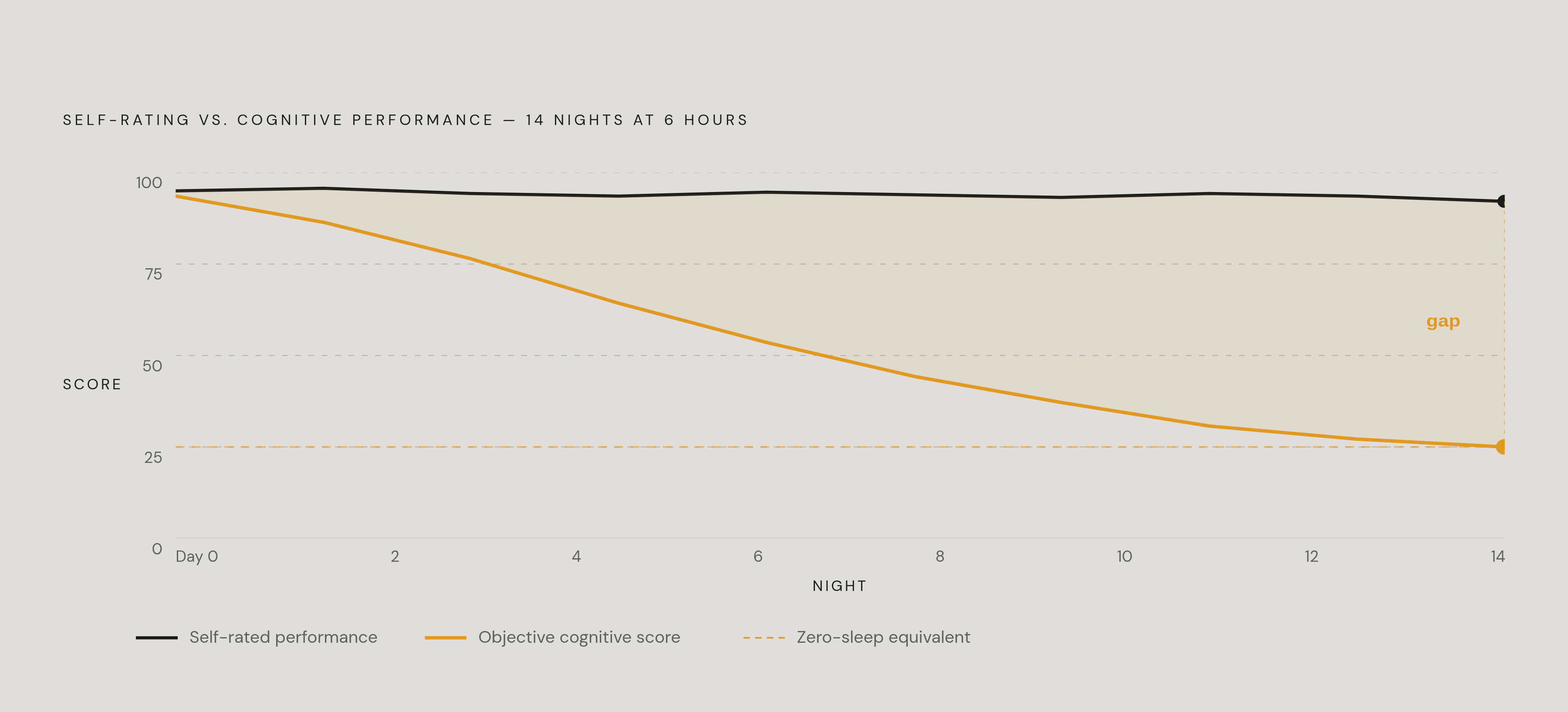
Here is the finding that should unsettle anyone who prides themselves on running lean: cutting sleep to six hours a night for two weeks produces cognitive impairment equivalent to a full night with zero sleep, and the people in that state consistently rate their own performance as fine. The brain does not send up a flare when it's running on a deficit. It recalibrates its own baseline downward, so chronic under-sleep starts to feel like the normal condition of being awake, even while objective testing shows measurable holes in attention, working memory, and executive function. That gap between how impaired someone feels and how impaired they actually are is the whole problem.
It matters most for exactly the people least likely to believe it applies to them. Entrepreneurs, competitive athletes, and professionals under deadline pressure treat six hours as evidence of discipline, a badge worn proudly in the group chat. The adaptation illusion is precisely why that belief doesn't hold up against the data: the person most confident that they've adapted is frequently the person whose test scores would say otherwise. Confidence is not a cognitive measurement. It is a subjective report generated by the same impaired brain the tests are measuring, which makes it worthless as a gauge of the very thing it's reporting on.
If the feeling can't be trusted, the next question is what sleep debt is doing to the body's systems, one by one.
Which cognitive systems take the hardest hits
The damage is not confined to one mental faculty. Attention, executive function, memory, cognitive flexibility, and reaction time all show documented decline under sleep restriction, which is a wider spread of impairment than most people assume when they picture "tired" as just sluggishness.
The prefrontal cortex absorbs an outsized share of the damage, and there's a metabolic reason for that: it runs at high energy demand, and PET imaging after extended wakefulness shows meaningful drops in glucose metabolism there, with the dorsolateral prefrontal cortex hit especially hard. That region governs judgment, planning, and impulse control, so when it goes quiet, the downstream effects include weaker executive function, poorer decisions, and looser emotional regulation as the connection between the amygdala and the prefrontal cortex slackens. Reduced learning capacity, more attentional lapses, a documented rise in vulnerability to false memories, and emotional dysregulation appear in how people react to ordinary friction.
Memory formation takes its own separate hit. During non-REM sleep, the hippocampus and neocortex trade information through sharp-wave ripples and sleep spindles, the mechanism that moves a memory from short-term storage into durable cortical archive. Cutting that process short makes encoding suffer directly.
None of this is abstract once it's translated into a number people already understand. Put that next to any workplace policy on operating machinery or signing off on a decision; the comparison does the work that a paragraph of hedged language can't. Nobody would hand someone the keys at that blood alcohol level. Plenty of people hand themselves a full workday at the cognitive equivalent. After 17–19 hours awake, cognitive performance mirrors a blood alcohol concentration of 0.05%, according to Science Times.
Why recovery takes far longer than a weekend of sleeping in
The instinct to treat Saturday as a reset button is understandable, and it is also wrong.
Controlled research on recovery sleep backs this up directly. Giving someone a single ten-hour recovery night after a period of restriction leaves their cognitive performance, sleepiness, and mood still not back to baseline. Extend that to two full weekend nights of recovery sleep, still generally insufficient to undo the cognitive decline built up during a stretch of chronic restriction. The homeostatic system does try to compensate: recovery sleep shifts its architecture to prioritize slow-wave sleep first, the deep stage most associated with restorative repair. But that compensatory boost has a ceiling, and a couple of long nights can't fully reverse weeks of shortfall.
The cruelest part of this is how it interacts with the adaptation illusion already covered. Feeling recovered and being recovered are different claims, and only one of them is measured on a test. Weekend catch-up sleep isn't a strategy so much as a partial patch stretched over a debt that keeps growing underneath it. Recovery is harder than it appears, with roughly 4 days needed to fully recover from each hour of lost sleep, according to Healthline.
How sleep debt compounds stress and worsens the next night's sleep
That shape reflects a specific function. It's what lets the body be alert when it needs to be and stand down when it's time to recover.
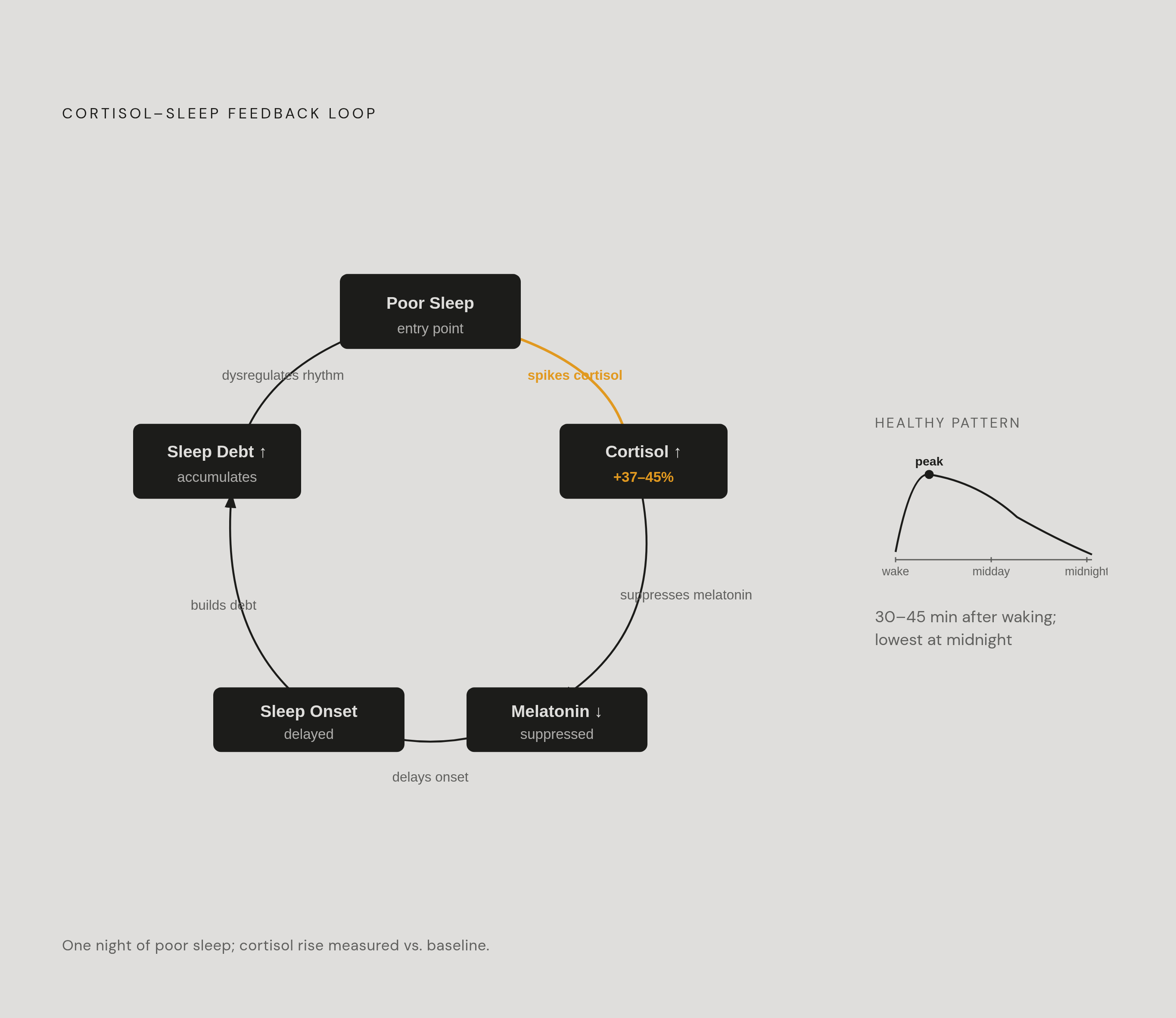
Disrupted sleep bends that curve out of shape, and the deformation tends to show up as evening cortisol that stays elevated instead of falling, which then makes falling asleep harder the following night. One documented data point puts this in concrete terms: a single night of poor sleep can raise next-day cortisol by 37 to 45%, a figure from research on healthy young adults that is decades old now but still widely cited as a baseline. Elevated cortisol suppresses melatonin production, so the very hormone that should be preparing the body for sleep gets crowded out by the stress hormone that should have quieted down hours earlier.
That said, the picture isn't uniformly grim or uniformly consistent across every study. Pooled research doesn't always find a stable overall cortisol difference between people who are acutely sleep-deprived and those who are rested, and the effect appears sensitive to how and when cortisol gets measured, so sweeping claims about one bad night wrecking the next deserve a qualifier rather than a headline. More recent work is starting to map this out with better tools: 2026 research out of Beijing Normal University and the University of Groningen used fMRI to trace the neurobiological pathways linking objective sleep efficiency to HPA axis regulation, adding real weight to the picture without settling every open question.
Stripped of nuance, the loop is simple to describe. Poor sleep raises cortisol, elevated cortisol suppresses melatonin, suppressed melatonin makes the next night's sleep onset harder, and that harder onset produces more debt, which produces more cortisol dysregulation. That's the mechanism that turns one rough night into a pattern, and it's also the reason sleep and stress can't really be managed as two separate projects. They're the same feedback loop viewed from different ends. A healthy cortisol pattern peaks 30–45 minutes after waking as the cortisol awakening response, declines through the day, and reaches its lowest point around midnight, a rhythm that supports alertness and recovery in sequence.
What sleep debt does to neuroplasticity and long-term brain structure
Everything covered so far describes short-term performance loss. The structural story is more serious. Brain-derived neurotrophic factor, the growth factor that lets neural circuits strengthen and rewire, drops by roughly 30% under sleep deprivation, which blocks the circuit-strengthening work that's supposed to happen during REM sleep.
Imaging backs up that this isn't only a short-term chemical dip. Even brief deprivation reduces prefrontal cortex activity and disrupts hippocampal function, and it's linked to structural changes that include gray matter reduction and hippocampal atrophy. Translate that out of the imaging lab and into daily behavior, and reduced neuroplasticity means a lower ceiling on learning, less cognitive flexibility, and thinner emotional resilience. That's a different claim than "thinking slower." It's a claim about the brain's capacity to adapt and grow at all.
The picture darkens further with age. Chronic sleep deprivation in older adults tracks with accelerated cognitive decline and may play a role in how dementias start and progress. That said, the long view here is still being filled in. Longitudinal research tracking the cumulative effects of chronic restriction across a full lifespan, especially its bearing on neuroplasticity, emotional resilience, and neurodegenerative risk, remains a gap in the literature. This is an open question researchers are actively working on, not a settled conclusion. What's already established is enough to make the point on its own: the brain's ability to grow, adapt, and defend itself depends on sleep in a way no supplement or productivity trick substitutes for.
The glymphatic system and the contested science of brain waste clearance during sleep
The glymphatic system is the brain's plumbing: a network of perivascular channels where cerebrospinal fluid and interstitial fluid exchange, carrying out metabolic waste that includes amyloid-beta and tau, the two proteins most associated with Alzheimer's pathology. The original research establishing this, done in mice, found that the system clears waste faster during sleep and that acute sleep deprivation impairs it.
A 2026 human trial published in Nature Communications, a randomized crossover study with 39 participants, gives this idea its strongest human backing yet. Morning plasma levels of amyloid-beta and tau came back significantly higher after a normal night of sleep than after a night of deprivation, which is consistent with sleep-driven glymphatic clearance flushing those proteins out into the bloodstream, a process that sleep deprivation seems to block. It's been described as the most solid human evidence so far that sleep-dependent clearance of these proteins is real and measurable.
The science is not settled, though, and pretending otherwise would be dishonest. A team at Imperial College London, publishing in Nature Neuroscience, reported the opposite result in mice: brain clearance actually dropped by roughly 30% during sleep and by about 50% under anesthesia compared to being awake, a direct contradiction of the original model. The disagreement made it to the main stage at the 2025 SLEEP Annual Meeting, where a featured debate took up the possibility that clearance runs more efficiently during wakefulness, pushing back on the assumption that sleep is the critical safeguard against neurodegeneration. A figure sometimes cited, that a single poor night raises brain amyloid-beta by about 5%, comes from a source outside peer review and shouldn't be repeated as settled fact until it's checked against the primary literature.
None of that contradiction erases the underlying hypothesis. A bidirectional relationship between impaired sleep and neurodegenerative disease, one that appears to start years before any clinical symptoms of Alzheimer's or Parkinson's show up, still has enough evidence behind it to take seriously. What's changed is the confidence with which anyone should state the mechanism. Live, contested science is worth more to a reader than false certainty, and the honest answer here is that researchers are still arguing about how the clearance process works, even while agreeing that sleep and long-term brain health are tied together somehow.
How to recognize sleep debt before it compounds: signals, measures, and honest self-assessment
Given everything above, subjective energy level is close to the worst tool available for judging cognitive capacity under chronic restriction. The adaptation illusion means self-report can't be trusted, so recognizing debt requires watching for signals that don't route through how someone feels: reaction time that's crept up, a rising error rate on routine tasks, trouble holding several pieces of information in mind at once, emotional volatility that wasn't there a month ago, and friction when switching between tasks. These appear in test results before the subjective sense of being worn down catches up to them.
A practical self-audit can be simple. Acute and chronic cases need to be separated. A rough night or two is a different animal from months of six-hour nights, and the recovery approach has to match which one someone is actually dealing with.
Recognizing the debt is only step one. A simple self-audit involves tracking sleep hours against the established adult requirement range of 7–9 hours, calculating weekly deficit, and noting mood and performance trends across days.
Practical approaches to reducing sleep debt and supporting cognitive recovery
Extending sleep works better as a gradual correction than a dramatic overcorrection. Circadian consistency is load-bearing here. It's load-bearing: irregular sleep and wake times flatten the cortisol awakening response and knock melatonin timing off course, feeding straight back into the stress-sleep loop covered earlier. A steady schedule protects that rhythm in a way no single long night of sleep can replicate.
Environment plays its part too. Evening blue light delays melatonin onset and reinforces the debt cycle from the other direction, so keeping devices out of the bedroom addresses both a behavioral habit and a hormonal one at the same time. Naps have a role, but a limited one: they take the edge off acute sleepiness without reconstructing the full architecture of sleep cycles, so they belong alongside a fix for the underlying debt, not in place of one.
Stress management belongs on this list, not next to it. Since elevated evening cortisol directly delays sleep onset, a structured wind-down routine and a deliberate drop in cognitive load before bed are sleep interventions in their own right, not separate wellness practices bolted on afterward.
There's also a role for supporting the biology directly while the sleep debt itself gets paid down. Lion's Mane contains hericenones in its fruiting body and erinacines in its mycelium, both compounds that cross the blood-brain barrier, influence nerve growth factor synthesis, and show anti-neuroinflammatory activity in research settings; animal studies have recorded a rise in circulating pro-BDNF following administration of hericene A. That detail lines up directly with the BDNF drop documented earlier under sleep deprivation, tying this pathway to a documented mechanism rather than generic supplement talk. Bioavailability isn't a footnote here either: erinacines absorb better with a fatty substance or in a lipid-based form, so how a compound is delivered changes how much of it the body can actually use. Bacopa and rhodiola carry their own evidence for building stress resilience and supporting cognition under fatigue, which gives them a role in holding performance steady while the deeper sleep debt gets resolved.
None of that changes the core arithmetic, though. Sleep debt built up gradually, night after night, and it comes down the same way: through a deliberate, compounding routine run in reverse. A single night was never the right unit to measure this by. The week is, and the month even more so. The sleep extension approach calls for adding sleep gradually, such as 15 minutes earlier each night, rather than sudden large shifts that disrupt circadian rhythm, while avoiding sleeping more than roughly two hours past a normal wake time even on weekends.
Sources
- Sleep Debt: Can You Ever Catch Up on Missed Sleep?
- Effects of sleep deprivation on cognitive performance
- Dynamics of recovery sleep from chronic sleep restriction | SLEEP Advances | Oxford Academic
- Effects of six weeks of chronic sleep restriction with weekend recovery on cognitive performance and wellbeing in high-performing adults | SLEEP | Oxford Academic
- How Does Sleep Deprivation Affect the Brain?
- Full article: Negative impact of insufficient sleep on the brain
- Sleep deprivation and memory: A neurobiological perspective - PMC
- Sleep debt