Digital Distraction Architecture for Remote Knowledge Workers
Redesigning your environment, not willpower, is what breaks the cycle of constant interruptions.
Digital distraction architecture is the design of the spaces, tools, schedules, and daily habits that shape attention. For remote knowledge workers, the central problem is not weak willpower but an environment built to interrupt. Sustained deep focus becomes more reliable when that environment is deliberately redesigned.
The environment remote knowledge workers actually work in — and why it is structurally built to fragment attention
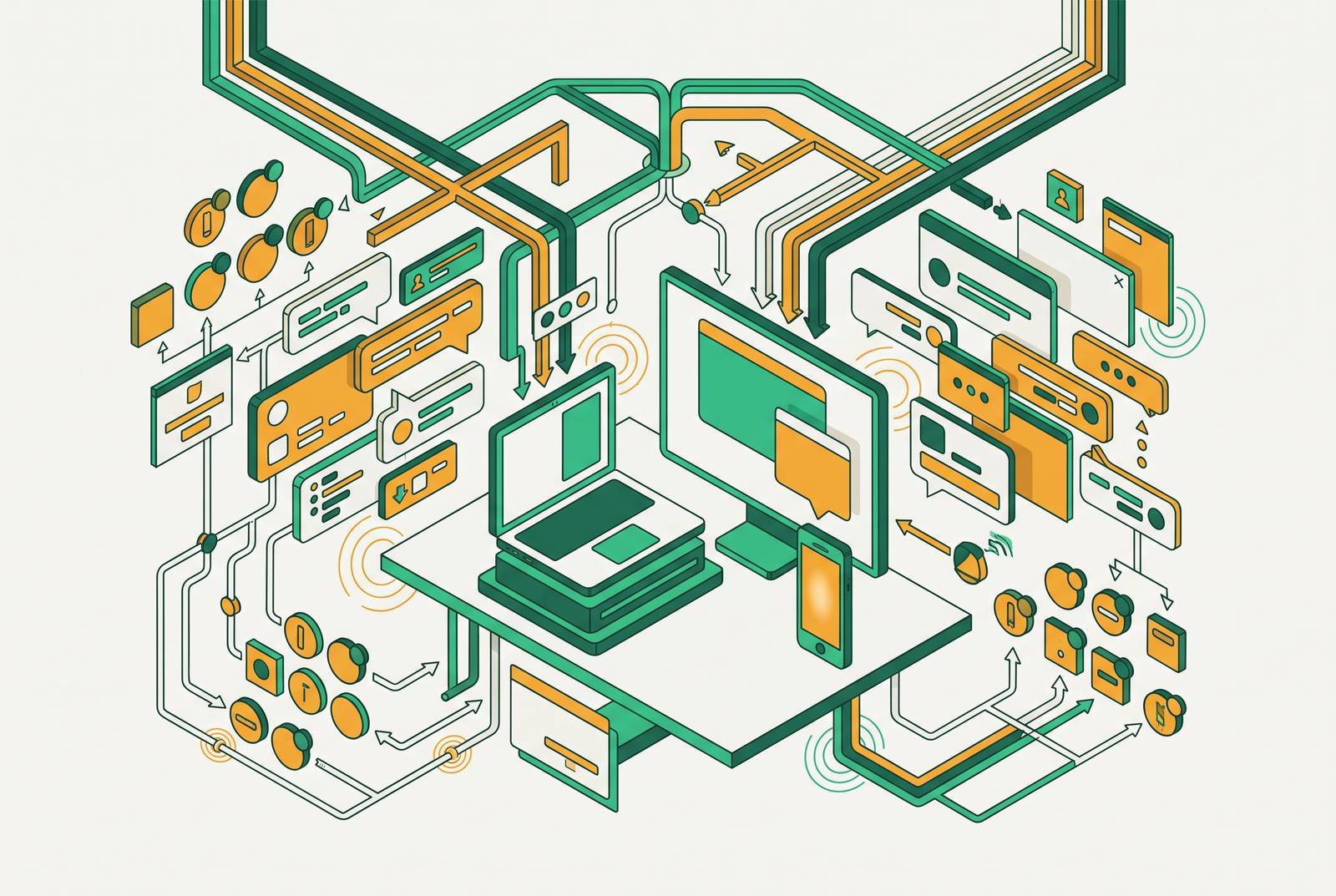
A remote worker opens the computer in the morning, and notifications arrive before the first task is touched. Email needs an answer, chat asks for attention, and the calendar announces a meeting. None of these demands has to be unreasonable for their combined effect to be disruptive. Together, they make responding the default activity and sustained thinking the activity that must wait. The worker starts the day inside a queue of other people’s requests.
That queue grows out of the way remote workers coordinate without meeting in person. Heavy IT use can overcompensate for missing social interaction, adding tools and exchanges that fragment the work they are meant to support. Microsoft’s 2025 Work Trend Index found workers receive a notification from meetings, emails, or chat tools every two minutes, accumulating to 275 separate interruptions over a full workday. ActivTrak’s 2026 State of the Workplace report found the average focused session lasted just 13 minutes and 7 seconds in 2025, down from the prior year. The setting rewards workers who are ready to respond, leaving them little time to think.
What chronic fragmentation does to the brain that makes recovery so costly
An interruption costs more than the time needed to read or answer it. To return to deep work, the worker has to rebuild the state of mind that held the problem together. The 23-minute recovery cost makes the interruption rate especially stark. If recovery takes that long while another notification arrives every two minutes, sustained thinking cannot reliably fit between incoming demands. Even a brief interruption can therefore consume time well beyond its visible duration.
Dhahbi et al. explain in Brain Sciences in 2026 how digital distractions get in the way of the executive control network and the default mode network working together. These systems must work together for people to do deep analysis, work through complex problems, and gain creative insight. Heavy media multitasking is linked to poorer cognitive performance, while chronic fragmentation may weaken sustained attention over time. Video meetings add a separate burden. Stanford’s Virtual Human Interaction Lab identifies nonverbal overload from excessive eye contact, constant self-viewing, reduced mobility, and the effort of reading degraded social cues.
The cost also accumulates across the day, leaving less capacity for strategic thinking and impulse control by mid-afternoon. Over longer periods, sustained cortisol elevation has been associated with poorer episodic memory through hippocampal injury. That association supports a health rationale for protected thinking time without establishing that every notification is a medical threat.
Why adding more tools — including AI — tends to make the fragmentation worse, not better
The obvious response to an overloaded workday is another tool that promises to save time. But each addition can create another stream of outputs to monitor and another reason to switch tasks. A tool may speed up one task while making the whole day harder to hold together. That is a design failure. Assess the tool by whether it reduces the total demand on attention.
Microsoft’s Work Trend Index reported that 75% of knowledge workers had adopted AI by 2024, nearly double the rate of six months earlier. Yet Microsoft’s 2025 Work Trend Index found that 60% of meetings are ad hoc. More capability has not automatically produced more protected time. Unrestricted adoption can instead add activity to a workday whose boundaries were already weak.
AI also raises a concern beyond notifications. Eliav’s 2026 MHIL preprint proposes the Delegation Feedback Loop, in which growing AI capability lowers the threshold for delegation until workers hand over even tasks of negligible demand. This remains a theory in a preprint that has not undergone peer review. Its relevance is the distinction between removing unnecessary effort and removing the cognitive practice that supports attention.
The strongest objection — distraction is internal, so removing tools doesn't fix it
There is a serious objection to the environmental argument. A worker can silence the phone, close chat, and still turn to another distraction. Readers who have tried app blockers with little gain in focus have reason to doubt that fewer tools alone will solve the problem.
Heitmayer’s 2025 Frontiers in Computer Science study gives that objection weight. When smartphones were moved away, people used them less but moved their non-work activities to their computers. Total time spent on work and leisure remained unchanged. The distraction migrated rather than disappeared, which challenges the idea that one device is the main cause.
Marx, Mirbabaie & Rieskamp likewise link problems with attention and self-regulation to where workers are and what they do. External restrictions are therefore insufficient on their own. Internal attentional control, habits, stress load, and cognitive readiness also matter. This refines the architecture argument rather than defeating it, because a complete design must address both the opportunities for distraction and the capacity to resist them.
Physical space design — separating work territory from rest territory in a home environment
Physical space is the first boundary because it supplies cues before any app opens. A place used for leisure carries those associations into a work session held there. Conversely, bringing work into a rest space can make rest harder. Working from a bedroom can contribute to conditioned arousal associated with insomnia, fragmented sleep, and reduced slow-wave sleep. The practical goal is not an impressive home office but a clear distinction between work territory and rest territory.
A dedicated desk used only for work provides that distinction without requiring a separate room. Using the same light or object can be a sign that it is time to work, while entertainment devices stay outside the work zone. A simple spatial ritual can mark the beginning and end of cognitive work.
When space is tight, the boundary can be temporal and sensory. Specific hours at a specific spot, paired with consistent lighting or noise-canceling audio, can establish a repeatable context. Marx et al. found that workers could also use immersive virtual environments to separate their workplace from surrounding distractions.
Digital environment configuration — notification architecture, app layering, and the meeting-to-focus ratio
Once there is a boundary around the work space, digital tools must stop cutting through it. Collaboration tools generally favor responsiveness, so leaving their defaults untouched gives incoming communication priority over the current task. Notification architecture reverses that priority. Batch notifications into two or three defined windows per day rather than allowing every message to announce itself immediately. This requires deliberate changes to chat, email, and calendar alerts.
Notifications are only one route into a worker’s attention. Microsoft’s 2025 Work Trend Index found that the average knowledge worker spends more weekly hours in meetings than in uninterrupted focus blocks. A silent computer does little good if the calendar still divides the day into scraps. Protecting contiguous focus blocks therefore belongs to digital configuration as much as changing alert settings does. An asynchronous-first default supports that boundary by making synchronous meetings the exception.
Close applications and tabs unrelated to the current task so that fewer competing activities remain in view. Marx et al. found that virtual environments introduced new distractions when workers failed to customize their technology’s affordances. A different interface is not inherently a quieter one, and a default setting is not a considered decision about attention.
Schedule architecture — when to do deep work, when to process communications, and how to protect both
A quieter interface still needs a schedule that gives focused work somewhere to happen. Without it, work with others spreads into whatever time is left. The most demanding work belongs in the first available morning hours, before meetings and communication processing, when prefrontal capacity is stronger. One or two deep work blocks of 90–120 minutes give that work a defined place. This block structure broadly follows the ultradian rhythm principle of alternating sustained effort with recovery, rather than demanding uninterrupted intensity all day.
Each block can begin with a brief transition ritual that signals a change into focused work. Communication and meetings can then be consolidated into afternoon windows, protecting a place for collaboration. This separation matters because meetings leave cognitive residue. Asana research found that workers experience a meeting hangover after more than a quarter of their meetings and spend additional time venting about it. Clustering meetings keeps that residue from repeatedly spilling into deep work.
Recovery belongs in the schedule too. Short, planned breaks that include movement or real sensory rest give the default mode network room to help with insight and memory consolidation.
Cognitive capacity as infrastructure — the biological layer of distraction architecture
The brain must arrive ready to use those protected blocks. Sleep and stress shape that readiness, so an empty calendar cannot compensate for poor recovery. Sustained stress can impair working memory and episodic recall, making stress load another part of the design. This is where the earlier objection lands most strongly, because fewer external distractions do not automatically produce a settled internal state.
Cognitive-support compounds also belong in this discussion, but their evidence must stay separate from the larger case for environmental redesign. Multiple RCTs found that L-theanine and caffeine together improve attention-switching accuracy and subjective alertness more reliably than caffeine alone. Evidence for reaction time benefits is less consistent. L-theanine modulates caffeine’s neurochemical effects rather than its absorption rate, a distinction that matters when claims about smoother alertness are made.
A 2021 study found that 300 mg daily of Ashwagandha root extract reduced cortisol levels over 90 days. Bacopa monnieri has a broader RCT evidence base than many cognitive-support compounds, with benefits in working memory and delayed recall requiring consistent daily use over 8–12 weeks. Cognizin® is a clinically studied form of citicoline that supports phosphatidylcholine synthesis, which underpins membrane integrity and acetylcholine production.
Formulation adds another limit to what an ingredient name can establish. A 2025 crossover study found that withanolide glycoside-dominant extracts produced substantially higher systemic exposure than lower withanolide glycoside extracts at the same total dose. Bioavailability and the accuracy of the finished product’s label therefore affect how much of the claimed ingredients reaches the body. Third-party testing for contaminants including heavy metals, PFAS, and mycotoxins provides a verifiable safety baseline for long-term use. None of this makes supplementation the foundation of distraction architecture, because it cannot create the uninterrupted time that the rest of the system must protect.
Putting the architecture together — a layered redesign that addresses space, tools, schedule, and biology as one system
The four layers work because each covers a limit the others cannot solve. A dedicated workspace cannot stop calendar invitations, and notification settings cannot restore lost sleep. Protected calendar time can still be cognitively hollow when stress and poor recovery have depleted attention. Piecemeal fixes fail when the next unprotected layer admits the same problem through another route. A layered redesign closes those routes together.
Separating work from rest supports sleep, better recovery supports focused work, and protected focus reduces the repeated rebuilding that makes fragmented days so costly. Dhahbi et al. call for multi-level strategies spanning individual practices, organizational policies, and technological boundaries. Structured autonomy adds support from the workplace by letting workers control their schedules while making clear how their performance is measured. Personal configuration matters most when the workplace allows those boundaries to hold.
The starting point need not be a perfect home office or a completely rebuilt workday. A protected morning focus block, consolidated notifications, and consistent support for sleep and recovery already change the default conditions. Repeating that structure gives focused work a dependable setting. The architecture pays forward because each better-supported day makes the next day’s focus easier to enter and sustain.
Sources
- Science Is About Thinking: How Can We Protect Thinking Time in a Distracted Digital World? - PMC
- The Cognitive Divergence: AI Context Windows, Human Attention Decline, and the Delegation Feedback Loop
- Frontiers
- "Just a Normal Day in the Metaverse" -- Distraction Conflicts of Knowledge Work in Virtual Environments