Cortisol Patterns and Decision Quality in High-Pressure Roles
Sustained stress rewires the brain circuits that high-pressure decisions require.
A leader who handles a surprise product failure well on Tuesday can still make a markedly worse call on Friday, even if Friday looks calmer on paper. Cortisol patterns, not single spikes, drive that decline. Most people in high-pressure roles treat stress as an event: a hard meeting, a brutal quarter, a bad call that gets made and then gets over. They manage it the way they'd manage a fever, by waiting for it to break. But cortisol doesn't work like a fever. It follows an inverted-U curve, where a moderate, short-lived dose sharpens attention and performance, while sustained elevation becomes neurotoxic and begins to erode the exact faculties that good judgment depends on. From here, this piece argues for that distinction between those two regimes, acute and chronic.
Acute Cortisol and the Deciding Brain
The body's stress response begins with threat detection in the amygdala, which triggers a chain running from CRH to ACTH to cortisol release from the adrenal glands. That cascade takes roughly three minutes start to finish. Unlike adrenaline, which spikes and clears within a few minutes, cortisol lingers in the bloodstream for hours after the triggering event has passed. It also reaches further into the brain than other stress hormones: cortisol crosses the blood-brain barrier and binds to receptors across nearly every brain region, a level of access no other stress hormone has.
That reach has consequences for how people think in the minutes and hours after a stressful jolt. Working memory, the capacity to hold and manipulate information needed to make a decision, takes its sharpest hit early after acute stress, and again after a later interval; these phases line up with peak central noradrenaline and cortisol levels, and the prefrontal cortex shows a measurable drop in activity. The practical effect is a shift from executive to automated thinking: the prefrontal cortex, which handles planning, impulse control, and rational deliberation, hands processing priority to the amygdala, a structure built for threat detection, not strategic judgment.
A 2025 study in Communications Psychology from the University of Melbourne tested this directly: it used NP-complete task methodology to measure how acute stress, indexed by cortisol, affected decision quality across tasks of varying computational difficulty. The deficits grew sharpest when acute stress combined with time pressure, and that pairing describes most working days in high-pressure roles; it is not an unusual edge case. Gaze-tracking data collected in the same study offered early evidence for one mechanism behind the effect: stressed subjects scanned more items but spent less time looking at each one before deciding, trading depth of consideration for the appearance of coverage.
The Iowa Gambling Task, a long-standing tool for studying real-world decision-making under uncertainty, adds a second line of evidence. Cortisol proved specifically harmful during the task's uncertainty phase, the stage that most closely resembles actual strategic decisions, where outcomes are unknown and a decision-maker has to work with incomplete information. Picture a leader fielding an unplanned conflict, a surgeon called in on a difficult case, or a pilot hitting unexpected turbulence: each one makes their next decision while cortisol from the last stressor is still circulating. What happens when that circulation never fully stops, when the next stressor arrives before cortisol has cleared from the one before it?
How chronic elevation structurally degrades judgment circuits
Sustained cortisol exposure goes beyond taxing the prefrontal cortex in the moment. It physically reshapes the hippocampus, the amygdala, and the prefrontal cortex itself, and the changes compound over time.
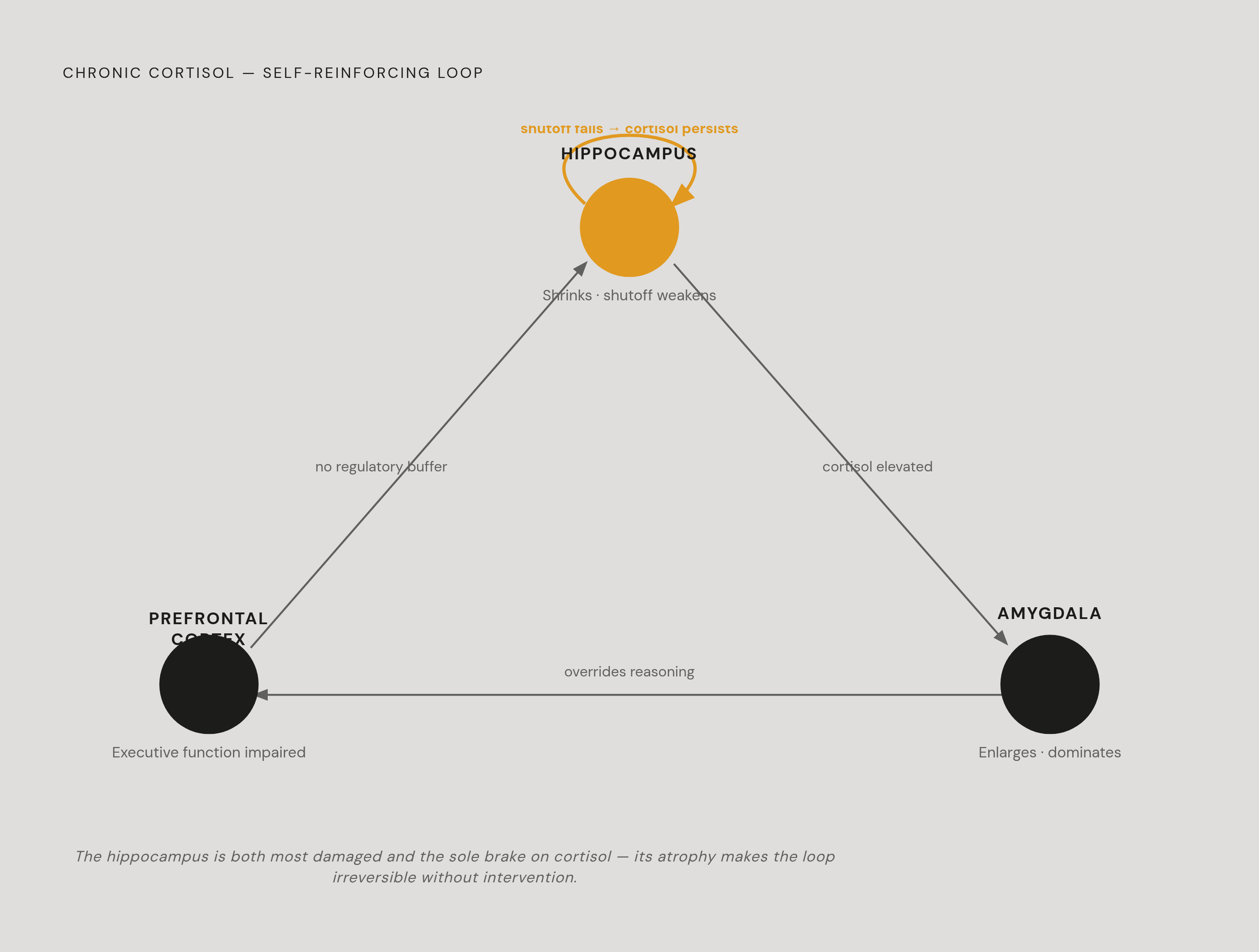
The hippocampus carries the highest concentration of glucocorticoid receptors anywhere in the brain, which makes it the structure most exposed to chronic cortisol. Sustained exposure causes hippocampal neurons to retract their dendrites, suppresses the growth of new neurons, and in extreme cases kills neurons. People with chronic stress or cortisol-overproduction conditions show measurable hippocampal volume loss as a result. The prefrontal cortex takes a parallel hit: chronic stress drives structural and functional changes there that can impair executive function and emotional regulation, and may raise susceptibility to stress-related psychiatric conditions, research published in Brain Research found. The amygdala responds in the opposite direction. It enlarges under chronic cortisol, grows more reactive, and becomes more dominant, so the brain's balance of control shifts away from deliberate reasoning and toward threat-driven response for good.
These three changes feed each other. The hippocampus is one of the structures responsible for telling the HPA axis to stand down once a threat has passed. When chronic cortisol shrinks the hippocampus, that shutoff signal weakens, cortisol stays elevated longer, and the hippocampus shrinks further still. Chronic stress damages the very structure built to stop chronic stress, which turns cortisol from a byproduct of a demanding role into an active force that makes the role progressively harder to do well.
Neuroplasticity, the brain's capacity to adapt, learn, and recover from strain, drops directly as a result of chronic cortisol exposure. That decline matters most in high-pressure roles because those roles demand constant adaptation to novel, complex situations, not repetition of familiar ones. At the leadership level, the behavioral signature is consistent: a less active prefrontal cortex paired with a more dominant amygdala produces urgency-driven decisions in place of strategic ones, narrows attentional focus, and weakens the capacity to process ambiguous or many-sided information.
The damage isn't limited to slow, deliberate reasoning. A completed randomized controlled trial, NCT07702747, run by the Centre de Recherche de l'Institut Universitaire en santé Mentale de Montréal and completed in November 2024, carried the title "Stress-induced Cortisol Clouds the Gut Feeling in Decision-making: A Randomized Controlled Study." The title states the clinical point directly: cortisol degrades intuitive judgment, the fast, experience-based signal that high-pressure professionals rely on just as much as formal analysis, not only the slower deliberative kind.
Which cognitive functions high-pressure roles depend on most
Cortisol doesn't damage all cognitive functions at the same rate. It hits working memory, inhibitory control, and flexible reasoning, the capacities that complex, adaptive judgment requires, hardest, while leaving routine, automated tasks comparatively untouched.
A systematic review and meta-analysis published in Psychoneuroendocrinology looked at cortisol and cognitive performance specifically in military subpopulations, a group whose operational demands make the stakes of this question unusually concrete. The review found that cognitive domain significantly moderated the relationship between stress and performance: cortisol didn't act as a consistent, across-the-board predictor of cognitive decline. What mattered was which specific domain was being tested. Speeded tasks significantly moderated performance decrements, meaning time pressure amplifies the damage within whichever domain is already vulnerable. Mean age also moderated outcomes, a point that matters for organizations that routinely place their most senior, experienced people in the highest-stakes roles.
Research from UCLouvain adds a second dimension to the picture. Inhibition and working memory significantly accounted for individual differences in cortisol response to a laboratory stress challenge: people with stronger executive function showed different cortisol reactivity patterns than those without it. Cognitive reserve, in other words, appears to partially moderate stress physiology itself. That runs in the opposite direction from the structural damage described above, and the two effects form a loop: strong executive function protects against cortisol dysregulation, while chronic cortisol erodes executive function, and the cycle can run either way depending on where a person starts.
The practical weight of this falls hardest on roles that require strategic planning, multi-variable trade-off assessment, ethical judgment under ambiguity, and novel problem-solving, all of them functions that run through the prefrontal cortex. Chronic cortisol elevation targets exactly these capacities, persistently and specifically. Routine, procedural, or highly automated tasks are relatively spared, and that is why chronically stressed high performers often feel entirely functional. They can still execute the familiar parts of their job competently, even as their higher-order judgment quietly erodes, and they can't see it happen because the tasks that still feel easy are the ones cortisol never touched.
How sleep deprivation amplifies cortisol's damage
Sleep deprivation doesn't simply add to cortisol-driven impairment. It accelerates it, and it shuts down the brain's primary mechanism for repairing the damage cortisol has already done.
The prefrontal cortex, already weakened by chronic cortisol, takes a second direct hit from sleep loss, producing compounding deficits in working memory, impulse control, and decision-making rather than two separate, additive problems. Sleep deprivation also increases amygdala reactivity and weakens the connectivity between the prefrontal cortex and the amygdala, the exact same directional shift that chronic cortisol produces on its own. The two stressors push the brain's decision architecture toward the same degraded end state, and the mechanisms behind that overlap. Attentional lapses rise substantially after even a single night of significant sleep restriction, and hippocampal encoding capacity drops sharply alongside them, so forming new memories and integrating new information both suffer at once.
The most dangerous feature of chronic sleep restriction is that it builds cumulative cognitive deficits the sleep-deprived person cannot accurately sense in themselves. Acute intoxication is often obvious to the person experiencing it, but someone running on insufficient sleep consistently feels less impaired than they actually are. That is structurally the same problem cortisol creates on its own: both forms of impairment are invisible from the inside, which makes self-assessment an unreliable guide precisely at the moments it matters most.
Sleep is also the period when the brain clears metabolic waste, consolidates declarative memory, and restores prefrontal-hippocampal connectivity. Chronic sleep loss blocks all three processes, so the structural damage already done by daytime cortisol exposure goes unrepaired. High-pressure roles tend to generate exactly the conditions that cut sleep short: late hours, elevated evening cortisol from demands left unresolved at day's end, and a working culture that treats sleep as a variable to trade away for output. Invisible impairment and blocked repair compound each other, so external structure and measurement matter more here than self-reported judgment, because self-reported judgment is what's failing.
Breaking the cortisol-impairment cycle through targeted nutritional support
A small set of well-studied compounds show evidence of supporting the systems cortisol degrades, not by removing stress from a high-pressure role, but by moderating the hormonal response, protecting neuroplasticity, and helping executive function hold up under sustained pressure.
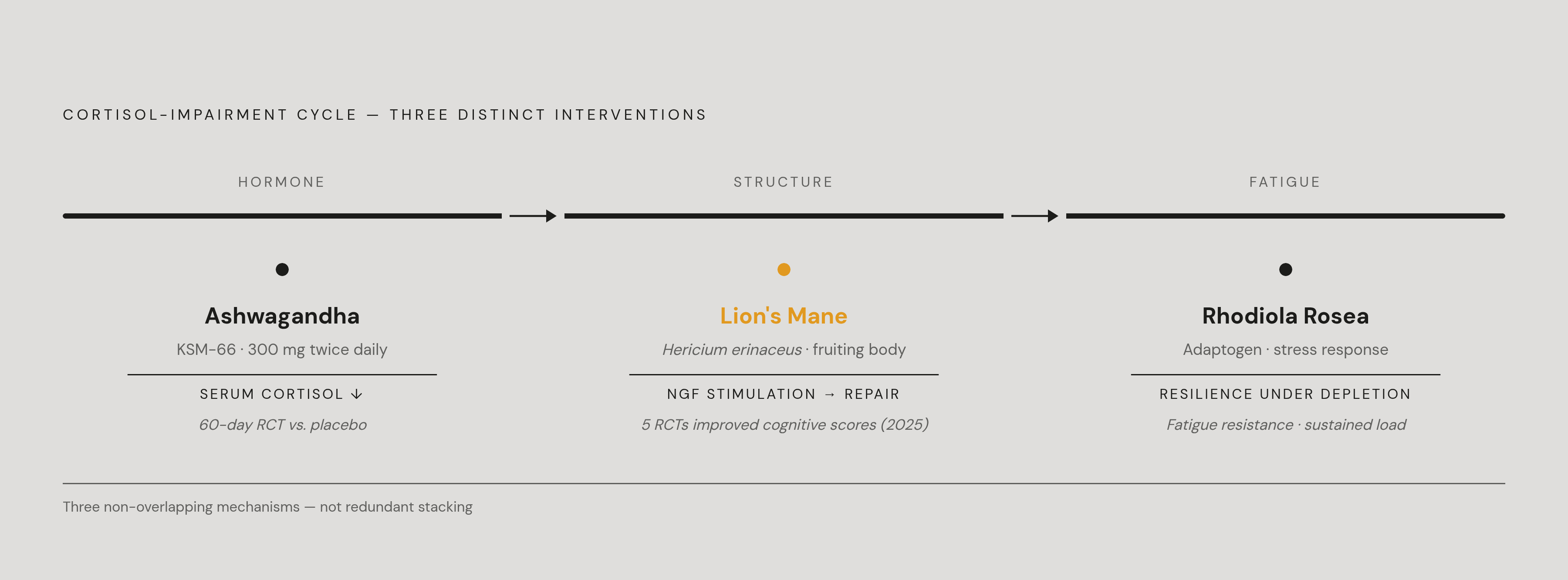
Ashwagandha, Withania somnifera, carries the strongest evidence for direct cortisol modulation among the compounds studied. A 60-day randomized, double-blind trial using 300 mg of KSM-66 ashwagandha root extract taken twice daily produced a meaningful reduction in serum cortisol compared with placebo (Chandrasekhar et al., 2012, Indian Journal of Psychological Medicine). The formulation used mattered as much as the plant itself: KSM-66, standardized to a defined withanolide concentration, is the extract form with the deepest clinical trial record behind it, and that standardization is part of why the results replicate. The weight behind this ingredient extends past a single trial. The World Federation of Societies of Biological Psychiatry and the Canadian Network for Mood and Anxiety Treatments have jointly, provisionally, recommended specific ashwagandha extracts for generalized anxiety disorder, a clinical endorsement that sits above the level most supplement ingredients ever reach.
Lion's Mane, Hericium erinaceus, works on a different part of the problem: neuroplasticity and structural protection. Its active compounds, hericenones and erinacines, stimulate synthesis of Nerve Growth Factor, which supports neuronal maintenance and synaptic plasticity, the same systems that chronic cortisol damages in the hippocampus and prefrontal cortex. A 2025 systematic review of five randomized controlled trials, published in Frontiers in Nutrition, found that Lion's Mane improved cognitive scores across all five trials, while laboratory studies included in the same review found enhanced production of pro-BDNF and BDNF alongside promoted hippocampal neurogenesis. The evidence has real limits: most human trials behind these findings involve small numbers of participants, so the base is promising but not settled. Fruiting-body extract with high beta-glucan content contains higher concentrations of beta-glucans than grain-grown mycelium products, though direct, head-to-head clinical trials comparing the two formats are still scarce.
Rhodiola Rosea addresses a third piece of the problem: fatigue resilience during sustained pressure rather than cortisol levels or structural protection directly. Its cognitive benefits appear most clearly when a person is already depleted, whether from sleep loss, prolonged stress, or the tail end of a demanding stretch, which makes it a tool suited less to isolated high-stakes moments and more to the long grind that chronic cortisol elevation actually describes. Taken together, these three compounds target three different points in the same cycle: ashwagandha at the hormone itself, Lion's Mane at the structural repair cortisol blocks, and Rhodiola at the fatigue that makes the whole pattern harder to tolerate day after day. None of them can replace sleep, boundaries around workload, or genuine recovery time. What the evidence supports is narrower and more useful: a biological lever that can be pulled alongside those changes, grounded in trials with real numbers behind them, not a substitute for addressing why the cortisol stays elevated to begin with.
Sources
- Cortisol, stress, and cognition in military subpopulations: A systematic review and meta-analysis - ScienceDirect
- Cortisol Responses to a Laboratory Challenge: The Moderating Role of Cognitive Performance
- Role of Cortisol and Testosterone in Risky Decision-Making: Deciphering Male Decision-Making in the Iowa Gambling Task
- Acute stress impairs decision-making at varying levels of decision complexity - PMC
- Acute stress impairs decision-making at varying levels of decision complexity
- The Association Between the Stress Hormone Cortisol and Decision-making
- Chronic stress-induced neuroplasticity in the prefrontal cortex: Structural, functional, and molecular mechanisms from development to aging - ScienceDirect