Meal Timing Effects on Afternoon Cognitive Performance
Earlier eating and a lower-glycemic lunch may steady your afternoons.

Meal timing affects cognitive performance in the afternoon because food changes both blood sugar and the signals that set the body’s internal clocks. The practical conclusion is straightforward. A steadier afternoon starts with when and what you eat. Earlier eating windows, a lower-glycemic lunch, and a short walk can help, though the research has yet to show that one schedule is best for everyone.
Why the afternoon slump is a timing problem, not an energy problem
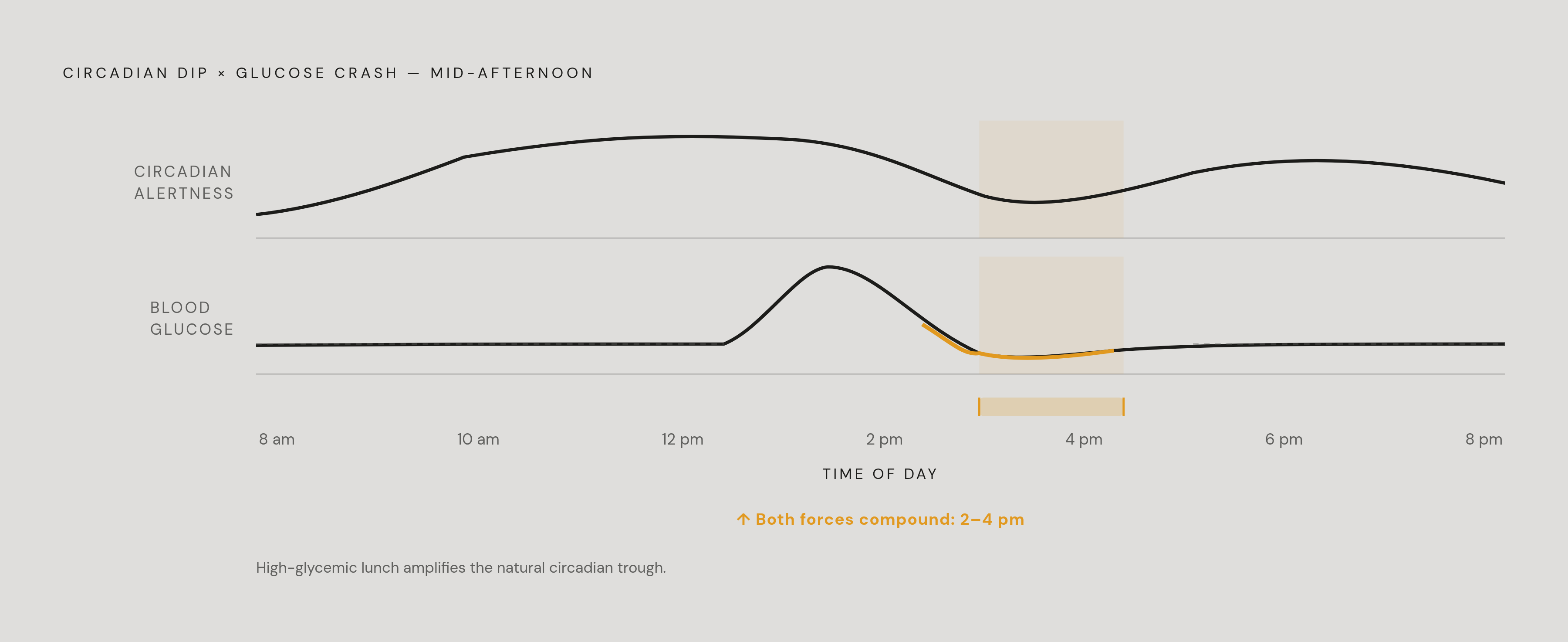
The screen is still open, but the work has stopped moving. It takes effort to hold a thought, and the second block of deep work feels harder than the first. That familiar mid-afternoon fog comes from two causes that overlap. One is a natural circadian dip in alertness that occurs independently of food. The other is the blood-sugar swing that can follow lunch, turning a mild pull toward sleepiness into a pronounced crash.
These are not the same problem, even when they feel identical. The circadian dip is part of the body’s daily rhythm, while the meal-related dip depends partly on the glycemic impact of what you ate. A high-glycemic lunch can amplify the background decline in alertness just when demanding work resumes. More calories do not automatically address a problem caused by how quickly glucose rises and falls.
Insufficient sleep deepens the natural dip and slows recovery after a meal, adding strain to an already vulnerable window. Meal timing remains a useful first lever because it is more directly adjustable than the underlying circadian rhythm.
How meal timing functions as a signal to the brain, not just the stomach
Eating sends a timing signal as well as nutrients. Researchers call environmental cues that synchronize internal rhythms zeitgebers, and meals are among those cues. The brain’s master clock, in the suprachiasmatic nucleus, responds to light. Peripheral clocks in organs, including the digestive system, also respond to when food arrives. Those clocks need to keep time together.
Ding, Zhang, and Moon’s December 2025 scoping review in Alzheimer’s & Dementia looked at this link at the University of Iowa. They generally found that earlier eating windows were linked to better cognitive function, while night-shift eating patterns were linked to worse cognitive function. The proposed connection runs through metabolic signaling. When eating pulls peripheral clocks away from the master clock’s rhythm, the brain receives signals at times that do not match its daily schedule.
Chrononutrition is the name for aligning eating with that rhythm. It treats the hour of a meal as a biological variable. Sleep loss can make that variable more consequential because it disrupts the CLOCK circadian gene in the hippocampus, a brain region central to memory consolidation. Calories alone cannot explain how an eating pattern affects mental performance, though measurable impairment is only a possible consequence of a late meal.
What postprandial blood sugar does to working memory and executive function
Postprandial simply means after a meal, and the chain of events starts when glucose enters the bloodstream. A lunch with a high glycemic load can produce a sharp rise in blood sugar. Insulin then rises to clear that glucose. If insulin remains elevated after clearance, the response can overshoot into low blood sugar, known as reactive hypoglycemia. The resulting fog is not simply hunger.
Working memory holds information in mind, while executive functions help with planning and switching between tasks. These are precisely the capacities that become harder to use when blood sugar is disrupted. Healthy adults can experience this cascade too, though its severity and recovery time differ from those seen in metabolic disease. It is a possible response to a disruptive meal.
Glucose oscillation is linked to oxidative stress, impaired blood-vessel function, and inflammation, all of which can get in the way of brain-network connectivity and how nerve cells communicate. Chronic oscillation has also been linked to tau phosphorylation, plaque formation, and synaptic disruption, processes relevant to Alzheimer’s disease. Those links give a reason to take glucose stability seriously beyond a single afternoon’s output.
What the clearest evidence on eating windows actually shows
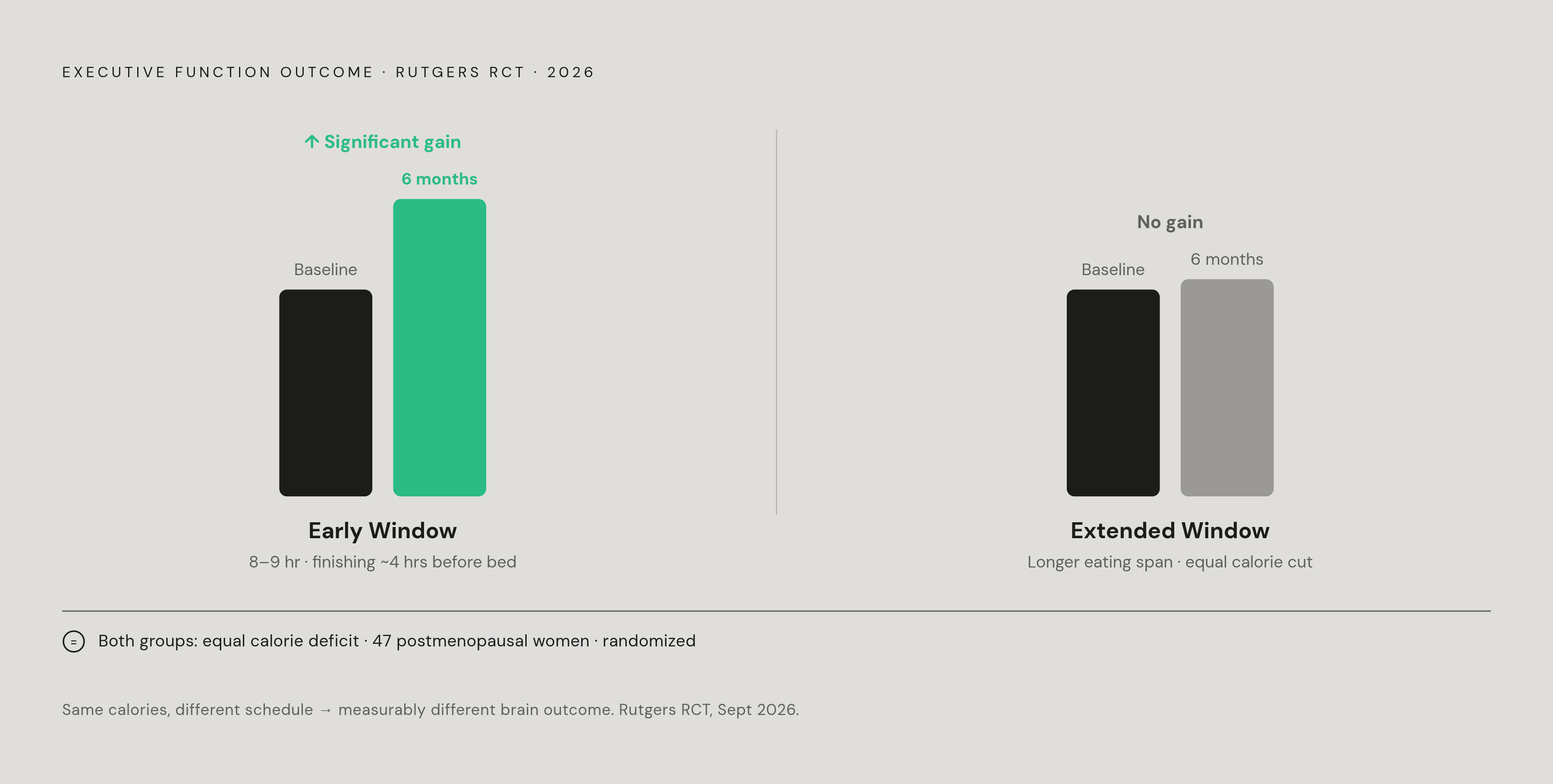
The Rutgers randomized controlled trial reported in September 2026 offers the clearest intervention signal in the brief. The trial had 47 postmenopausal women, and both groups cut the same number of calories. Only the group that ate within an earlier eight-to-nine-hour window, finishing roughly four hours before bed, had a significant improvement in executive function at six months. The group that ate across a longer window had no gain in cognitive function.
Sue Shapses, the study author and director of the NJ Institute for Food, Nutrition, and Health, noted that the magnitude of the executive-function finding surprised her. Significant findings are difficult to achieve in this field. Still, the population was narrow. Participants were postmenopausal women actively losing weight, so the result does not establish the same benefit for people who are not dieting or for other demographic groups. Shapses identifies that transfer as a next research priority.
The Iowa review found a broadly similar direction after screening thousands of studies. Most of the evidence from trials of time-restricted feeding and intermittent fasting pointed toward better cognitive function. However, eating lunch after noon was associated with better performance, which complicates any blanket claim that earlier is always better. One study also linked time-restricted feeding to a higher prevalence of cognitive impairment in older adults. Age may change the balance.
ClinicalTrials.gov trial NCT07181057 is testing how meal timing affects cognitive performance more directly by comparing one meal a day at morning, midday, and evening times. It measures the brain’s electrical activity and how well people do on the Stroop test in morning and afternoon sessions, including tests roughly six hours after eating. Its results are not yet published. For now, the evidence is directionally consistent and biologically plausible, but much of it comes from small samples and cross-sectional studies. A precise prescription for the general knowledge-worker population would outrun those findings.
Why dinner composition may matter as much as lunch timing
The Frontiers in Nutrition study found that supper was the meal most consistently associated with memory-related outcomes. Western-style evening meals that had little fiber, large portions of animal protein, and added sugars were linked to poorer memory performance. Milk-based products and sweets at supper were the strongest predictors of worse episodic memory, the ability to recall experiences. Younger adults showed the strongest negative associations.
Calling a meal plant-based did not mean it would lead to better results. The details of the meal were more informative than its broad dietary category. This expands the timing argument rather than reversing it, because eating earlier and changing dinner composition address different parts of the same system. When a meal is eaten matters for circadian alignment, while what is in dinner may affect the metabolic signals at work during sleep-dependent memory consolidation. The evening meal is therefore a plausible delayed influence on next-day performance, although an association with memory does not prove that a particular supper causes the following afternoon’s fog.
The post-lunch walk as a mechanistically justified cognitive intervention
The first practical step is deliberately small. Take a short walk immediately or soon after lunch, before returning to demanding work. Movement helps peripheral muscles take up glucose, reducing the size of the post-meal rise and the insulin response needed to handle it. That can blunt the overshoot behind a meal-related crash. The evidence described here extends to cognitive outcomes.
Walking is a modest intervention. That makes it a realistic bridge between eating and the next work block, rather than another task requiring a separate part of the day. Its role is specific, however. A walk dampens the glucose disturbance but cannot fully compensate for a meal dominated by refined carbohydrates or eaten at a circadian-misaligned hour.
How to structure an eating schedule around afternoon cognitive output
For a practical test, start with the overall eating window. An earlier window of nine hours or less, ending roughly four hours before bed, is the most specific structure supported by the Rutgers trial. Treat it as a pattern to test. Its evidence comes from a particular population, and a shorter window is not automatically a better one. The aim is to place meals coherently within the day.
Within that window, put lunch around midday and finish well before the mid-afternoon dip. There is no case here for pushing it as early as possible. The Iowa finding favoring lunch after noon suggests a more measured target than simply eating sooner.
Next, lower the meal’s glycemic load by prioritizing protein, fiber, and healthy fats over refined starches and added sugars. Aim for a steadier response while retaining carbohydrates. Follow lunch with the short walk before settling back into cognitive work.
Dinner then completes the schedule. Focus on fiber, keep protein portions moderate, and eat fewer sweets and refined carbohydrates at the evening meal. The goal is to keep dinner within the earlier window while avoiding the dietary composition high in sweets and refined carbohydrates linked to poorer episodic memory. For readers over 60, the older-adult finding is a reason to approach aggressive restriction more cautiously and consult a clinician before trying it.
Where targeted cognitive support compounds fit into the timing picture
Targeted compounds belong after the meal framework. Ceremonial-Grade Matcha supplies L-theanine and caffeine, a combination associated with better attention and cognitive performance than either alone. L-theanine may also ease the stress response to caffeine. That makes the combination relevant to afternoon focus, but it does not make a disruptive lunch irrelevant.
Ashwagandha, or Withania somnifera, addresses a different pressure through modulation of the stress-response system known as the HPA axis. Evidence for stress reduction and cortisol balance concerns adults with stress and/or anxiety. Its effects build over four to eight weeks. Rhodiola Rosea, by contrast, can produce anti-fatigue effects within hours of a single dose, with rosavins and salidroside contributing to its effects on stress signaling and cellular energy metabolism.
Cognizin® is a clinically studied form of citicoline that supports neuron-membrane components and dopamine and acetylcholine signaling, making it relevant to attention and working memory. Lion’s Mane also appears among the proposed ingredients, but the evidence supplied here does not establish a specific afternoon benefit for it. These distinctions should govern expectations. A consistent morning or midday routine may fit the timing framework, but the ingredient evidence does not establish that a combined formula corrects circadian misalignment or a post-meal glucose crash.
Sources
- Neurocognitive Effects of Meal Timing in a One-Meal-a-Day Regimen
- Effect of meal timing on cognitive function: a scoping review - Ding - 2025 - Alzheimer's & Dementia - Wiley Online Library
- Effect of meal timing on cognitive function: a scoping review
- Study on the Relationship between Postprandial Brain Function Decline and
- Postprandial Hyperglycemia Is Associated With White Matter Hyperintensity and Brain Atrophy in Older Patients With Type 2 Diabetes Mellitus