Blood Sugar Stability Strategies for All-Day Cognitive Output
Steadier blood sugar throughout the day sharpens focus and protects long-term brain health.
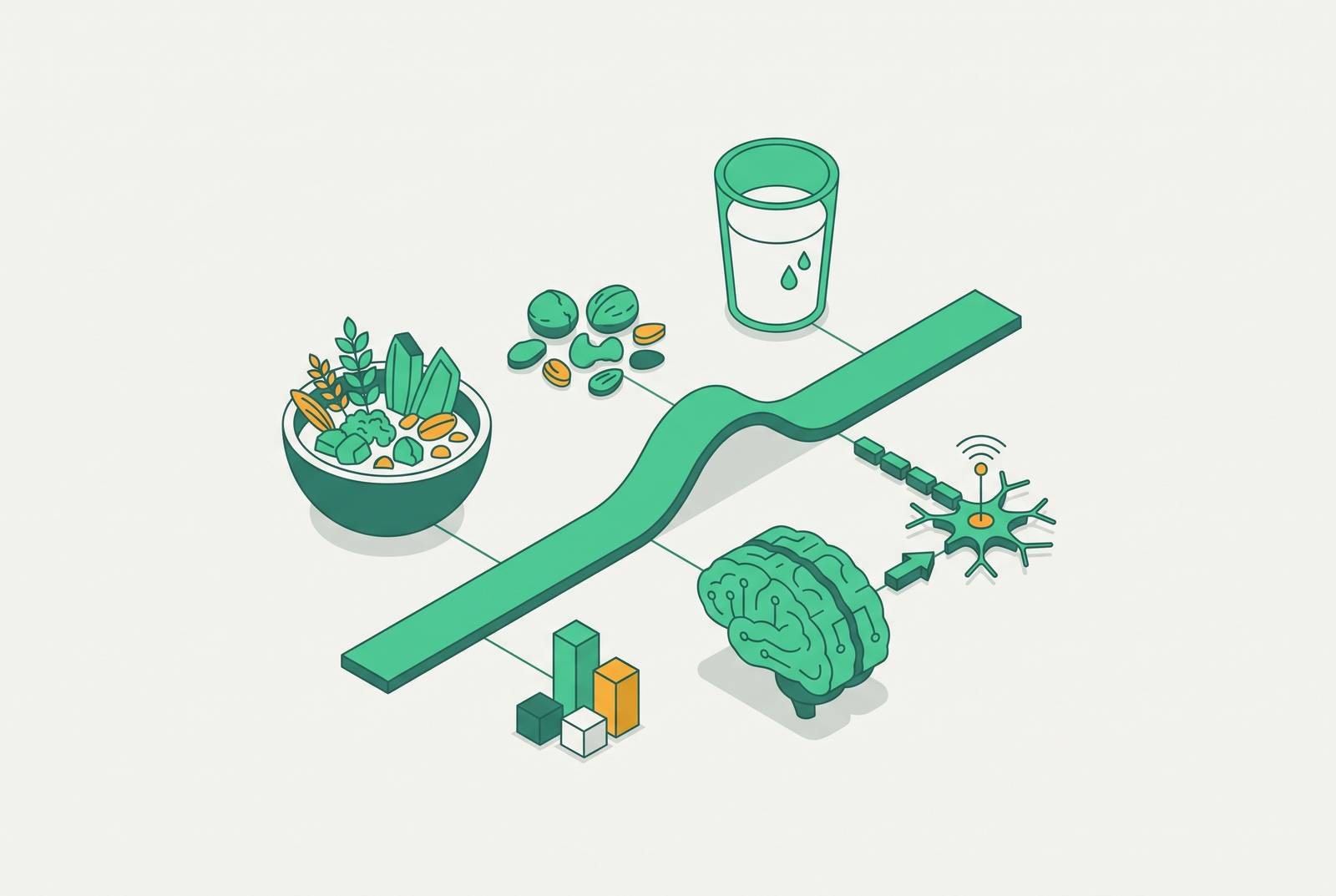
All-day focus depends on steadier fuel. Blood sugar stability strategies work by combining meals that limit spikes, habits that support glucose control, and ingredients that may help stress or cognition. For anyone looking for a caffeine-free or low-caffeine nootropic shot without jitters, the dose and form of each ingredient and the evidence behind it offer more to go on than promises of instant clarity. The research here cannot show which shot is best or promise anxiety-free focus.
Why blood sugar instability is a cognitive performance problem, not just a metabolic one
A demanding morning goes well, lunch arrives, and then clear thinking gives way to rereading the same paragraph. That slump can come from the same glucose-supply mechanism described in clinical research, even in someone who has no diabetes diagnosis. The brain needs a continuous supply of glucose. The brain needs that supply to make electrical impulses, release neurotransmitters, and send signals between nerve cells. When it becomes unstable, mental energy can become unstable too.
Refined carbohydrates can push glucose into the blood quickly, prompting a large insulin response. If that response overshoots, glucose falls and the brain can become temporarily underfueled. This is one physiological route to brain fog. The distinction is important for another reason. A 2025 bioRxiv preprint links the brain’s own moment-to-moment metabolic variability to better cognitive performance, which is different from an unstable glucose supply reaching it.
Blood glucose that stays high poses more risks than a slump that passes. A 2026 Molecular Psychiatry multimodal genetic study associated elevated plasma glucose with adverse cognitive, movement, and mental health outcomes, including dementia, stroke, depression, and anxiety. A 2025 Frontiers in Endocrinology review describes insulin resistance, inflammation, oxidative stress, and injury to brain blood vessels as distinct but compounding pathways to cognitive impairment. Those findings establish the stakes without making an ordinary lunch crash equivalent to long-term neurological disease.
How glucose variability harms the brain even when lab values look normal
A normal annual blood panel does not show every rise and fall during a day at work. Nor does a result inside the normal range establish that glucose has no relationship to cognition. Research in community-dwelling older adults without diabetes has found structural associations between higher glucose within that range and shrinkage of the hippocampus and amygdala. They also concern older adults, rather than proving the same changes in every healthy knowledge worker.
A 2025 Frontiers in Neuroscience longitudinal study linked within-day glucose fluctuations to damage in cortical and subcortical gray matter involved in habit-learning, reward, and prediction-error signaling. Its participants had Type 2 diabetes. That limits how directly its findings apply to healthy readers, although the affected circuits are relevant to learning and sustained work. Across the research described here, vulnerable cognitive domains include delayed recall, working memory, executive function, and information processing speed.
The practical frame is performance. Ordinary eating patterns can produce a spike-crash cycle without turning the person experiencing it into a clinical case. Remembering an earlier discussion, holding several facts in mind, and deciding what deserves attention all draw on the capacities implicated in glucose-related cognitive problems. A normal lab result therefore does not close the question of whether steadier meals could support a steadier workday.
The sleep–cortisol–glucose loop that makes a bad night compound into a bad day
After a rough night, it is harder to focus and high-carbohydrate foods seem more tempting. That combination can make a familiar slump harder to escape. Research links short sleep with larger glucose spikes after meals, higher cortisol in the evening, and changes in leptin and ghrelin that make people feel hungrier. Those changes can last even after a good breakfast.
Cortisol provides one link between sleep and glucose. Sleep deprivation can raise it in the evening, when it should be declining. High cortisol tells the liver to make more glucose through gluconeogenesis, so blood sugar can rise even without eating. With lower insulin sensitivity, the body then has a harder time keeping glucose in check. The next day’s instability is not simply the result of choosing the wrong lunch.
The loop also runs in the opposite direction. High blood sugar can disrupt sleep architecture, so the next night’s sleep does less to restore the body and the pattern starts again. This is why a diet-only strategy has limits. To keep thinking clearly through the day, sleep needs to be part of the glucose plan.
Dietary strategies that flatten the glucose curve across a full day
The food-first approach begins with breakfast composition. Front-load protein and healthy fat rather than making refined carbohydrates the center of the meal. Protein and fat slow gastric emptying, which helps blunt the early glucose rise. Carbohydrates do not have to disappear. Pairing them with fat or protein is a simple rule that can apply across breakfast, lunch, and snacks.
At meals, change the order as well as the ingredients. Eat vegetables and protein before carbohydrates, since this sequence reduces the post-meal glucose excursion compared with a carbohydrate-first approach. Order is a separate lever from food choice. It changes how glucose rises and falls after a meal without having to change the whole menu. That makes sequencing useful at the day’s largest carbohydrate meal.
Fiber adds another brake on rapid absorption. Soluble fiber slows glucose entering the blood and softens the insulin response, so prioritize fiber-dense foods throughout the day. Legumes, non-starchy vegetables, whole grains with intact fiber, nuts, and foods rich in resistant starch provide practical anchors. The goal is a meal structure that repeatedly slows the arrival of glucose.
The afternoon is where that structure often breaks down. An ultra-processed, high-glycemic snack can start another spike-crash cycle while the work still calls for clear thinking. For that point in the day, the same pairing rule applies. Fiber-dense choices with protein or fat fit the strategy better than a rapid sugar hit.
Behavioral habits — meal timing, movement, and caffeine — that sustain glucose stability without changing what you eat
A short walk after eating engages large muscle groups that draw glucose out of the blood. Movement gives that glucose somewhere useful to go. This accelerates clearance without requiring a change in the meal itself, so it complements dietary choices. After lunch, it also places the intervention directly after a common source of afternoon instability.
Eating within a regular daily window aligns glucose handling with the body’s circadian clock, while late-night eating places a glucose load in a period of naturally lower insulin sensitivity. Mild dehydration can impair cognition independently of glucose. Drinking regularly throughout the day removes one cause of poor focus that can feel like a blood sugar crash.
Caffeine complicates the picture because feeling stimulated is not the same as having stable fuel. High-dose coffee can raise cortisol, and the return of adenosine’s effects as caffeine clears can contribute to fatigue. A delayed first caffeine intake is one timing strategy described in the notes, rather than an immediate high-dose response to waking tired. It is not a guarantee against an afternoon slump. For people sensitive to stimulants, the next question is whether an ingredient supports cognition without depending on a large caffeine dose.
How specific ingredients support glucose stability and the cognition that depends on it
Ashwagandha targets the stress side of the loop. Albalawi’s 2025 meta-analysis of seven RCTs found that cortisol fell by a meaningful amount at 600 mg/day, but self-reported stress did not improve significantly across all studies. The lab result and the felt result differed. Arumugam’s 2024 review of nine RCTs found improvements in stress scores, showing that findings depend on the evidence being pooled. Standardized extracts such as KSM-66® or Sensoril® provide more consistent forms than non-standardized products, but reduced cortisol alone does not establish all-day glucose stability.
L-theanine is relevant to calm alertness. A 2025 JCIM systematic review and meta-analysis of five RCTs in healthy adults found that the cognitive effect depended on the dose and that plasma concentration reached its peak within under an hour. It acts on caffeine’s neurological effects while leaving caffeine absorption unchanged. A Neurology and Therapy study also found reduced salivary cortisol after a psychological stressor. These findings support an ingredient-level case.
Matcha contains theanine, EGCG, and caffeine, so it is not a caffeine-free option. A 2024 twelve-month Nutrients RCT in 99 older adults found improvements in social acuity and emotional perception compared with placebo. For a stimulant-sensitive reader, the distinction is straightforward. Evidence for matcha cannot establish that its caffeine will be tolerable, and evidence for theanine cannot validate an unspecified drink formula.
Lion’s Mane, or Hericium erinaceus, belongs to the longer-term neural-support category. University of Queensland research found that hericene A increased the size of growth cones, the tip structures involved in developing neuronal connections. It is thought to work through Nerve Growth Factor and help maintain neurons, with no immediate surge in energy. The timeline described for measurable benefits is 4–8 weeks of daily use. Hot-water extraction and a study-relevant dose are key distinctions, since many mushroom coffee servings contain far less than cognition studies use.
Long-term supplementation with Bacopa Monnieri has improved delayed word recall and visual information processing speed, while research also reports reduced salivary cortisol under acute cognitive challenge. The practical guidance is 300–450 mg daily, standardized to a high bacoside concentration and taken with fat for absorption. Effects emerge within 4–6 weeks.
Rhodiola Rosea has a more energizing profile. A study of physicians working night shifts found that 170 mg daily improved cognitive performance and reduced fatigue within two weeks. Standardization to defined rosavin and salidroside ratios distinguishes the studied approach from an unspecified extract. Because it is energizing, it belongs earlier in the day. Caffeine-free does not automatically mean calming, and these different timelines rule out treating all nootropic ingredients as interchangeable.
Why absorption determines whether any of these strategies actually work
For supplemental ingredients, the label dose is only the starting point. Active compounds must survive digestion and reach the bloodstream before they can exert systemic effects. First-pass metabolism can degrade compounds in the gut and liver, so identical listed doses may not produce identical exposure. Form changes what the body receives. This limits how much a buyer can infer from a prominent ingredient name on a shot.
Mushrooms make the gap especially clear. Lion’s Mane and other mushroom-based ingredients need hot-water extraction to release compounds that may be hard to get from un-extracted powders. A powder is not automatically equivalent to a study extract. Dose creates a second gap in mushroom coffee, where reaching a study-equivalent amount of Lion’s Mane may require enough servings to make caffeine intake problematic. That conflicts directly with the goal of focus without heavy stimulation.
The advice to take Bacopa with fat shows how what is eaten with an ingredient can affect its absorption. However, absorption does not prove clinical benefit by itself, and no evidence here establishes that a shot outperforms every other format. Walking and meal sequencing work independently of supplement absorption. It is a test of the supplemental layer.
Building a daily routine that keeps glucose and cognitive output stable from morning through evening
Start the morning with the meal structure, then fit optional ingredients around it. Breakfast emphasizes protein and healthy fat, with carbohydrates paired with them. Delay caffeine rather than making a large dose the first response to fatigue. If included, energizing Rhodiola belongs here, while Bacopa fits a meal containing fat. Matcha remains an option with caffeine.
At midday, put vegetables and protein before carbohydrates and follow lunch with a short walk. Keep hydration steady through the working afternoon. If energy drops, avoid reaching for a high-glycemic snack or another strong coffee out of habit. Poor sleep and dehydration can also contribute, so the sensation alone does not identify glucose as the cause.
In the evening, avoid late-night eating and give sleep protection a fixed place in the plan. If used, standardized ashwagandha fits this period better than energizing Rhodiola. Longer-term ingredients need their intended daily timeline. Each dietary, behavioral, or supplemental lever offers only part of the answer. Consistency is what lets those modest benefits compound into a more stable day.