Working Memory Capacity and Its Role in Complex Problem Solving
Attention control, not storage capacity, predicts who solves hard problems well.

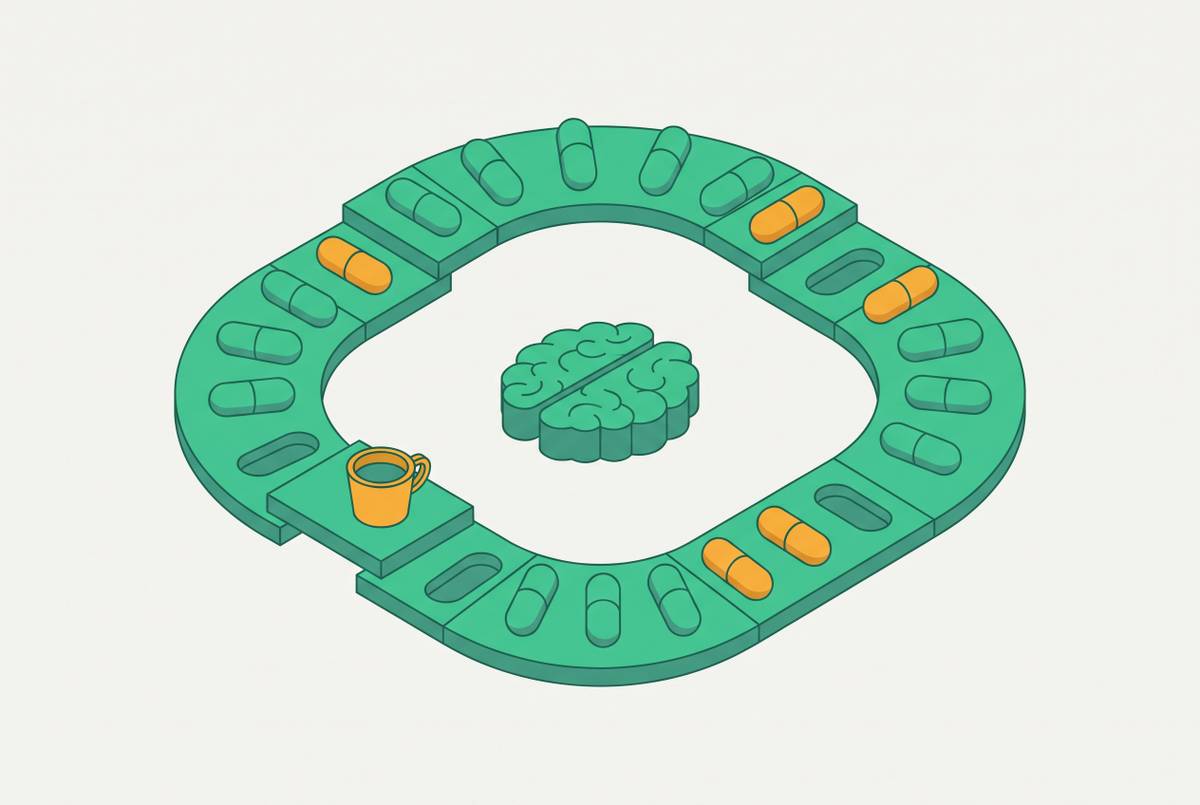
Most people assume that smarter problem solvers simply hold more information in their heads at once, the way a bigger cup holds more water. That assumption misrepresents what the research now shows. The idea traces back to early short-term memory research by Atkinson and Shiffrin in 1968, which treated memory as a passive buffer kept alive by rehearsal, something closer to a holding pen than an active system. Baddeley and Hitch moved the field past that picture in 1974, when their working memory model introduced a "central executive," a control system that manipulates information. Popular accounts never fully absorbed that shift, and they still describe working memory as if its whole job is holding more. If storage were the real story, the question remaining is what actually separates strong problem solvers from weak ones when the amount they can hold looks the same.
Attention control and its place inside working memory
Attention control is a domain-general ability to direct information processing toward a current goal, not the everyday sense of trying harder to pay attention, and it breaks into three distinct jobs. Goal maintenance keeps the objective of a problem active and accessible while other mental work is happening around it. Interference resolution suppresses competing or outdated information that would otherwise crowd the workspace. Disengagement releases representations once they stop being useful, so they quit draining resources that are needed elsewhere. The span tasks used in decades of working memory research measure these three functions together, tracking how well someone holds relevant information and blocks interference under dual-task demands, which is a large part of why working memory capacity correlates so strongly with fluid intelligence. Two people can post the same score on a span task and still solve problems at very different levels, because one holds a goal steady under pressure and the other loses it the moment a distraction appears.
How attention control determines performance on genuinely hard problems
Hard problems strain attention control because they force a person to hold a goal, track several moving parts at once, and resist the pull of easier or habitual responses, all at the same time. A February 2026 review by Yoonsang Lee and Randall Engle in the Journal of Intelligence pulled together evidence across six areas, perception, learning and problem solving, cognitive control and decision making, retrieval, multitasking, and clinical applications, and found that working memory effects line up with attention control demands in all of them. A study on visuomotor learning makes this concrete. When researchers expanded a mapping task to eight mappings, pushing past what working memory could support, performance flattened out at roughly half of full compensation, and more strategic effort from participants did not move that number. A parameter-free model built on working memory capacity predicted that exact plateau, confirming a real bandwidth limit: once task complexity crosses the ceiling, strategy stops helping. Cognitive load research reaches the same wall from a different direction. A study on task complexity and pre-training, led by Zeitlhofer and colleagues, found that once a problem's complexity exceeds a learner's working memory capacity, schema construction, the process of internalizing how a problem is structured, gets blocked. The same study found that pre-training cut the number of moves needed to solve a problem, which confirms that lowering the load at the start of a task frees up attention control for the parts that actually need it.
What happens when attention control is protected versus overwhelmed
Attention control is not a fixed trait sitting quietly in the background. It degrades under cognitive load, stress, and poor sleep, so the conditions around a problem matter almost as much as a person's underlying ability. Stress and working memory pull on each other in both directions: inhibition and working memory account for a meaningful share of the cortisol stress response, and that relationship holds up even after controlling for smoking, caffeine, and medication use. Cortisol's effect on thinking follows an inverted U. Moderate levels support prefrontal function, while levels that run too low or too high degrade it, and for most high performers the more common failure is the high end, chronic stress that never lets up. Sleep makes the problem worse in a loop that feeds itself: elevated evening cortisol delays sleep onset, fragments the sleep that does happen, and raises cortisol again the next day. Cortisol can also push back the onset of REM sleep, and chronic disruption of REM is tied to worse memory consolidation, harder concentration, and less stable mood, all of which lower attention control the following day. None of this gets fixed by trying harder to focus in the moment. Protecting attention control means managing the physiological conditions, sleep and cortisol chief among them, that make attention control available to use. The most powerful interventions for solving a hard problem may happen well before anyone sits down to solve it.
Offloading and structuring the environment to extend what AC can handle
Since working memory capacity is a hard limit, one dependable strategy is not to expand that limit but to shrink what has to pass through it, moving information out into the environment so attention control stays free for the parts of a problem that genuinely need active control. Research on offloading during math problem solving shows that strong problem solvers already do this: they shift information out of working memory and retrieve it later. When people with lower working memory capacity get external aids for this purpose, they close part of the gap with people who start with higher capacity. Pre-training works through a related channel. The 2026 study on task complexity found that pre-training cut the number of moves needed to reach a solution, which lowers the attention-control cost of the early stages of a problem and leaves more in reserve for the harder parts later on. Worked examples add a further piece to this picture, but only the interactive kind. A 2026 study on interactive worked examples, run with 155 undergraduates, found that formats requiring students to fix errors or fill in missing steps beat passive reading, with the size of the benefit shifting depending on how much prior knowledge a student already had. Writing out sub-goals on paper protects goal maintenance. Building familiarity with a problem's structure ahead of time lowers the attention-control cost once the real solving starts. Matching the difficulty of a task to current mental state, rather than attempting the hardest problem on the worst day, is a deliberate use of limited resources, not a retreat from them. High performers with strong working memory capacity tend to do these things automatically. Making the same habits explicit puts them within reach of anyone.
How specific ingredients can support the physiological conditions attention control depends on
No single ingredient adds extra slots to working memory. What a handful of well-studied compounds can do is lower cortisol, support the brain's capacity for new connections, and sustain alertness without the spike-and-crash pattern that wears attention control down over a long day. Bacopa monnieri is the clearest case, because it acts on two sides of the stress-memory link at once. The plant contains alkaloids, saponins, and cucurbitacins with documented biological activity, and it has a long history of use in Ayurveda for memory support. A clinical study found reductions in serum cortisol at both day 56 and day 84 of supplementation, alongside an increase in BDNF, a key marker of the brain's capacity to form new connections, by day 84. That combination, lower cortisol and higher BDNF, lines up directly with the stress-memory pathway described above. Bacopa's drawback is absorption: conventional extracts suffer from poor oral uptake and heavy first-pass metabolism in the liver, which has pushed researchers toward newer delivery forms such as nanoparticles, phytosomes, and SNEDDS. Ashwagandha, the adaptogen Withania somnifera, works on the body's stress response more broadly and has documented benefits for calm, focus, and short-term memory. Clinical experience combining ashwagandha at 600 mg of dry extract with Bacopa at 50 mg of dry extract has shown the pairing can ease stress and anxiety, which argues for combining ingredients. Rhodiola rosea supports energy production at the cellular level by raising ATP and creatine phosphate in mitochondria, and a double-blind crossover trial in humans found it improved associative thinking, short-term memory, concentration, calculation, and the speed of audio-visual perception, all functions that depend on attention control. A separate clinical trial found a benefit to exercise endurance from a single dose of this adaptogen, suggesting it can act quickly. The combination of L-theanine and caffeine, found together in matcha, has the most solid evidence behind it for jitter-free alertness. Caffeine blocks adenosine receptors, which raises dopamine and norepinephrine and keeps fatigue at bay, while L-theanine activates GABA receptors and increases alpha brain wave activity, which removes jitteriness without causing drowsiness. Together the two produce a steadier alertness than either one manages alone. A 2025 randomized trial of sleep-deprived adults found that 200 mg of L-theanine combined with 160 mg of caffeine improved measures of selective attention, both behavioral and neurophysiological, in people who were acutely short on sleep. Most of the studies behind L-theanine report small-to-moderate effects, and some of the broader health claims made for it go beyond what the evidence supports, but the attention-specific findings are the strongest part of the record. Lion's Mane, or Hericium erinaceus, shows a more complicated picture. A controlled trial found improvement in working memory, complex attention, and reaction time just two hours after ingestion, which runs against the common assumption that mushroom-based nootropics need weeks to show anything. A 2025 review from the Alzheimer's Drug Discovery Foundation pointed to a 16-week trial in people with mild cognitive impairment that showed gains on a cognitive test during treatment, but those gains faded once treatment stopped, suggesting the benefit may not hold up on its own. A 150-participant trial, registered as NCT06870136, measuring a composite of attention, short-term memory, and working memory as primary outcomes, along with mood, motivation, sleep quality, daytime alertness, and stress as secondary outcomes, was expected to finish in late 2025. Comparing studies on Lion's Mane is also harder than it should be, since proprietary extracts are rarely dosed the same way from one trial to the next.
Why absorption technology determines whether an ingredient stack works
An ingredient backed by solid clinical evidence only works as well as the fraction of it that actually reaches the bloodstream, and for several of the compounds discussed above, that fraction is small by default. Bacopa is the clearest illustration: conventional extracts are poorly absorbed and heavily broken down by first-pass metabolism, so a dose that looks adequate on a label can deliver far less active compound than the dose used in the trials that established its benefits. Newer delivery systems, including self-nanoemulsifying drug delivery systems, lipid-based nanoparticles, and phytosomes, are built specifically to get around these absorption barriers, and formulation science in this area was actively advancing through 2025 and 2026. Two products can list identical ingredients at identical doses and still produce different real-world results if one delivers more of the active compound than the other. The right question to ask about any supplement is not only what is in it, but how much of what's in it actually gets absorbed.
What the attention-control model means for how high performers should train their problem-solving edge
Moving from a storage model of working memory to an attention-control model changes what "getting better at working memory" should actually involve, and it rules out a fair amount of conventional advice built on the storage assumption, brain-training apps and raw memorization drills among them. Three layers support attention control in practice. Sleep quality and cortisol regulation cause everything else to depend on them: nothing built on top holds up if that physiological floor is unstable. Behavioral strategies, offloading information, pre-training before a hard problem, and matching problem difficulty to current mental state, extend what attention control can handle without adding to its load. Adaptogens and nootropic compounds round out a third layer, lowering cortisol, supporting the brain's capacity for new connections, and sustaining alert focus without the crash that wears attention control down over time. The strongest challenge to this whole framework deserves a direct answer: evidence that any single nootropic ingredient produces durable gains in working memory or attention control on its own remains thin, and any case built around supplementation needs to say so. The claim here was never that one ingredient substitutes for sleep or for training attention directly. The real edge in solving hard problems was never a bigger tank, but a cleaner, steadier signal.
Sources
- Received: 27 September 2025 Revised: 15 January 2026 Accepted: 21 January 2026
- Beyond Working Memory Capacity: Attention Control as the Underlying Mechanism of Cognitive Abilities
- Exploring the Design and Impact of Interactive Worked Examples for Learners with Varying Prior Knowledge
- Effects of task complexity and pre-training on problem solving: A cognitive load perspective
- Working memory capacity constrains learning of complex ...
- (PDF) Understanding working memory as a facilitator of math problem‐solving: Offloading as a potential strategy
- Lion's Mane Mushroom