Stimulant Cycling Strategies to Prevent Cognitive Dependency
Structured breaks restore stimulant effectiveness better than raising doses.
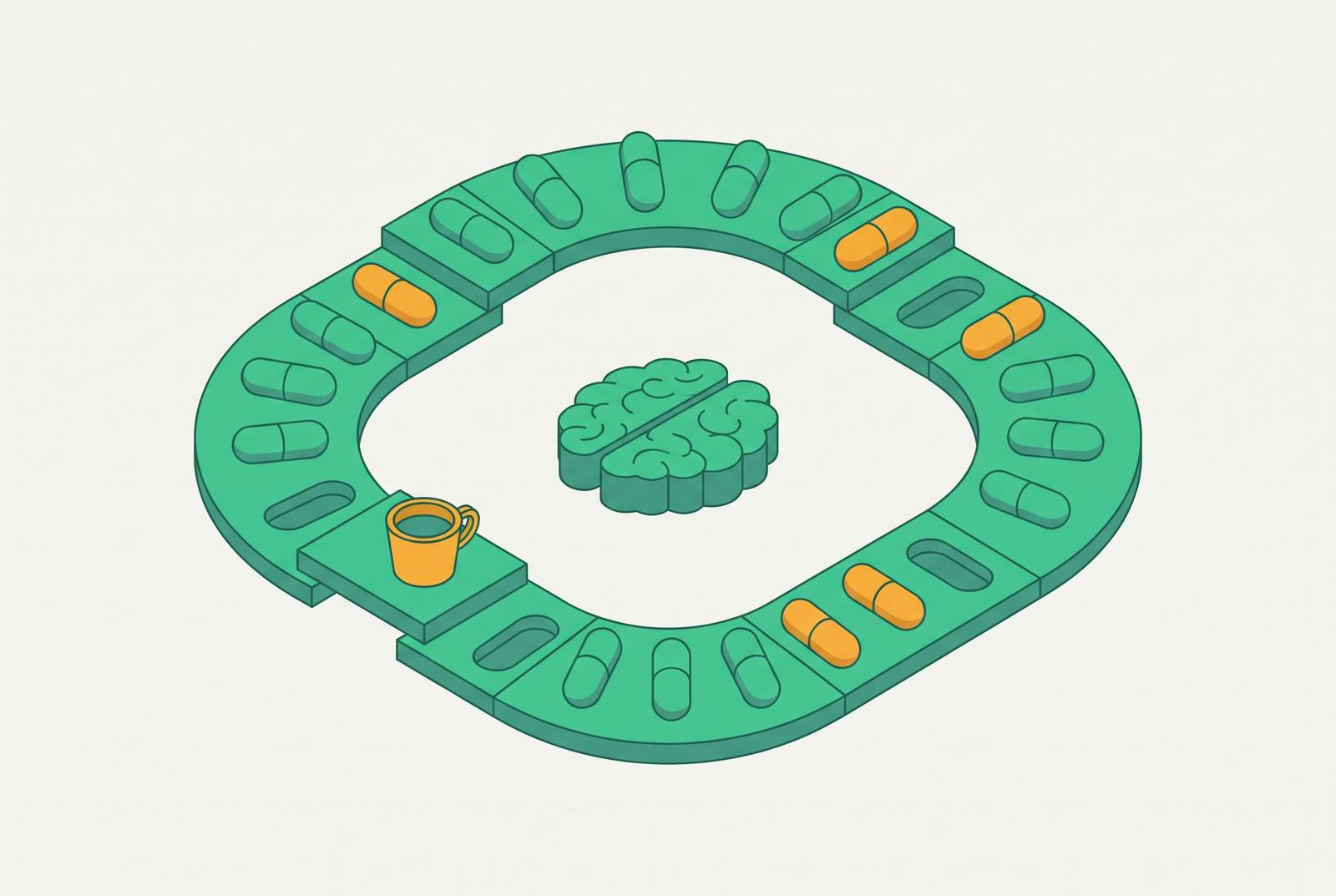
The second coffee that barely works the way the first one used to is the predictable output of a nervous system defending its own equilibrium against a chemical signal it keeps receiving on a fixed schedule. Demand for cognitive enhancement, whether through coffee, energy drinks, or prescription stimulants like Adderall and Ritalin, keeps rising across academic and professional settings, and most of that demand pushes in the direction biology argues against: more frequent use, higher doses, earlier doses, later doses. If you use a stimulant daily, two separate adaptation processes run at the same time inside your brain. One involves the adenosine receptors that caffeine blocks to produce alertness; the brain responds to constant blockade by building more of those receptors. The other involves dopamine signaling, the pathway central to how prescription stimulants work, and it shifts in its own compensatory direction when use continues. Both tracks point to the same outcome: the dose that once worked stops working, and the instinct to raise it only restarts the cycle.
What the brain is physically doing when tolerance builds
Tolerance is a specific, countable change in how many receptors exist and how actively certain genes get expressed, carried out by the brain in direct response to a persistent chemical signal. Caffeine's entire mechanism depends on occupying adenosine receptors so that adenosine, the molecule that builds sleep pressure over the course of a day, can't dock and do its job. If you keep that occupation going day after day, the brain starts manufacturing additional adenosine receptors, like adding more locks to a door because someone keeps using the same key. More locks means more places for adenosine to bind even while caffeine is circulating, and the blocking effect that used to produce a clear, sharp lift starts getting diluted. Research on caffeine and physical performance puts a number on how fast this happens: peak cycling power rose by about 4.0% in the early days of daily use, and that ergogenic benefit measurably shrank after roughly two weeks of continued use. Prescription stimulants run on a parallel but separate mechanism, tied to dopamine rather than adenosine, and models of long-term stimulant tolerance in ADHD pharmacology describe dopamine system adaptations that build up with sustained exposure and require their own management strategy. The two processes don't cancel each other out. They stack: tolerance is a feature of how the brain handles any substance that keeps nudging the same signaling pathway, over and over, without pause, regardless of whether that substance is caffeine or a prescription stimulant. Breaks matter here because they partially reverse these adaptations: research on stimulant breaks describes the effect as resensitizing neurons and restoring the drug's original effectiveness. The receptor count and the gene expression changes aren't permanent fixtures, just the brain's current best guess at maintaining balance under constant exposure.
The secondary damage loop: how unmanaged tolerance hurts sleep and cortisol, not just focus
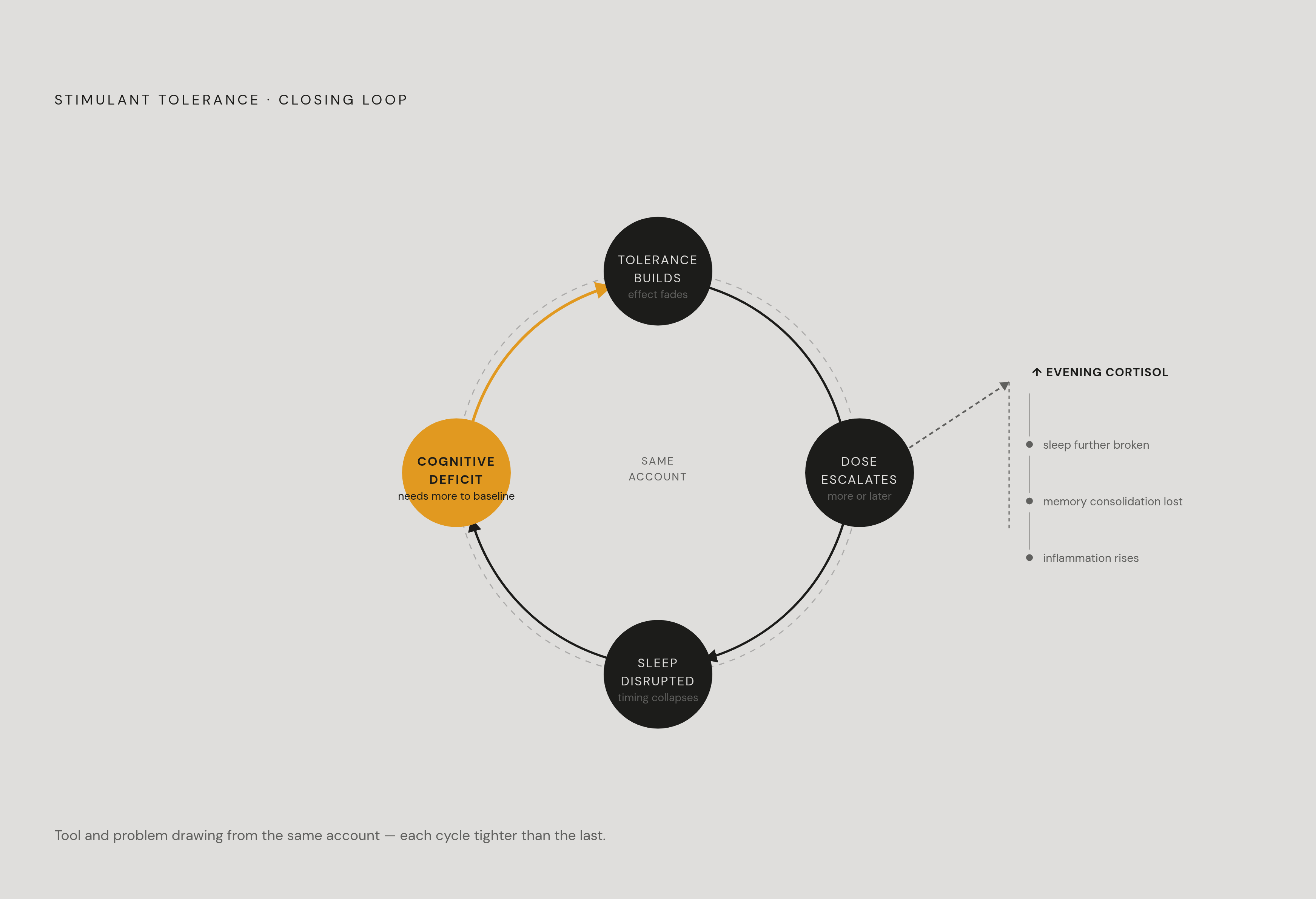
The costs of unmanaged tolerance don't stop at needing a stronger dose to hit the same mental state. A degrading loop sets in: the stimulant stops producing its original effect, the user compensates by taking more or taking it later in the day, that timing disrupts sleep, and the cognitive deficit left behind by a worse night's sleep requires still more stimulant the next morning just to get back to baseline. Habitual caffeine use disrupts sleep even at doses well below anything resembling a clinical overdose, and this isn't incidental to how caffeine works. Pairing caffeine with L-theanine has been shown to suppress the nighttime awakenings that caffeine use produces on its own, which points to the sleep disruption as a direct pharmacological effect of the stimulant rather than a side issue separate from its main action. Lost sleep then feeds directly back into the cognitive capacity the stimulant was being used to protect in the first place, so the tool and the problem start drawing from the same account. Cortisol runs a similar loop. Lifestyles built around heavy stimulant use tend to push evening cortisol higher than it should be, and elevated cortisol in turn disrupts sleep further, interferes with memory consolidation, and drives inflammation throughout the body. If you reach for coffee to compensate for a bad night's sleep that coffee itself helped cause, you are running a closed loop that gets tighter with each pass. Research on heavier, longer-term stimulant use documents neurocognitive deficits that fade over time during abstinence, and that recovery pattern is the clearest evidence available that structured time off a stimulant restores function.
Why the standard response (just take more, or push through) fails on its own terms
Raising the dose is the instinctive move when a stimulant stops working as well as it used to, and it guarantees the problem returns sooner. Each increase triggers a fresh round of the same receptor upregulation that caused the plateau in the first place, so the next increase arrives on a shorter timeline than the last one did. Clinical guidance on stimulant tolerance management names dose increases and medication breaks as the two primary tools available, and it says dose increases alone don't solve the underlying problem and need to be paired with other approaches. The subgroup that kept raising doses consistently over a decade in a long-term stimulant treatment study reached an average cumulative dose of 117,102 mg, and that group ended up with no better symptom control than people who used their medication inconsistently. Sustained escalation produced sustained tolerance, not sustained benefit. A universal "take more" approach also runs into a genetic wall that most people never account for. Caffeine sensitivity ties to a gene governing adenosine receptor response, and that gene varies enough between people that a dose producing mild stimulation in one person can impair fine motor control and decision-making in another; liver enzymes also clear caffeine from the body at different speeds in different people, which shifts both the effective dose and the timing of withdrawal symptoms. A protocol built around escalation treats everyone as though they metabolize and respond to stimulants identically, and they don't. None of this is to dismiss how hard it feels to function without the usual dose. Functioning without the usual dose is genuinely hard, but that difficulty is an argument for structuring a break carefully, not an argument for skipping it. Structured reduction is the only approach that addresses the actual mechanism: resensitizing adenosine and dopamine signaling requires lowering the pharmacological signal, not increasing it.
Taking a Break from Stimulants
A cycling protocol built on evidence tells you more than just to rest more. It's timed to match the specific adaptation curve of whatever stimulant is in use, so the timing of the break carries as much weight as the decision to take one. On the caffeine side, the performance research showing ergogenic benefits fading after roughly two weeks of continuous daily use gives a practical ceiling: somewhere around that point, a break starts adding more value than another day of the same dose. Weekend breaks and caffeine-reduced days are the simplest structures to apply, but the evidence here carries a real caveat. Tolerance to caffeine's effect on physical performance is better documented than tolerance to its cognitive effects, and the alerting, focus-sharpening side of caffeine may only partially habituate rather than fading the way physical performance gains do. On the prescription stimulant side, the evidence base runs through clinical channels. The American Society of Clinical Psychopharmacology's 2026 task force consensus statement on stimulant deprescribing in adult ADHD recognizes structured medication breaks as a legitimate clinical tool when tolerance, side effects, or a need for diagnostic reassessment calls for one, and the statement reached agreement on 91 percent of its Delphi statements, a level of consensus that reflects a mainstream clinical position. That consensus addresses deprescribing specifically, not cycling as a performance strategy, but the reasoning behind it, restoring receptor sensitivity and periodically re-evaluating whether a given dose is still necessary, maps onto the same logic that supports cycling more broadly. The honest complication is that cognitive tolerance to caffeine looks more partial than physical tolerance does: the same research found cognitive performance improvements held up more consistently across habitual and non-habitual users than physical performance gains did. That raises a real question about whether the discomfort of withdrawal is worth the resensitization gain for every user, and the answer depends on the individual. Genetic and behavioral variability means some people stand to gain far more from a structured break than others, which argues for a calibrated approach.
Compounds to Use During a Stimulant-Reduced Period
Reducing stimulant intake creates a gap, not a vacuum to simply tolerate. The goal during that window is to support the adenosine and dopamine systems directly while they resensitize, which calls for a specific set of compounds aimed at specific parts of the gap. Matcha gives you a practical step-down path because it delivers caffeine alongside L-theanine in a single source, and the combination has direct research behind it. A 2025 double-blind crossover study from the University of Peradeniya found that 200 mg of L-theanine combined with 160 mg of caffeine improved selective attention in young adults who were acutely sleep-deprived, a result that lands squarely at the overlap between cycling and the sleep debt that heavy stimulant use tends to produce. L-theanine's specific contribution is suppressing the nighttime awakenings that caffeine causes on its own, while also smoothing out the jittery edge of a caffeine dose into a steadier attention profile. It addresses the quality of focus and the sleep disruption at the same time. Fatigue tends to increase once stimulant input drops, and Rhodiola Rosea is suited to that specific gap. Its active compounds, rosavins and salidroside, inhibit monoamine oxidase, lower cortisol output during acute stress, and support how mitochondria produce energy, which together target the drop in motivation and mental energy that shows up when a stimulant is pulled back. Doses between 200 and 400 mg per day are associated with reduced mental fatigue and sharper working memory under pressure and under sleep deprivation, and clinical guidance on supplement use points to Rhodiola specifically for mental fatigue, low motivation, or cognitive fog under pressure, noting that it acts faster than alternatives like Bacopa or Lion's Mane, which makes it a reasonable fit for a bridging period. Heavy stimulant use tends to push cortisol higher, so a reduction period needs something that addresses that directly. Ashwagandha reduces overactivity in the HPA axis and improves how GABA receptors function, which makes it a complement to cycling rather than a redundant addition, since it targets the cortisol elevation that stimulant use tends to compound rather than the dopamine or adenosine systems themselves. The same clinical guidance recommends ashwagandha specifically when anxiety, poor sleep, or elevated cortisol symptoms are the dominant problem, which separates its role clearly from Rhodiola's faster-acting, fatigue-focused function. None of these compounds make the break optional or painless. They support the systems that do the actual work of resensitizing while that work happens.
Compounds That Work Best with Continuous Use
Cycling logic applies to stimulants because stimulants work by repeatedly triggering a signal the brain then compensates against, but not every compound in a cognitive performance protocol operates that way. Rhodiola and ashwagandha both function as adaptogens, so their value comes from sustained presence in the system, not from a sharp, repeatable spike the brain needs a break from. Ashwagandha's effect on HPA axis regulation and GABA receptor function builds through consistent use rather than producing an acute jolt that fades with repetition. That is why it belongs in the daily baseline of a protocol rather than in the on-again, off-again rotation reserved for stimulants. The same logic holds for Rhodiola when it's used for general stress resilience rather than as an acute fatigue bridge during a specific reduction period: a compound that lowers cortisol reactivity and supports mitochondrial function over time doesn't generate the receptor-level tolerance that caffeine or dopaminergic stimulants do, so withdrawing it periodically serves no pharmacological purpose. Getting this distinction right matters, because if a protocol cycles everything, stimulant and adaptogen alike, on the same schedule, it misunderstands what each compound is doing. Stimulants need interruption because continuous exposure is the cause of the problem they eventually create. Adaptogens need consistency because their benefit depends on steady presence, not on being novel to a system that has adapted around them. Building a cycling protocol means knowing which compounds belong on the calendar and which ones belong in the daily baseline underneath it, and that distinction is what keeps well-intentioned protocols from undermining the very systems they were designed to protect.
Sources
- Tolerance to Stimulant Medications in the Treatment of Children With ADHD
- The American Society of Clinical Psychopharmacology task force consensus statement on the deprescribing of stimulant medications in adults with ADHD✰ - ScienceDirect
- The Dopamine Dilemma—Part II: Could Stimulants Cause Tolerance, Dependence, and Paradoxical Decompensation? - PMC
- Time course of tolerance to the performance benefits of caffeine - PMC
- Tolerance to Stimulant Medication for Attention Deficit Hyperactivity Disorder: Literature Review and Case Report - PMC
- Neurobiology of chronic caffeine use and withdrawal: Mechanisms, effects and implications - ScienceDirect
- Habitual caffeine intake, genetics and cognitive performance - Angeliki Kapellou, Leta Pilic, Yiannis Mavrommatis, 2025