Nootropic Beverages That Use Clinically Dosed Ingredient Stacks
Drinks claiming cognitive benefits need transparent doses matched to actual human trials.

A ready-to-drink nootropic shot can be an alternative to capsule supplements, but convenience is not evidence that it works. The useful comparison is whether its ingredient stack matches human trials in dose, extract form, delivery and daily use. Clinically dosed nootropic beverages make those details visible, rather than asking buyers to trust familiar ingredient names.
Why most nootropic drinks fail before you open the can
You have read the label, the ingredients look serious, and then you feel nothing. It may mean the drink contains far less than the amounts used in the trials that gave those ingredients their reputations. A label can accurately say an ingredient is present without establishing that enough is present to produce the advertised effect.
Proprietary blends make that gap hard to spot. Proprietary blends name the ingredients but hide how much of each they contain, so the buyer cannot compare the formula with doses used in published trials. The useful standard is not how many nootropics fit on the can, but whether the formula supports cognition beyond raw stimulation at amounts backed by human evidence.
What "clinically dosed" actually means and why the phrase is usually misused
“Clinically dosed” means a compound is present at the dose, in the form and through the delivery route used in randomized controlled human trials that demonstrated a measurable cognitive effect. Those conditions belong together. Matching a milligram figure is not enough if the study used a standardized extract and the drink uses generic root powder. Nor does a plausible explanation of how an ingredient might affect the brain establish that people perform better after taking it.
Double-blind, placebo-controlled trials in healthy adults give different support for a claim about focus at work than tests in animals or studies in people who already have cognitive impairment. A mechanism can justify further research without justifying a promise on a label. “Clinically studied ingredient” and “clinically dosed product” are different claims.
For the buyer, this becomes a four-part check. Are individual doses fully disclosed, and do they match the amounts used in trials? Is the specific extract or standardized form named, and is third-party testing documentation available on request? These questions establish whether the claim can be assessed at all. They do not prove that every person will get the same result, or that the finished stack itself has been tested.
The caffeine and L-theanine pairing as the baseline case for what clinical dosing looks like in practice
Caffeine and L-theanine provide the clearest reference case because the combination is extensively studied and its dose ranges are well defined. The ranges are 40–200 mg for caffeine and 100–200 mg for L-theanine. Caffeine blocks adenosine receptors, reducing fatigue signaling and improving vigilance and reaction time. People who took the pairing have been faster and more accurate during attention-switching tasks and less distracted during memory tasks.
The label test is straightforward in this case. A drink that supplies caffeine but includes L-theanine well below 100 mg does not match the stated range for the combination. It may still feel stimulating, but that sensation does not establish that it reproduces the pairing’s trial effects. This is how an ingredient earns its place in marketing without receiving enough space in the formula.
Matcha adds a useful distinction between ingredient choice and dose proof. It naturally delivers both caffeine and L-theanine, so ceremonial-grade matcha can serve a purpose beyond flavor. But having it in the finished drink does not tell the buyer how much of either compound the drink contains. The same dose comparison still applies.
How theacrine and methylliberine extend the clinical dosing argument to tolerance and duration
A drink meant to help people perform every day needs to be tested differently from one used for a boost now and then. Testing needs to assess whether it helps today and how its effects hold up with repeated use. Theacrine and methylliberine extend the dosing argument to tolerance and sustained performance. Their trial ranges are 50–125 mg for theacrine and 50–100 mg for methylliberine.
The Journal of the International Society of Sports Nutrition published a study in which caffeine, methylliberine and theacrine together produced similar vigilance benefits to double the dose of caffeine alone. The combination caused no unfavorable changes in diastolic blood pressure, although systolic blood pressure rose in both groups. That qualification belongs with the finding. The result supports examining the combination rather than simply adding more caffeine, but it does not by itself establish that any blend containing these names is tolerance-proof.
Bucked Up Energy Drink provides a concrete label example. Bucked Up’s ingredient breakdown lists TeaCrine, Dynamine and AlphaSize Alpha-GPC with a disclosed 300 mg caffeine dose. That much stimulant may not suit people who are caffeine-sensitive. Without individual amounts for theacrine and methylliberine in the information provided, their inclusion cannot establish that the drink matches the trial ranges.
Why Bacopa Monnieri requires chronic dosing and what that means for drink formats specifically
Bacopa Monnieri exposes a weakness in judging every nootropic drink by its first-hour effect. Its memory benefits build with consistent use. Several randomized controlled trials found that episodic memory, working memory, attention and executive function improved, mainly when people took 300 mg/day for 8 to 12 weeks.
For Bacopa, the calendar is part of the dose. A drink with 300 mg may have the same daily amount on paper, but drinking it now and then does not match how it was used in the trials. This creates a particular problem for drinks, which can invite buyers to expect an immediate result. A correctly sized serving and a clinically relevant course of use are not the same thing.
The distinction also changes how a mixed stack should be understood. Caffeine and L-theanine can have effects on the day they are taken, while Bacopa takes time to work. Combining them can address different timelines, but the immediate sensation cannot be treated as proof that Bacopa is working. Likewise, feeling no change right away does not show whether it helps memory over time.
Lion's Mane — the most marketed ingredient in the category and the most misrepresented on dose
Lion’s Mane has a promising mechanism. Its bioactive compounds, particularly hericenones and erinacines, can promote nerve growth factor synthesis and potentially support neuroplasticity. That gives the ingredient a legitimate basis for research. It does not settle which extract, dose, duration or population will show a measurable benefit.
Mori et al. (2009) ran a randomized, double-blind, placebo-controlled trial in Japanese adults who were 50- to 80-year-old and had mild cognitive impairment. The trial found measurable cognitive improvements after 16 weeks of H. erinaceus extract. Those participants already had cognitive concerns. Their results cannot simply be transferred to healthy working-age adults seeking sharper focus during the afternoon.
Frontiers in Nutrition published an acute randomized, placebo-controlled, double-blind crossover study of a drink containing H. erinaceus fruiting body extract in healthy adults aged 18–35. The study found no overall significant effect on cognitive function or mood, although psychomotor performance improved on one task. The researchers described the results as “inconclusive”. That is narrower than either claiming the ingredient works immediately or dismissing it outright.
The trials give a range of 750 mg–3 g/day of fruiting body extract. A can supplying a few hundred milligrams falls below that range, regardless of how prominently the mushroom appears on its packaging. Even a dose within the range must be judged against the extract and population studied. Claims need to reflect the high doses and daily use, as well as how long effects took to appear in studies that mainly involved older people.
Ashwagandha and Rhodiola — how the cortisol-cognition connection makes dosing form-specific
Ashwagandha and Rhodiola approach cognition through stress. Sustained cortisol elevation can impair the brain processes involved in memory and executive function while disrupting sleep. A product therefore needs to match the evidence on stress, whether or not it gives people a noticeable buzz.
A 60-day double-blind, placebo-controlled trial gave chronically stressed adults 300 mg of KSM-66 ashwagandha twice daily, totaling 600 mg/day. The trial found a meaningful reduction in serum cortisol. A single 300 mg serving does not reproduce the full daily regimen, and generic ashwagandha root powder is not interchangeable with KSM-66.
Olsson, von Schéele & Panossian (2009) used the standardized Rhodiola extract SHR-5 at 576 mg/day in a randomized trial. The trial reported improvements in fatigue and attention and a modified cortisol response to awakening in people with stress-related fatigue. This is evidence tied to a particular form and population. A label that says only “Rhodiola” leaves out a detail needed to connect the product to that evidence.
Can a ready-to-drink nootropic shot replace capsules when absorption counts?
A liquid shot does not become clinically equivalent to a capsule merely by matching its milligrams. The compound must stay stable in the delivery system, and the body must be able to absorb it. The bloodstream is the destination. A change in format can therefore change how much of the listed dose becomes available to the body.
Liquid formats can offer higher bioavailability for water-soluble compounds, but the advantage depends on the ingredient and formulation. Fat-soluble vitamins A, D, E and K need a fat matrix so the body can absorb them. A liquid without a lipid carrier may underperform a softgel for those ingredients. “Liquid” Liquid” is a format description.
SOLIS by Sunstone is formulated using nano-emulsification to address stability and absorption in a high-dose liquid nootropic format. Emulsification and encapsulation can help protect sensitive compounds and improve their delivery. Their presence still does not, on its own, establish that the finished drink reproduces a clinical trial’s results.
For buyers tired of capsules, the useful comparison is ingredient by ingredient. The dose and extract name show what went into the shot, while details on delivery help explain whether that formula works in a liquid. Absorption technology can help buyers choose between products that are otherwise alike when there is evidence that the technology works. It cannot rescue an undisclosed dose or replace evidence of a cognitive effect.
How to read a nootropic drink label using the clinical dosing framework
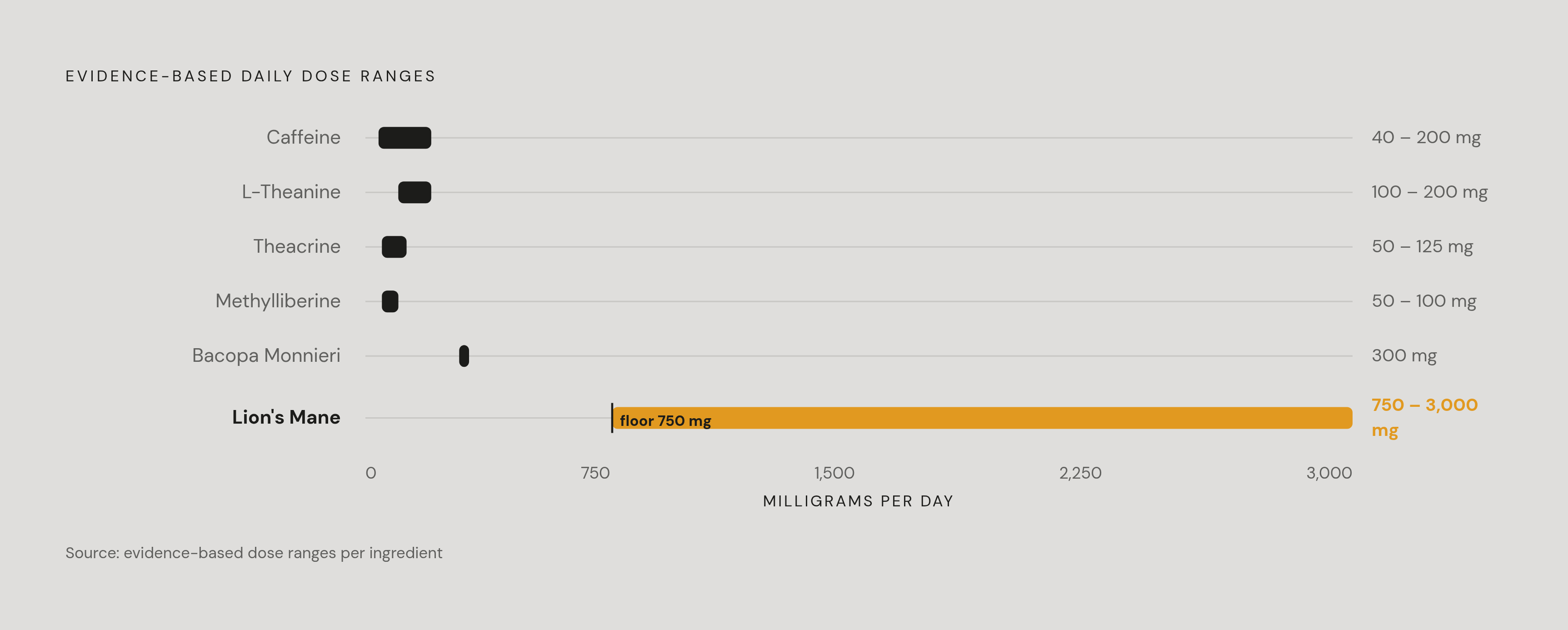
Reject a proprietary blend that hides how much of each ingredient it contains, because those amounts are needed to compare it with the trials. Then compare each disclosed amount with the relevant trial range, rather than treating the combined weight of the stack as evidence.
For the core pairing, look for caffeine at 40–200 mg and L-theanine at 100–200 mg. Theacrine’s range is 50–125 mg, while methylliberine’s is 50–100 mg. For the slower-building ingredients, the reference points are Bacopa at 300 mg/day and Lion’s Mane fruiting body extract at 750 mg–3 g/day. Keep the daily schedule attached to those figures.
Next, check that the extract name matches. The ashwagandha trial discussed here used KSM-66 at 300 mg twice daily, while the Rhodiola trial used SHR-5 at 576 mg/day. Names such as AlphaSize and Cognizin® also tell the buyer which form of an ingredient was used. An unnamed extract prevents a like-for-like comparison, even when the milligram figure looks convincing.
Finally, request third-party testing documentation, including certificates of analysis covering contaminants such as heavy metals, PFAS and mycotoxins. Testing supports confidence in label accuracy. Base expectations on which ingredients can work the same day and which need to be taken over weeks. A promise of immediate transformation from Bacopa, or a prominent Lion’s Mane claim backed by a token dose, is a reason to leave the drink on the shelf.