Adaptogens vs Stimulants for Sustained Daily Energy
Caffeine masks tiredness while adaptogens work on stress, so pairing them wins.
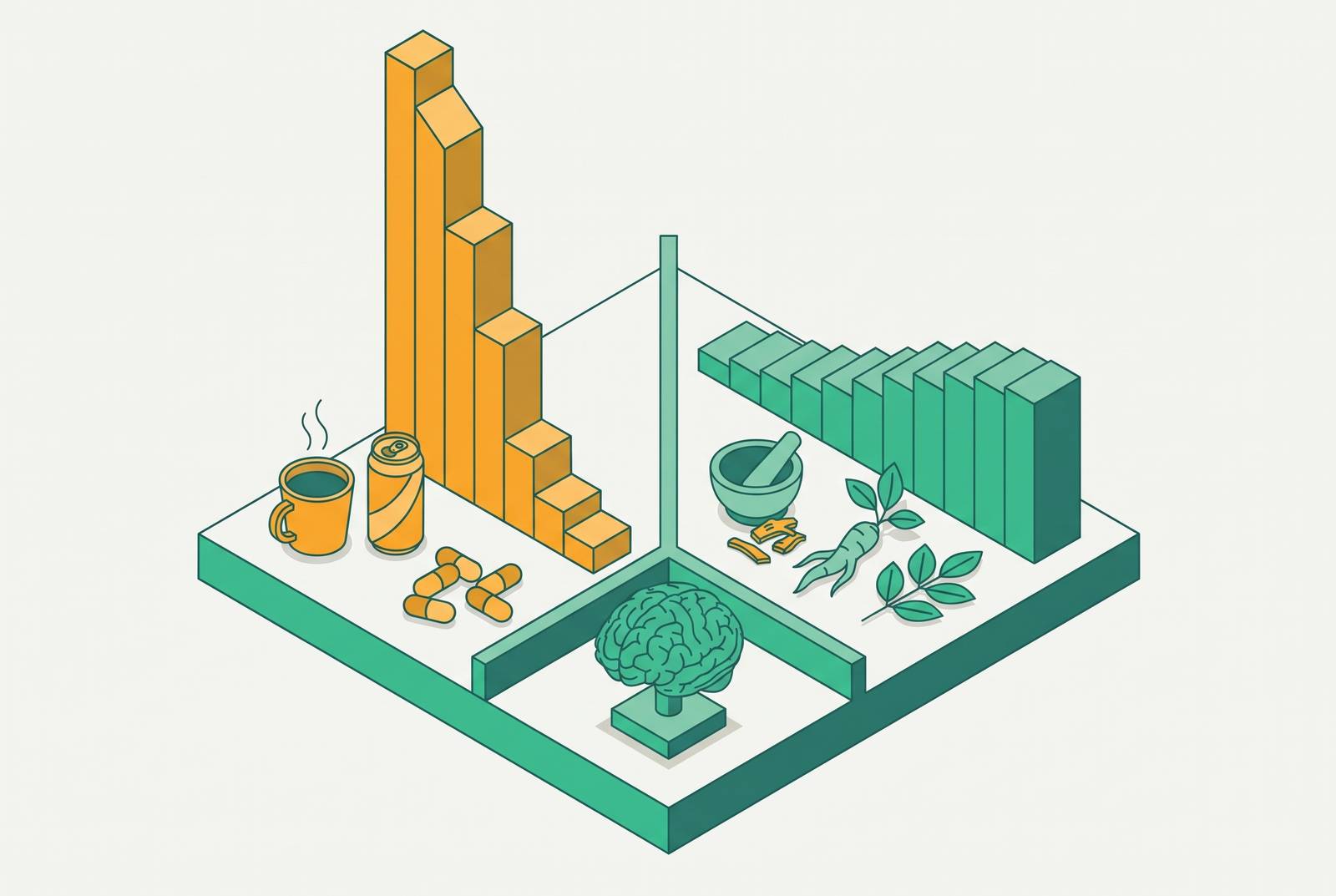
Stimulants and adaptogens address different parts of daily energy. Caffeine blocks the signal that says you are tired, while adaptogens can help regulate the stress response that makes it harder to keep working. That difference makes combining them a more useful strategy than treating them as rivals, provided the ingredients, timing and evidence fit the goal. Neither approach can make up for poor sleep.
Why stimulants and adaptogens produce energy through completely different mechanisms
Caffeine occupies adenosine receptors, preventing the brain from fully registering the sleepiness that builds during waking hours. It does not create energy or remove the need for rest.
Adenosine continues to accumulate while caffeine blocks its receptors. As caffeine clears, the sleep pressure that has built up becomes harder to ignore and helps bring on the familiar crash. Caffeine’s half-life ranges from roughly 3–7 hours in healthy adults, so the blockade does not disappear at the same pace for everyone.
Adaptogens work through a different set of controls. Their proposed mechanisms include regulation of the HPA axis, the body’s stress-response system. One pathway involves the stress-sensor protein Hsp70, which interacts with glucocorticoid receptors and JNK signaling. Those interactions affect circulating cortisol, nitric oxide and how quickly the stress system gets back to baseline.
What stimulants actually do to the body's stress chemistry over a full day
Caffeine also triggers a cortisol response, adding a hormonal effect to its blockade of sleepiness. But regular coffee drinkers need an important qualification. Their cortisol response is substantially blunted by habitual use, and the dramatic responses often discussed come largely from people unaccustomed to caffeine. Treating every morning coffee as a major hormonal shock overstates the case. Chronic stress is the more durable concern.
Timing adds another layer to that response. Cortisol naturally peaks in the first hour after waking, helping mobilize energy, prime immune function and prepare the body for physical and mental demands. Caffeine taken just after waking adds to the stimulation during that natural rise. It may also hide the tiredness that is still there by making someone feel more alert. Feeling awake and having cleared morning sleepiness are not the same thing.
For people adjusting their caffeine routine, the practical option is to wait roughly 90–120 minutes before the first dose. The aim is to allow morning sleepiness to subside before caffeine takes over. Fatigue can persist with this timing strategy. Repeated stimulant use can also reduce sensitivity, prompting larger doses for a smaller return. That escalation can increase the stress-hormone burden without addressing why the person needs more stimulation.
How chronically elevated stress hormones degrade cognitive performance
Chronically elevated cortisol can impair working memory, attention and processing speed. These are the abilities needed to hold a thought, stay with a task and make sense of incoming information. The cost is not just feeling stressed. When attention falls apart after a hard morning, or afternoon fog makes everyday work feel slow, the way the body regulates stress can be part of the problem. Those experiences alone, however, do not establish that cortisol is chronically elevated.
Under chronic stress, HPA-axis dysregulation redirects metabolic resources from efficient cognitive performance toward survival pathways. The system is responding to pressure, but that response works against sustained concentration. More stimulation can make someone feel more awake while leaving the underlying stress response untouched. This is the gap that makes adaptogens relevant to people who already use caffeine.
General fatigue is among the most common complaints in primary care. Its frequency does not prove that caffeine has failed or that everyone needs an adaptogen. An intervention should be judged by how well it eases the source of strain as well as how well it makes tiredness easier to ignore.
What the clinical evidence actually shows for each major adaptogen
Rhodiola has one of the stronger profiles for mental performance under fatigue. Olsson et al.’s 2009 randomized, double-blind trial found that a course of the Rhodiola extract SHR-5 reduced burnout, improved attention and lowered the cortisol awakening response compared with placebo. That last result was a measurable HPA-axis marker. The findings fit the “wired but depleted” state.
Ashwagandha is better judged on stress and sleep. Its withanolides modulate the HPA axis and support inhibitory neurotransmitter signaling. A 2025 randomized trial published in Advances in Therapy found that a novel formulation improved perceived stress, sleep quality and mood versus placebo. In that trial, 200 mg outperformed 400 mg. More was not better, and that formulation-specific result should not become a universal dose rule. Taking it in the evening fits its role in sleep, while taking it in the morning or splitting it between morning and evening fits its role in managing daytime stress.
Panax ginseng has a different performance profile again. Its ginsenosides seem to work in part by helping regulate glucose when mental work is hard. It is better suited to effort that has to last than to a brief test of sharpness. Like Rhodiola, it is one of the faster-acting options when mental work goes on for a long time, while ingredients chosen mainly to improve sleep or memory take effect more slowly.
Lion’s Mane, or Hericium erinaceus, is aimed at underlying brain support. It is thought to work in part by helping the body make nerve growth factor. Daoust et al.’s 2026 study found that adults aged 40–75 who took a full-spectrum preparation each day for eight weeks had better visual attention, working memory, sleep quality and mood, and felt more rested in the morning, than those who took placebo. Product differences remain a substantial limitation. Extracts, doses, fruiting body versus mycelium products and study durations vary, so findings cannot simply be transferred between preparations. Evidence that cognitive scores moved back toward baseline within four weeks of stopping also suggests that benefits may depend on continued use.
Bacopa monnieri likewise belongs on a longer timeline. It is thought to help increase dendritic branching, the physical connections between neurons, and support cerebral blood flow, though the evidence for more branching comes from studies of animals and cells. Eraiah et al.’s 2025 randomized, double-blind, placebo-controlled study tested B-Lit Bacopa extract and reported improvements in memory, concentration, reasoning and sleep quality. Benefits generally emerge after eight to 12 weeks of consistent daily use. Absorption depends on formulation, with phytosome or lipid-based delivery outperforming simple dry extracts, and taking Bacopa with a fat source can help. Rhodiola and ginseng therefore fit nearer-term performance under load, while Bacopa and Lion’s Mane require patience.
Where matcha fits: a compound that is partly stimulant and partly adaptogenic modulator
Matcha provides a familiar example of stimulation paired with modulation. Its caffeine blocks adenosine, while its L-theanine affects alpha-wave brain activity and can soften the way caffeine activates the sympathetic nervous system in the short term. The latter is part of the body’s stress response. That makes matcha more than a different delivery vehicle for caffeine. It combines an alerting ingredient with one that changes the character of that stimulation, though this does not make L-theanine identical to an HPA-axis adaptogen.
L-theanine also has a sleep-related role. Trials of supplements using 200–450 mg/day report that people fall asleep more easily, stay asleep, have better sleep efficiency and feel more refreshed when they wake, without daytime sedation. The distinction is quality, not simply more hours asleep. These supplement findings should not be treated as the expected effect of an ordinary serving of matcha. The evidence also gives no basis for assuming that taking higher doses as supplements helps brain health in more ways.
Form quality adds a further caution. Manufactured theanine can contain both L- and D-theanine, and the D form is far less studied. Animal research suggests the two forms may compete during intestinal absorption, although that does not establish the same effect in people. Matcha’s value to the argument is simpler than any supplement claim, because pairing stimulation with a modulator already happens in something people drink.
Why combining stimulants and adaptogens outperforms choosing one over the other
Caffeine cannot build dendritic structure, normalize HPA-axis reactivity or remove the cortisol burden of daily stress. Adaptogens, in turn, cannot reproduce rapid adenosine blockade on demand. Even the faster-acting options are not interchangeable with caffeine, and a course of Rhodiola is different from an immediate stimulant effect. Each approach leaves a gap the other may help address.
That gives a combination a clearer purpose. Rhodiola helps people resist fatigue and perform under load, while Ashwagandha helps the body gradually get better at regulating baseline stress. Lion’s Mane targets longer-term brain support, and L-theanine can moderate the caffeine someone already consumes. Bacopa adds a memory-focused option whose benefits take weeks to emerge. These roles make a combined strategy more coherent than simply escalating caffeine, although the separate ingredient trials do not prove that every combination outperforms every single ingredient.
Consistency is central to that distinction. Ashwagandha’s effects on stress build over weeks, and Bacopa’s memory benefits depend on taking it over time. The intended gain is therefore not a bigger jolt on a demanding morning. It is better support for repeated days of work, with less dependence on increasing stimulation. That is also why judging a slow-acting ingredient by how it feels after one dose misses what it was selected to do.
The obvious objection is the burden of managing separate supplements. For readers who choose this approach, taking one preparation each day can make it easier, with ingredients backed by clinical evidence, clearly stated doses and technology suited to helping the body absorb them. Convenience alone is not evidence of effectiveness. Bacopa’s exposure in the bloodstream varies by formulation, and the form of theanine also deserves scrutiny. A combined label does not establish that each ingredient reaches an effective level, so delivery and dosing need scrutiny.
How sleep closes the loop between daily stimulant use and long-term cognitive resilience
This strategy supports recovery when it allows sleep and merely extends wakefulness when it interferes with sleep. The adenosine signal that caffeine blocks during the day also drives sleep pressure at night. Late caffeine use can keep masking the accumulating adenosine signal when falling asleep should become easier, interfering with the brain registering the need for sleep. More daytime alertness can therefore come at the expense of the next day’s starting point.
This is where ingredient timing earns its place. L-theanine can support sleep quality without acting like a sedative, while Ashwagandha’s cortisol-related effects and effects on inhibitory neurotransmitter signaling make evening use a reasonable fit when sleep is the goal. Lion’s Mane’s reported sleep and morning-restedness benefits connect its cognitive role with recovery as well. Some of the processes involved in neuroplasticity are strengthened during sleep. Poor sleep works against the longer-term capacity that these ingredients are intended to support.
The registered trial NCT07893561 is looking at how Adrenal Adapt affects sleep quality, daytime energy, stress resilience and cognitive performance together. Its registration is not evidence of a benefit, but the linked outcomes reflect the right physiological question. Better sleep, lower baseline stress and better HPA-axis regulation can help one another and may lessen the need for high doses of stimulants. Stimulants handle immediate demand, adaptogens can support the capacity behind it, and sleep provides the conditions in which that capacity is rebuilt.