Why Liquid Delivery Format Determines How Much of Your Nootropic Stack You Actually Use
Liquid format alone doesn't guarantee absorption—extract quality and carrier system do.
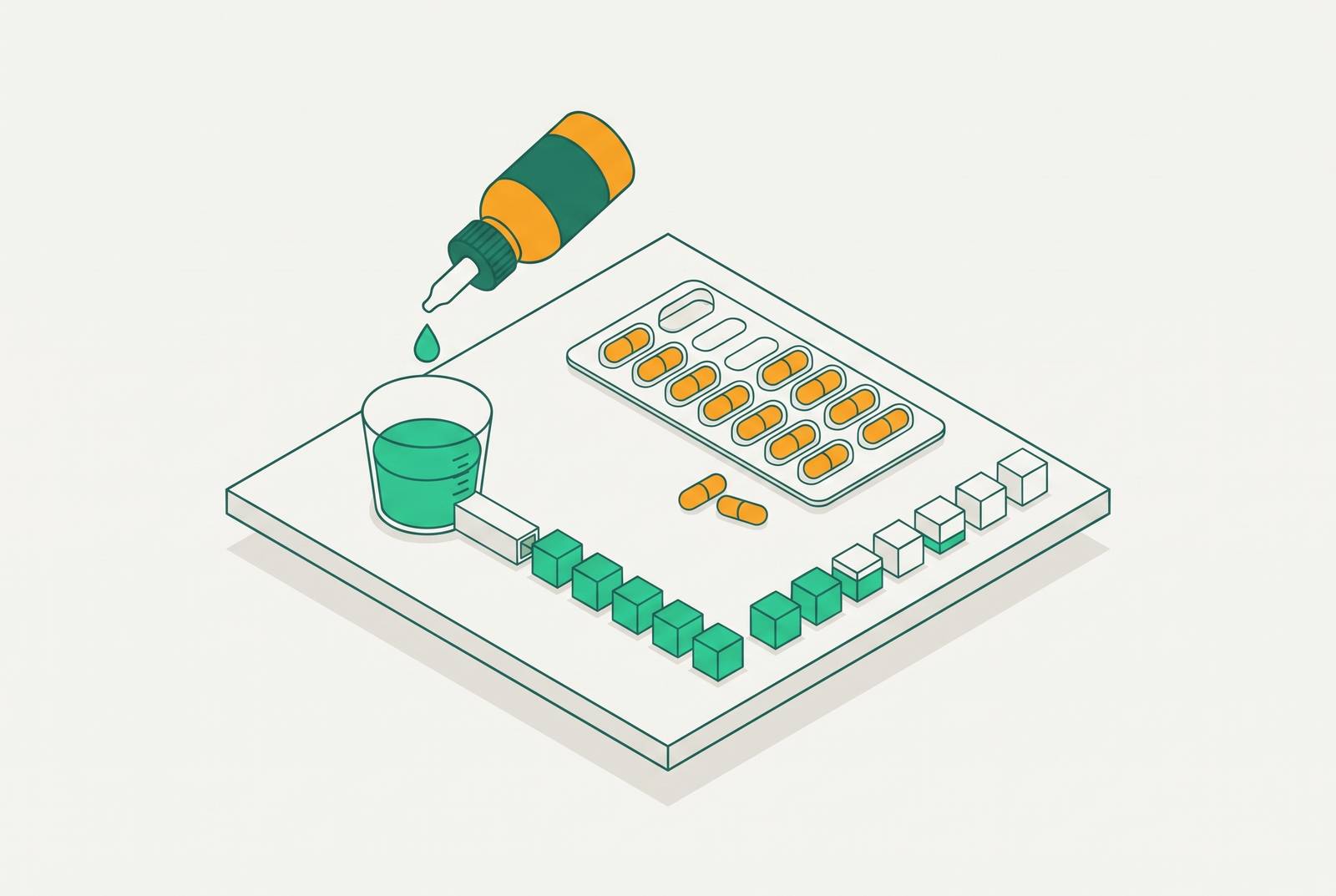
Liquid delivery can remove the dissolution delay between swallowing a nootropic stack and making its ingredients available for absorption. A daily nootropic shot with nanoencapsulation may also improve delivery, but liquid format alone does not prove superior bioavailability. The useful distinction is between a formula that is merely drinkable and one whose extract quality, carrier system and dosing support the amount that actually reaches the bloodstream.
Why the dissolution-to-absorption chain determines what your nootropic stack actually delivers
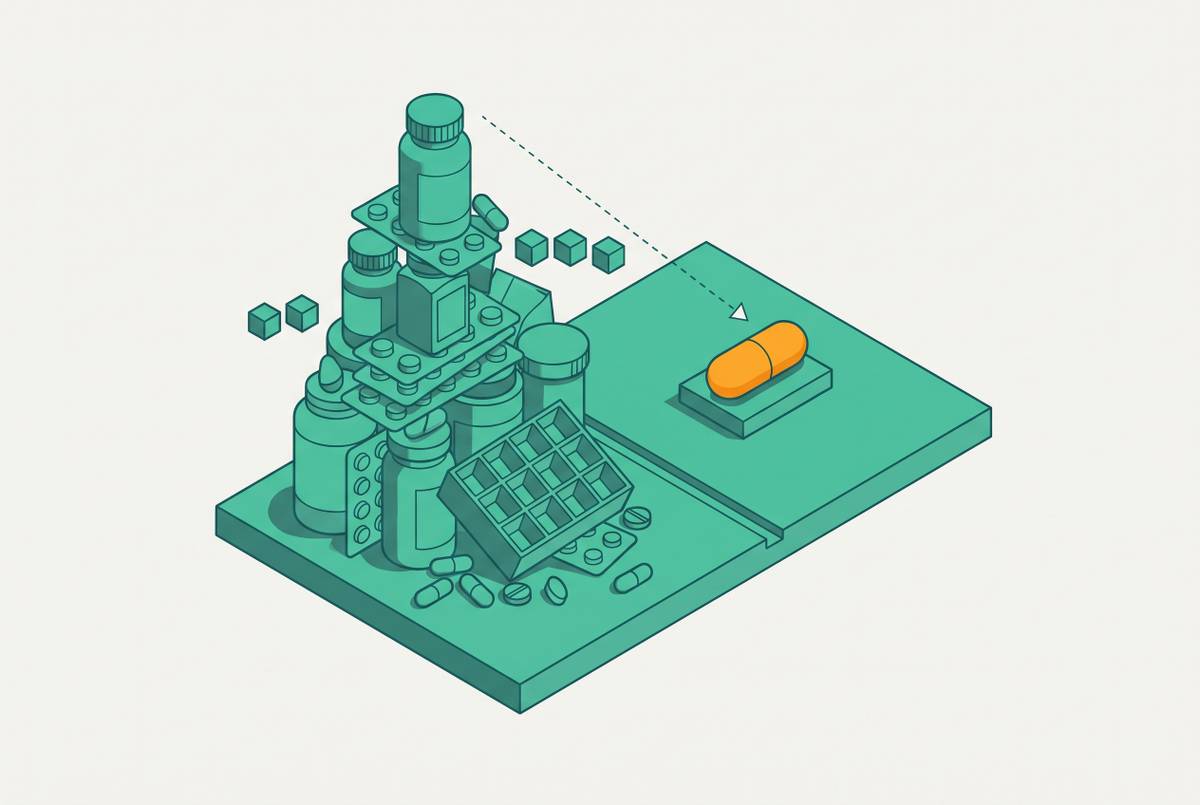
A swallowed capsule puts several physical steps between its contents and the blood. Its casing must break down, the ingredients must be released, and those ingredients must become available for uptake through the intestinal wall. Release is not the same as absorption. Absorption means entry into the blood, while bioavailability describes the portion of a dose that reaches systemic circulation in active form. A label states what goes into the serving at the start of that journey.
A liquid with already-dissolved ingredients removes the need for those ingredients to dissolve after swallowing. That changes the starting point, but it does not eliminate the rest of the digestive and absorption process. The active ingredients still need to reach the bloodstream. Nor does putting an ingredient into a drink establish that it is fully dissolved or readily absorbed. A well-formulated ingredient is only as useful as the delivery path that gets it into circulation.
How capsule dissolution creates a compounding delay, not just a slower start
Shell thickness, stomach acidity and food in the stomach can change how quickly the contents become available. A thicker coating and lower acidity, for example, can both extend the period before the ingredients are released. The start time therefore varies across servings.
That variability can also differ between people and days. The stomach makes less acid with age, while food can buffer stomach acid and slow the breakdown of a capsule. Taking the same capsule with or without a meal therefore changes the conditions through which it must pass. This is a reliability issue as well as a timing issue, although a delay alone does not establish that less will ultimately be absorbed. The defensible concern is that an identical swallowed dose does not guarantee identical exposure, especially when dissolution is only the first of several hurdles.
Why the bioavailability gap between liquid and solid forms is especially consequential for nootropic compounds
For a nootropic ingredient, faster release is useful only if it helps deliver enough active material to support the intended effect. Cognitive and stress-support compounds need to be absorbed to work, and being in the digestive tract alone is not enough. But format is not a universal ranking system. Solubility, particle size, extract preparation and dietary fat for fat-soluble compounds can influence absorption as much as whether the serving is a capsule, powder or drink.
The distinction is especially important when comparing a cognitive stack with a familiar vitamin or mineral supplement. Evidence about one ingredient cannot establish the best format for another, and a faster start cannot substitute for evidence of a higher active fraction reaching circulation. Powders also have no capsule shell to break down. US Patent Publication No. 12697348 describes a potential absorption advantage for a powdered composition over tablets or capsules.
How nanoencapsulation and engineered liquid delivery address the formulation variables that format alone cannot solve
Encapsulation or emulsification can place ingredients within a carrier system. Protection through digestion is one purpose of that system. For fat-soluble compounds, a lipid carrier can also address the difficulty of delivering those compounds in a water-based formula.
The aim is to release ingredients sooner, protect them along the way and help more of the active material reach circulation. First-pass metabolism is another potential target, but claiming to bypass it requires more than naming a lipid ingredient. The technology label is not the evidence. Liposomal delivery can be used in capsules as well as liquids, and liquid-filled softgels show why “capsule versus drink” is too crude a comparison. To compare delivery systems, the active ingredient and its carrier must be known, with evidence that the finished system improves exposure.
What happens to Lion's Mane and Bacopa when absorption is inconsistent across daily servings
Studies of Bacopa Monnieri use a standardized extract taken each day for several weeks, so how it is delivered day after day matters. If absorbed exposure changes a lot from day to day, the relationship between the label dose and the studied regimen becomes less dependable without one under-absorbed serving resetting all progress.
Lion's Mane, or Hericium erinaceus, adds another variable because its bioactive constituents include hericenones and erinacines, whose delivery depends on extract quality, concentration and preparation. Format cannot rescue a poorly specified extract. A 2025 randomized controlled trial, PMID 40276537, found no significant overall acute improvement in cognitive performance and mood after a single dose in healthy adults. Possible task-specific effects do not establish a broad immediate benefit, and that result does not by itself prove an accumulation mechanism. For an eight-week routine, daily servings need to provide the same, properly prepared extract each time, and a prominent ingredient name on the bottle does not show that they do.
Why ashwagandha and Rhodiola require bioavailability to produce their HPA-axis effects, not just their label claims
Ashwagandha and Rhodiola rosea also depend on delivery for their proposed effects on stress regulation. Their proposed effects involve the hypothalamic-pituitary-adrenal axis, usually shortened to the HPA axis, which participates in the body's stress response. An ingredient must be absorbed to act systemically. But that requirement alone does not show the exact blood concentration needed for an effect or prove that a given capsule falls short of it. Clinical outcomes show how an extract affects people, while delivery comparisons test how well it gets into the body.
A 2026 trial published in Medicine reported mean reductions in Perceived Stress Scale scores of 38.6 to 41.6 percent from baseline to day 60, with improvements in sleep quality and psychological well-being. A separate 2026 randomized controlled trial involving 103 healthy physically active adults found that ashwagandha at 600 mg combined with Rhodiola at 300 mg improved subjective stress and sleep quality over a short controlled period. Neither finding establishes liquid superiority on its own. Extract standardization is still needed, and the bioavailability study identifier supplied with this topic has no matching registry record, so it cannot be used to compare delivery formats. For readers evaluating a “liquid” formula, comparison with trial conditions requires the specified extract and a transparent dose.
How L-theanine and Ceremonial-Grade Matcha illustrate liquid delivery's timing advantage for the caffeine stack
With L-theanine and caffeine, how their timing lines up matters as well as repeated exposure. L-theanine is quickly absorbed through the intestinal mucosa, and the neutral amino acid transport carrier system carries it across the blood-brain barrier, where it reaches peak cerebral concentrations in under an hour. A dissolved serving has no capsule to break down before uptake can start, which may help when the aim is to have L-theanine available while caffeine is taking effect. That alone does not prove that both compounds peak at the same time.
A randomized, triple-blind, placebo-controlled crossover study found that a single dose of L-theanine increased frontal alpha brain wave power and reduced salivary cortisol after a stress protocol. That supports a stress-response explanation for the “clean energy” experience, but does not establish that every caffeine combination prevents jitter. Randomized trials of the combination have found attention-switching benefits, while reaction-time and subjective-alertness results have been mixed. Ceremonial-Grade Matcha contains caffeine and L-theanine that occur together naturally in one liquid serving with no capsule casing, but the measured cognitive effects are small to moderate, with gains of fractions of a second on computer tasks that fall short of transforming workdays.
Why sleep quality is the downstream variable that makes or breaks daytime cognitive performance — and why format affects it too
Sleep sets the baseline that a daytime cognitive stack tries to improve. Poor sleep impairs neuroplastic processes, including hippocampal memory consolidation, that memory-focused ingredients are intended to support. Even a daytime formula cannot be judged apart from the recovery conditions in which it is used. If a sleep-supporting ingredient is poorly delivered, its intended contribution may also fall short, although that possibility is not evidence that a particular liquid improves sleep more than a capsule.
A 2024 randomized controlled trial from Kyung Hee University, published in Nutrients, found improved sleep quality in adults with disturbances using a mixture of Rhodiola rosea and Nelumbo nucifera extracts. The mixture is an important qualification. The results cannot show what Rhodiola did on its own, just as the earlier combination trial cannot show how much each adaptogen helped. Together, the findings connect stress-support formulas with nighttime recovery, but they do not compare delivery formats. A liquid engineered for reliable absorption could serve both daytime stress support and sleep-related goals through the same ingredients, provided its formulation supports that claim rather than borrowing it from a different preparation.
What should you look for in a daily nootropic shot with nanoencapsulation for better absorption?
For a buyer, the first question is what the delivery technology actually does. A useful label or product explanation identifies the lipid carrier, encapsulation system or liposomal matrix and connects it to the ingredients being delivered. “Nanoencapsulation” alone is not enough to decide. An olive-oil-derived lipid, for example, identifies a possible carrier, but its presence does not establish that fat-soluble withanolides bypass first-pass metabolism. Evidence of better absorption needs to address the formula.
The active extracts need to be specified clearly enough to compare with the research. That includes bacoside percentages for Bacopa and withanolide percentages for ashwagandha, together with transparent serving amounts. Standardization makes the comparison more meaningful. Without it, two products can name the same plant, yet the reader has no way to tell whether their extracts are alike. A daily format is most useful when its dosing information also makes consistent use possible, rather than hiding quantities behind a general promise of brain performance.
Third-party testing checks ingredient quality and contamination as well as what the delivery technology does. Tests for heavy metals, mycotoxins and other contaminants check for things that delivery technology cannot fix, while tests of the stated contents help show what is in the product the consumer gets. It does not measure what reaches the bloodstream. The notes name no product that meets the requirements and give no head-to-head evidence on finished formulas to back a claim that one daily shot is the best.