Sleep Architecture Stages and Their Specific Cognitive Functions
Each sleep stage handles a separate job: memory, waste clearance, emotional processing.
Sleep is not a single switch that flips off at night and back on in the morning. It runs on a fixed architecture, a repeating sequence of distinct stages, each doing a separate and non-interchangeable job for the brain. Most people track hours slept and stop there, but hours are just the container. What fills that container, the actual mix and order of stages, is what decides how sharp or sluggish the next day turns out to be.
Why sleep is architecture, not just duration
When someone is asked how they slept, they'll tell you a number: six hours, seven and a half, maybe a rough guess at "not enough."" That number is close to useless on its own. Sleep moves through a cycle of stages, N1, N2, N3 (also called slow-wave sleep, or SWS), and REM, and this cycle repeats several times across a night, with the balance between stages shifting as the night goes on.
Each of those stages has its own electrical signature on an EEG, its own mix of brain chemicals, and its own job to do. N2 handles one kind of memory work, N3 handles another, and REM does something different again. A person who sleeps eight hours but loses most of their deep sleep to alcohol or stress is not getting the same brain benefit as a person who sleeps seven hours with intact architecture. Total sleep time tells you how long the container was open. Architecture tells you what actually got done inside it, and that variable is visible in tomorrow's focus, mood, and memory.
What N2 does: spindles, motor learning, and procedural memory
N2 gets waved off as filler, the stage between falling asleep and the "real" deep sleep. That reputation doesn't hold up. N2 has its own defining EEG features, sleep spindles (short bursts of fast, sigma-band oscillation) and K-complexes, and these aren't just markers that a machine uses to label the stage. They're doing the work.
Sleep spindles coordinate the transfer of procedural and motor memories between the hippocampus and the cortex while the body is in NREM sleep. That's the mechanism behind why a skill practiced during the day, a golf swing, a piano passage, a new sequence of keystrokes, feels more automatic the next morning even without additional practice. The brain is filing it during the night.
There's also a link between sigma power and how physically active someone is during the day. Research measuring daily step counts against overnight EEG found that higher step totals correlated with greater slow and fast sigma power during NREM sleep. That's a real, physical bridge between something as mundane as a daily walk and the specific brain oscillation that drives N2's memory function.
Slow-wave sleep: declarative memory, synaptic housekeeping, and the hippocampal-cortical transfer
N3, also called slow-wave sleep, is marked by slow, high-amplitude delta waves and it's the hardest stage to rouse someone out of. It's also where the deepest physical restoration happens. Its main cognitive job is systems consolidation: reactivating memory traces stored in the hippocampus and moving them into long-term, distributed storage across the cortex.
This isn't a vague hand-off. It runs on a tightly timed sequence of neural events coordinating the transfer of memory from the hippocampus to cortical storage. If that coordination is disrupted, the transfer doesn't happen cleanly.
SWS also runs a kind of nightly cleanup on the synapses themselves. Neurons that fired heavily during the day, the ones that encoded new information, get selectively scaled back, while the connections that matter for memory stay intact. Think of it as a signal-to-noise reset: weak, noisy connections get pruned so the meaningful ones stand out more clearly the next day.
The glymphatic system: what slow-wave sleep clears
Beyond memory, slow-wave sleep runs the brain's waste removal system, called the glymphatic system (short for "glial-lymphatic"), discovered by Maiken Nedergaard at the University of Rochester in 2012. The brain's tissue doesn't have the conventional lymphatic vessels that clear waste elsewhere in the body. There are lymphatic vessels in the meninges surrounding the brain, but inside the brain itself, cerebrospinal fluid does the work, flowing through and around brain cells to carry waste out.
During slow-wave sleep, the interstitial space between brain cells expands substantially, and that expansion sharply increases how much fluid can flow through and how efficiently waste gets carried away. What gets cleared matters: metabolic byproducts including amyloid-beta, tau, and alpha-synuclein, the same proteins tied to Alzheimer's and Parkinson's pathology. When SWS is chronically short or fragmented, these proteins don't get flushed at the same rate, and they build up instead.
Research has continued to sharpen the mechanistic picture of glymphatic clearance during NREM sleep, with norepinephrine rhythms emerging as a candidate driver of the process.
REM sleep: emotional memory, abstraction, and creative integration
REM sleep runs on an entirely different neurochemical setup than NREM. Acetylcholine is high, norepinephrine is suppressed, and the EEG shows characteristic theta oscillations, a brain state that resembles neither ordinary wakefulness nor any of the NREM stages.
REM does three jobs that NREM doesn't touch. First, it consolidates emotional memory in a specific way, processing the affective dimension of experiences while preserving their content. Second, it drives abstraction: REM reorganizes stored episodes into rules, patterns, and general schemas, which is the raw material behind insight and creative problem-solving. Third, it plays a role in stabilizing recently formed memories.
Theta power during REM also tracks with physical activity, mirroring the sigma finding in N2. Physical activity has also been linked to REM sleep quality more broadly, tying a simple behavioral lever to REM's own functional signature.
None of this works as isolated stages, either. The sequential hypothesis holds that sleep's cognitive benefit doesn't come from NREM alone or REM alone, but from the repeated back-and-forth of NREM and REM episodes across the night. The stages work in sequence, each one setting up conditions for the next.
Sleep deprivation degrades specific cognitive domains rather than performance globally
Losing sleep doesn't dim everything evenly, like a dimmer switch on the whole brain. It knocks out specific capacities tied to whichever stages got cut short. Short-term memory goes first, along with focused attention, cognitive flexibility (the ability to switch between tasks), and higher-order functions like decision-making and problem-solving.
The physiological evidence backs this up directly. Sleep-deprived adults show measurably reduced cognitive flexibility and slower reaction times across a range of cognitive tasks. And this isn't a rare condition: an estimated 20% or more of adults deal with some form of sleep deprivation.
A 2025 deep-learning model called CogPSGFormer, tested on 817 people from the STAGES dataset and presented at the IEEE Engineering in Medicine and Biology Society's 47th annual conference, sorted individuals into low- versus high-cognitive-performance groups using nothing but sleep-derived physiological signals, and it got the classification right 80.3% of the time. A night's sleep architecture, in other words, predicts next-day executive function with real accuracy, not just a loose correlation.
Sleep deprivation's disruption of cortisol and erosion of executive functions in high performers
Cortisol is the main biomarker of the hypothalamic-pituitary-adrenal (HPA) stress axis, and sleep is one of the primary things that keeps it on a normal daily rhythm. Circadian timing and sleep architecture work together to set cortisol's rise and fall over 24 hours.
Cutting sleep short breaks that rhythm in two directions at once: baseline cortisol rises, and the cortisol response to the next stressor gets bigger too. The HPA axis becomes harder to regulate once sleep is chronically disrupted, responding more strongly to stressors that a full night's sleep would have buffered.
The cognitive fallout from elevated cortisol isn't generic either. It lands hardest on working memory and cognitive flexibility, exactly the functions someone needs most when making a high-stakes call under pressure. Left unmanaged, the pathway runs in one direction: chronic stress raises cortisol, cortisol dysregulation sets in, the system desensitizes, and cognitive performance continues to erode. Sleep sits at the center of that whole chain.
Sleep architecture degradation and the inputs that protect each stage.
Some inputs build better architecture, and some tear it down. On the positive side, the 2025 study already mentioned found that higher average daily step counts significantly increased N2 time and overall sleep efficiency, while cutting down WASO (wake after sleep onset). The same steps also tracked with the microstructural gains already described, higher sigma power in N2/NREM and higher theta power in REM, alongside elevated BDNF (brain-derived neurotrophic factor), which points to a plausible neurochemical link between daytime movement and nighttime brain repair.
On the negative side, a short list of familiar habits does most of the damage. Alcohol disrupts REM sleep. Caffeine taken late in the day interferes with sleep onset and sleep quality. Blue light exposure late in the evening can interfere with the timing of sleep onset and the stages that follow.
Cortisol management deserves its own line item here, since elevated HPA activity directly fragments SWS and compresses REM. Anything that reliably brings cortisol down should, in theory, protect architecture downstream. Ashwagandha in its KSM-66 form, dosed at 600 mg a day, has published randomized controlled trials showing a 27.9% reduction in cortisol over 60 days, with cortisol benefits observed over a 60-day period. Lion's Mane (Hericium erinaceus) works through a different channel, its hericenones and erinacines stimulate a nerve growth factor, and an 8-week trial at 550 mg found reductions in anxiety, depression, and sleep disorder scores; separate research has pointed to measurable cognitive and mood effects with consistent use.
None of this matters if the compound never reaches the bloodstream in a usable amount. Efficacy has a ceiling set by bioavailability, and a supplement that doesn't absorb at a therapeutic level can't do its job regardless of what the label says the dose is. Delivery technology that improves absorption is, functionally, just as important as which ingredient gets chosen.
Reading your own sleep architecture data
Consumer sleep trackers now report stage breakdowns, light sleep, deep sleep, REM, and knowing which number to actually watch shapes how the raw total should be read.
Start with N2. Trackers lump it into "light sleep" and don't yet report the microstructural detail (sigma power) that actually drives its function, that's still a research-lab measurement, not a consumer one. What consumer devices do report is WASO, wake after sleep onset, and elevated WASO tracks with worse cognitive scores, so it's a reasonable stand-in even without spindle-level detail.
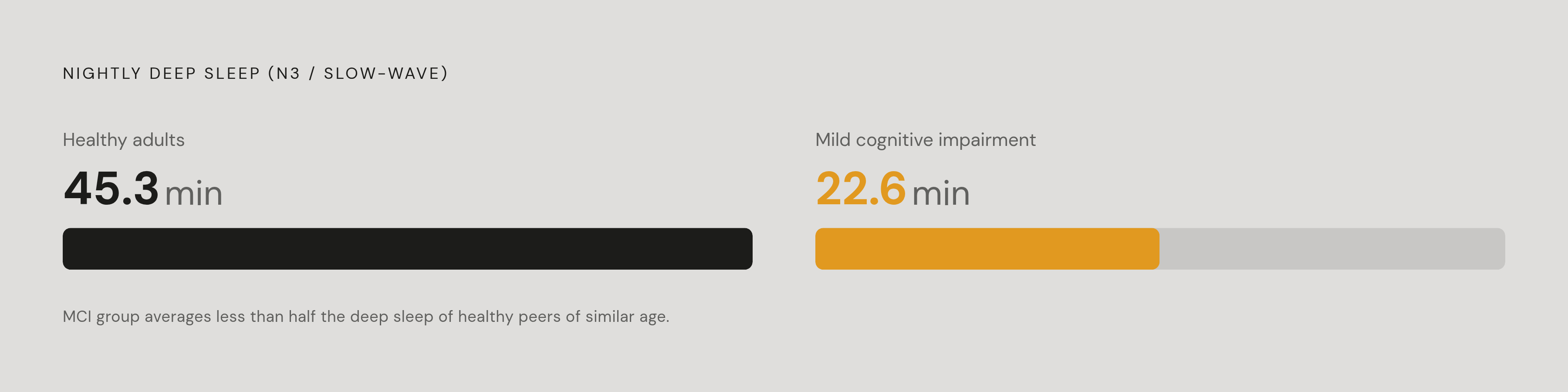
Deep sleep, meanwhile, is the number worth protecting above the rest. Adults with mild cognitive impairment average around 22.6 minutes of deep sleep a night, compared to roughly 45.3 minutes in healthy adults of similar age. Adults with mild cognitive impairment average around 22.6 minutes of deep sleep a night, compared to roughly 45.3 minutes in healthy adults of similar age, and that gap is wide enough to matter even for someone reading a non-clinical tracker: the direction is the signal to track.
Sources
- doi.org
- Frontiers | The impact of physical activity on sleep architecture and cognitive function among college students
- Comparison of Sleep Architecture in Individuals Aged 65 to 80 Years With and Without Mild Cognitive Impairment Using Multi-Channel Sleep Monitoring
- Increased Sleep Spindles in Regions Engaged during Motor Learning Predict Memory Consolidation | Journal of Neuroscience
- NREM2 and Sleep Spindles Are Instrumental to the Consolidation of Motor Sequence Memories
- nature.com
- en.wikipedia.org