Alcohol and Sleep Architecture in High-Performing Adults
Alcohol hijacks early sleep but sabotages the recovery hours that matter most.

Alcohol reshapes the night into two opposing halves: a first half with accelerated slow-wave sleep and suppressed REM, and a second half where slow-wave sleep falls and REM rebound is disrupted, leaving the architecture worse than if no alcohol had been consumed. Sleep comes faster, feels heavier, and the next morning carries a vague sense of having been knocked out rather than rested. That sensation is real and measurable: alcohol does front-load deep sleep early in the night, but the bill for that early sedation comes due a few hours later, in the part of the night that matters most for recovery. The rest of this piece explains why that early feeling of "sleeping hard" is one of the most misleading signals in performance biology, and what it actually costs.
The two-phase mechanism that makes alcohol a net negative for sleep
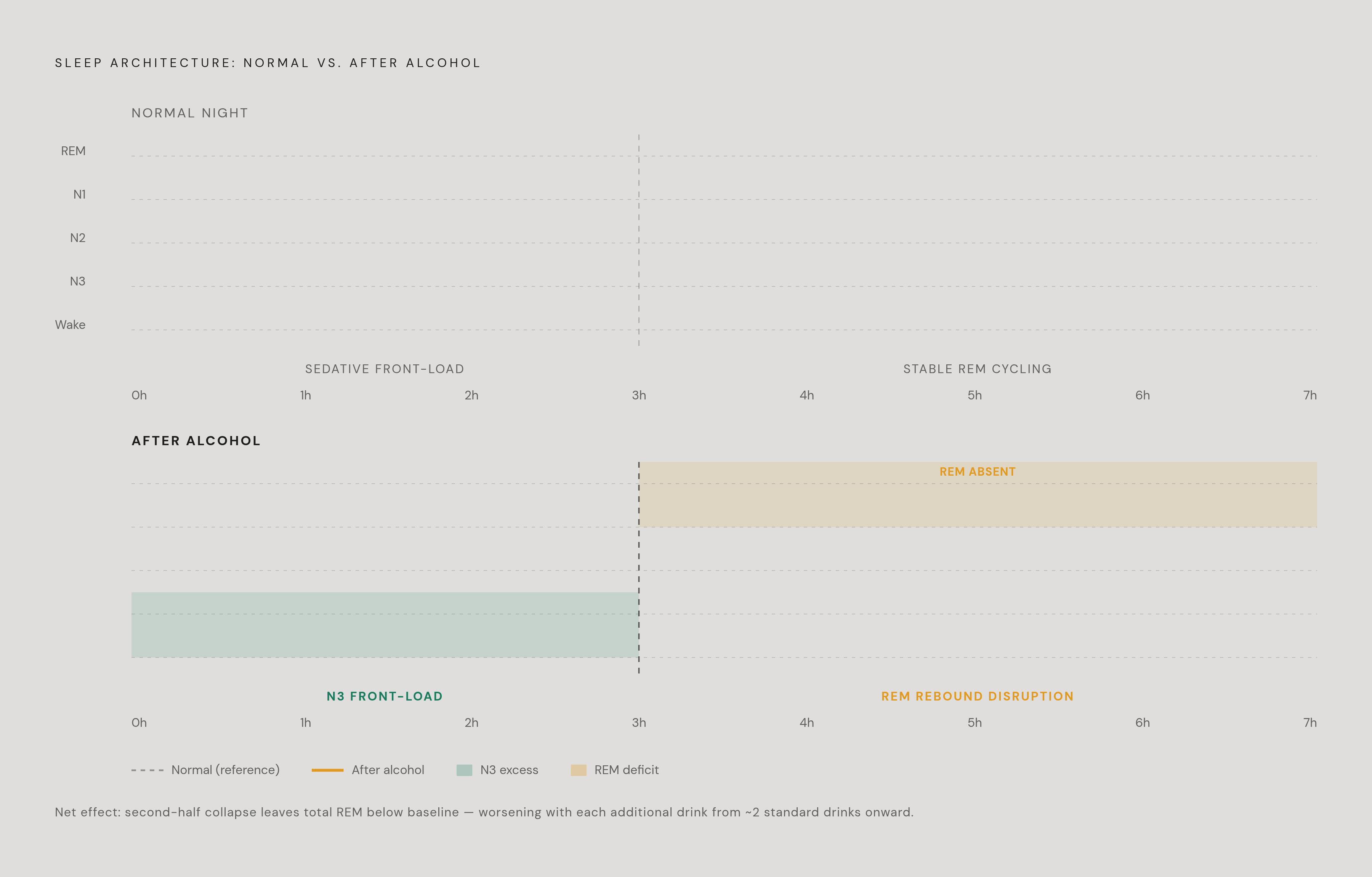
Alcohol splits the night into two halves that work against each other. In the first few hours, it speeds the brain into slow-wave sleep, the deep, physically restorative stage sometimes labeled N3, while suppressing REM sleep, the stage associated with dreaming, emotional processing, and memory work. A systematic review and meta-analysis lays out this pattern in full: slow-wave sleep rises early, REM gets pushed down, and then in the second half of the night both N3 and REM drop below what they would have been without alcohol in the system, with the REM losses growing larger as the dose increases.
That second half is where the trade turns negative. The slow-wave sleep that felt so convincing at midnight doesn't hold, and the REM rebound that would normally restore balance later in the night gets disrupted instead of delivered. Timing offers only partial protection: drinking late in the evening makes the fragmentation and breathing disturbances worse, while drinking earlier softens but does not remove the effect (source material on timing drawn from the broader review). The core finding holds regardless of when the drink is poured.
The sharpest number in this research is the dose threshold. REM disruption starts at a low dose, roughly two standard drinks, and gets worse step by step as intake rises. There is no quantity small enough to avoid the effect entirely; the nightcap that feels harmless is already inside the window where REM sleep measurably suffers.
REM sleep is a stage the brain cannot skip without consequence. It's where emotional memory gets consolidated, where the brain does pattern integration work, and where mood regulation is maintained; REM may also play a role in procedural memory, though that link is more firmly tied to slow-wave sleep. Those are exactly the cognitive outputs that separate strong professional performance from a mediocre day at the edge of one's abilities. Losing REM is a direct hit to the mental processes that high performers depend on most.
Tolerance, adaptation, and consecutive nights of drinking
The evidence doesn't support that read. The nervous system does adapt somewhat to repeated alcohol exposure, but adaptation is not the same as repair: the structural suppression of REM sleep continues even after the subjective experience of disruption fades, which is precisely the mechanism by which habitual drinkers convince themselves nothing is wrong.
A consecutive-night study out of Brown University tracked this directly. The first night of drinking produced the largest REM decrease, and that effect shrank on the second and third nights, but total REM sleep stayed below baseline across all three nights. The researchers reading this result interpreted the partial recovery as evidence of how important REM sleep is: the body works to preserve some of it even under repeated alcohol exposure, but what it preserves is a partial save, not a full restoration.
This is the gap that misleads habitual drinkers. What feels like "fine" sleep after a few nights of drinking is tolerance to the acute, first-night shock, not evidence that the nightly REM deficit has stopped accumulating. Coverage of the Brown study makes the same point from the outside: even with the adaptation observed over consecutive nights, the cumulative disruption carried real consequences for cognitive performance. Someone who drinks nightly isn't escaping the mechanism described above. They've simply stopped noticing it.
Alcohol, the stress axis, and overnight cortisol regulation
That pattern has a specific hormonal cause. Alcohol does not lower stress at the level of the body's chemistry. It activates the hypothalamic-pituitary-adrenal axis and triggers a cortisol surge, and that surge collides with the overnight hormone rhythm sleep depends on to stay stable.
Cortisol normally follows a predictable daily curve, falling through the evening and staying low overnight so the body can rest. Alcohol interrupts that fall, pushing cortisol back up at a point in the night when it should be quiet, which leaves the stress-response system unstable while the body is supposed to be recovering. The early waking so many drinkers report traces directly back to a cortisol surge that an already overactivated HPA axis can't bring back under control.
For high performers, the cost of this runs in two directions at once. An overnight stress response degrades the restorative sleep biology described in the sections above, and it also interferes with the neuroplasticity that cognitive performance depends on; mood regulation, anxiety risk, and BDNF-related pathways are all affected when the brain spends the night maintaining an active stress response instead of resting. It's the visible symptom of a hormonal system that never got the signal to stand down.
What the day after drinking costs in cognitive output
The conversation about drinking and sleep tends to default to hangovers: headaches, nausea, the physical discomfort of overconsumption. That frame misses the real story. The deficits that matter for a working professional come from the sleep architecture disruption itself, not from intoxication, and they land on the exact capacities that define high performance.
A systematic review and meta-analysis found that short-term memory, long-term memory, sustained attention, and psychomotor speed all show measurable impairment the day after a night of heavy drinking, with effect sizes large enough to carry real clinical weight (impairment domains per the review). Among college-attending young adults, high-intensity drinking carried roughly double the odds of reporting a cognitive lapse the following day, with an odds ratio of 2.32 and a 95% confidence interval of 1.91 to 2.83. Days following a blackout drinking episode carried an even higher likelihood of both memory lapses and general cognitive lapses.
None of this is a separate phenomenon from what the earlier sections describe. REM sleep is where pattern recognition, emotional regulation, and memory integration happen, so these next-day deficits aren't general tiredness. They are the direct downstream consequence of the suppressed REM architecture described in earlier sections. The bill for the previous night's "deep" sleep arrives the next morning, in exactly the cognitive currencies a high performer can least afford to spend.
The long-term structural damage to the brain that disrupted sleep accelerates
Stretch the time horizon from one bad morning to years of regular drinking, and the stakes change in kind, not just in degree. Alcohol's direct neurotoxic effects on the brain and the sleep disruption described above are not separate risks running in parallel. They share overlapping brain targets, and the two act together to accelerate structural damage faster than either would produce alone.
Research on this overlap is specific: the same brain regions responsible for regulating sleep show the kind of pronounced grey matter reduction seen in people with alcohol use disorder, suggesting a compounding cycle in which disrupted sleep speeds up the same structural damage that alcohol itself causes. At the molecular level, ethanol exposure alters BDNF expression and disrupts the neuroprotective effects BDNF normally provides, worsening neuronal vulnerability and cognitive decline; BDNF is tied directly to synaptic plasticity and the processes underlying memory.
The evidence on recovery matters here because it keeps the picture from tipping into fatalism. MRI studies show the brain does regain frontal grey matter volume after months of abstinence, and sobriety restores the neurogenesis that alcohol suppresses. But the months required for that recovery are themselves a measure of how expensive the ongoing disruption really is. Recovery is possible. It is not fast, and it is not free.
Practical alternatives for wind-down and morning recovery
The pathways alcohol dysregulates, cortisol rhythm, BDNF-driven neuroplasticity, and REM sleep architecture, are the targets of well-studied compounds that produce the desired outcomes without the architectural trade-off. They are the same targets a number of well-studied compounds act on directly, without the architectural trade-off alcohol forces on the night.
For evening cortisol management, a standardized ashwagandha extract, KSM-66, with a high concentration of withanolide glycosides, produced lower perceived stress and anxiety, better sleep, and improved well-being compared with placebo in controlled trials, with cortisol trends favoring the ashwagandha group. Its mechanism works through modulation of the HPA axis, the same system alcohol overstimulates rather than calms. KSM-66 gives the evening wind-down a tool that works with the body's stress chemistry instead of against it, since across landmark randomized trials it shows a meaningful reduction in cortisol alongside a substantial improvement in sleep quality.
Morning recovery calls for a different set of tools, since the deficit left by a disrupted night runs through focus, memory, and neuroprotection rather than relaxation. Lion's Mane has the strongest support for brain fog, memory, focus, and long-term neuroprotection, working through stimulation of nerve growth factor, a pathway that complements BDNF, both of which chronic alcohol exposure suppresses. Rhodiola, standardized to 3% rosavins and 1% salidroside and taken at 200 to 400 milligrams in the morning on an empty stomach, supports cellular energy production and neurotransmitter balance, improving focus and cutting fatigue without drowsiness; its effects can last six to eight hours, so morning dosing matters.
Ingredient choice only goes so far without attention to form. For Lion's Mane, fruiting body extracts contain hericenones, while the other active compounds, erinacines, show up only in mycelium, so a product grown on mycelium and grain can dilute potency compared with fruiting body extract. Absorption technology, such as nanoencapsulation, affects how much of any given ingredient actually reaches the bloodstream rather than passing through unused. That combination addresses the morning cognitive deficit left by suppressed REM and the longer neuroprotective gap that chronic alcohol use opens up.
Reading your own sleep data in light of what alcohol does
Wearables and sleep trackers now put sleep-stage estimates in front of millions of people every morning, and that data is only useful if it's read correctly. The gap between how sleep feels and what the architecture actually did overnight is where most high performers lose ground without realizing it, and closing that gap starts with knowing which signals to trust.
A fast sleep onset and a high early slow-wave reading after a night of drinking are not signs of good recovery. They are the first half of the two-phase pattern described earlier in this piece, the sedative front-load that comes at the expense of REM later in the night. Waking at 3 or 4 a.m. after a night that started with easy, fast sleep onset is a specific, recognizable pattern tied to that same cortisol mechanism, not random bad luck.
None of this requires giving up on sleep data. It requires reading the data against the mechanism rather than against the feeling. A night that felt deep because it started deep is not the same as a night that delivered the REM architecture the brain needed to consolidate memory, regulate mood, and prepare for the next day's cognitive demands. The subjective sense of having slept hard is the least trustworthy signal in the entire data set. The sleep architecture itself is what actually determines what the next day will cost.
Sources
- Alcohol before bed: New research uncovers its impact on sleep architecture
- The effect of alcohol on subsequent sleep in healthy adults: A systematic review and meta-analysis - ScienceDirect
- The effect of alcohol on subsequent sleep in healthy adults: A systematic review and meta-analysis - PubMed
- Altered sleep architecture following consecutive nights of presleep alcohol - PMC
- High‐intensity and blackout drinking impact on next‐day cognitive functioning among college‐attending young adults - Linden‐Carmichael - 2026 - Alcohol, Clinical and Experimental Research - Wiley Online Library
- A systematic review of the next‐day effects of heavy alcohol consumption on cognitive performance - Gunn - 2018 - Addiction - Wiley Online Library
- Alcohol and Cortisol: What Drinking Really Does to Your Stress Hormones