Sleep Optimization Protocols for Frequent Travelers
Jet lag recovery takes weeks, not days, despite what most travelers assume.
Sleep Optimization Protocols for Frequent Travelers. Lion's Mane.
Why frequent travelers pay a compounding sleep debt that rest alone cannot clear
Sleep disruption from travel is a layered problem that a long weekend does not fix. It's a layered one, involving circadian timing, sleep architecture, and the physical environment a traveler sleeps in, and each layer recovers on its own schedule, which is why so many frequent flyers never actually catch up. That's a fairly damning list, because those three things sit across different layers of sleep, duration, timing, and architecture, that recover at different speeds.
The baseline most travelers start from is already thin. Six in ten adults fail to hit the recommended seven to nine hours on a normal night at home, according to the National Sleep Foundation's 2025 Sleep in America Poll. CDC figures put insufficient sleep at 36% of the adult population, and Gallup separately finds 49% of people report frequent stress while 57% say they'd feel better with more sleep. Travel doesn't introduce a new problem into a clean system. It stacks onto a deficit that was already running.
The stakes here are cognitive. Adults who report good sleep satisfaction are 88% likely to describe themselves as flourishing in life, compared to 47% among those dissatisfied with their sleep, which is roughly double. For a frequent traveler, that gap is concrete. It's the difference between landing sharp for a negotiation and landing foggy for one. Treating travel as a one-off inconvenience, something to shake off with coffee and willpower, is the central mistake this piece is built to correct. Travel is a recurring variable in a working life, and recurring variables deserve a system, not an ad hoc fix each time. 63% of travelers report worse sleep while away, with noise (75%), lighting (72%), and bedding (70%) identified as the top environmental disruptors, according to Global Wellness Institute Sleep Initiative data from the Global Wellness Institute Sleep Initiative Trends for 2025.
What travel does to the sleeping brain, and why it takes longer to recover than most people expect
The clearest picture of what travel does to sleep comes from a collaborative study out of the NUS Yong Loo Lin School of Medicine, which drew on 1.5 million nights of Oura Ring data across 60,000 trips, the first large-scale, real-world look at jet lag recovery ever assembled Sleep, Oxford Academic. The headline finding cuts against intuition: sleep duration snaps back to baseline within about two days, but sleep timing and sleep architecture, meaning things like nighttime awakenings, can take more than a week to realign. Duration recovers to within 15 minutes of a person's habitual baseline almost immediately. Timing is the stubborn one, with sleep occurring 60 to 70 minutes off from normal on longer trips, regardless of which direction someone flew.
Direction still matters, though, and eastward travel demands more recovery time than an equivalent westward trip across every length studied. Eastward travel is harder to recover from across every trip length studied, with even a short eastward hop demanding more recovery than an equivalent westward one ncbi.nlm.nih.gov. That's not just a sleep-tracker curiosity. An analysis of 11,481 NBA games across ten seasons found eastward travel measurably hurt home-team performance after adjusting for the usual confounders ncbi.nlm.nih.gov. Direction is a variable teams and travelers alike can actually plan around, not just endure ncbi.nlm.nih.gov.
Age plays a role too, and not in the direction people expect. Younger frequent travelers, the ones assumed to bounce back fastest, may in fact be absorbing more disruption, not less.
The useful way to hold all of this is as three layers stacked on top of each other. Duration recovers fast. Timing recovers slowly. Architecture, the internal structure of a night's sleep, recovers slowest of all. Adrian Willoughby, who led the research, said the data show "just how persistent the impacts are, particularly when it comes to adjusting sleep timing to a new time zone."That sentence captures the point directly. Sleep duration returns to baseline within about two days, but sleep timing and architecture can take more than a week to realign. It's that the clock inside them stays wrong for much longer than the tiredness itself. Along the age gradient, a 20-year-old experiences a 15-minute greater sleep reduction than a 60-year-old over initial post-travel days, suggesting younger frequent travelers may actually be more disrupted, not less.
The cortisol loop that keeps travel fatigue going after the jet lag clears
"Travel fatigue" is a misleading label, because it implies that rest is the cure. What's actually happening involves cortisol, and cortisol doesn't respond to a good night's sleep the way people assume it should.
Sleep deprivation triggers a loss of sleep-dependent processes in the hippocampus and pyriform cortex, the regions responsible for memory formation and perception, according to research published in the Journal of Clinical and Diagnostic Research. Jet lag and nightshift work carry a similar signature: both are linked to cognitive impairment and reduced memory function, and a 2024 Nature study suggests sleep and circadian disruption may contribute to longer-term cognitive decline. That's a serious claim, and it's one the underlying research treats seriously.
The cognitive cost isn't distributed evenly across the day, either. Performance ratings run higher during daytime and evening hours and drop during the night and early morning. Circadian misalignment doesn't just make someone tired, it actually relocates the window during which the brain performs well. A traveler whose internal clock still thinks it's 3 a.m. isn't going to think clearly at what the calendar says is 10 a.m., no matter how many hours they logged the night before.
The body sits in this loop, cortisol running on the wrong schedule and executive function degrading in turn. The body sits in a low-grade stress response, cortisol running on the wrong schedule, and that stress response keeps degrading executive function and working memory independent of total sleep time. Managing it requires an active intervention, something done deliberately before, during, and after a trip. It is not a problem that resolves itself once the suitcase is unpacked.
The ingredients that address circadian stress and what the evidence supports for each
A handful of compounds have real evidence behind their ability to blunt this cortisol loop, though the evidence varies in strength from one to the next, strong for some and still thin for others.
Ashwagandha has the deepest research base of the group. It works by supporting the HPA axis, the hypothalamic-pituitary-adrenal system that governs cortisol release. A 2025 systematic review and meta-analysis in BJPsych Open concluded that ashwagandha supplementation is safe and effective for reducing stress and anxiety, with a statistically significant reduction in cortisol levels. One trial found a 23% drop in cortisol after 60 days of use compared to placebo, and a 2024 meta-analysis pooling nine randomized controlled trials across 558 patients confirmed significant reductions in perceived stress, anxiety scores, and serum cortisol seed.com. There's also a plausible sleep-quality mechanism involving GABAergic activity, the same pathway some sleep medications target, which is part of why ashwagandha tends to get positioned for evening use.
Rhodiola rosea plays a different role entirely. Its active compounds, rosavin and salidroside, help regulate cortisol while supporting mitochondrial energy production and oxygen efficiency, which translates to less fatigue without sedation. Timing matters here in a way it doesn't for ashwagandha: rhodiola suits daytime or morning use, and taking it too late in the day risks interfering with sleep onset.
There's evidence the combination is more than the sum of its parts. A study pairing ashwagandha with rhodiola and Bacopa monnieri found the combined group saw an average 30% decrease in cortisol, compared to 22% for ashwagandha alone dailynutra.com. That's a real synergy, not statistical noise. Bacopa itself carries a separate reputation for cognitive support, and a 2025 clinical trial protocol in the Journal of Clinical and Diagnostic Research set out to compare it directly against ashwagandha for stress and sleep quality in a double-blind format.
L-theanine belongs in this conversation too, mostly for its role in the hours immediately around travel stress. It raises GABA and serotonin activity while reducing neuronal excitability, producing a calm, focused state without sedation. In one study, 200mg of L-theanine taken before a stressful task produced lower cortisol readings than placebo, with the effect most pronounced in people prone to anxious rumination, which maps fairly directly onto the anxious, overstimulated state of a delayed connection or a red-eye departure Sleep, Oxford Academic. It occurs naturally in matcha, and the whole-leaf form delivers more L-theanine per serving than standard green tea, while carrying roughly 70mg of caffeine against the 95mg in an average 8oz cup of coffee, a lower-jitter, more sustained option for a travel day.
Lion's mane sits at the more speculative end. Its compounds, hericenones and erinacines, cross the blood-brain barrier and may support nerve growth factor synthesis, which matters for neuroplasticity after repeated disruption. But a 2025 acute randomized controlled trial in Frontiers in Nutrition, testing an 18-person sample given a single 3g dose, found overall cognitive and mood improvements weren't statistically significant across most tasks, though some participants improved on specific measures like a pegboard dexterity test. An earlier trial with 41 participants tested a 1.8g daily dose and measured effects at 48 hours and again at 28 days Frontiers in Nutrition nutraingredients.com. The honest read is that lion's mane belongs in a long-haul traveler's stack as a neuroprotective, plausibility-supported addition.
Across all of these, absorption is the detail that gets skipped in most conversations. A compound studied at a clinically meaningful dose only matters if the body actually absorbs it at that dose, in a bioavailable form. That's a central point. It's the difference between a formula that mirrors the studies and one that mimics them on a label.
Pre-travel protocols: the circadian adjustments to make before leaving home
Most jet lag recovery problems start before the plane leaves the ground. Travelers routinely shorten their sleep the night before an early flight, and the NUS research identifies this as a compounding factor, one that extends recovery time well past what the time-zone shift alone would cause. Protecting that last night of sleep at home is a measurable lever. It's a measurable lever.
Departure timing is another lever, and it's a plannable one. Combined with the direction effect noted earlier, this means itinerary selection itself is part of the protocol, not an afterthought to it.
For eastward trips of up to three time zones, the advancing move is to shift bedtime and wake time 30 to 60 minutes earlier each day in the run-up to departure. Westward travel calls for the opposite, a modest delay in bedtime. Light hitting the suprachiasmatic nucleus is the primary driver of the 24-hour clock, so light at the wrong time actively works against adaptation, while timed morning light before an eastward trip speeds up the pre-adjustment. Melatonin can support this too, though the effective timing is variable enough that generic "take it before bed" advice undersells the complexity, and a conversation with a clinician beats guesswork.
The supplement stack should start several days out, not the morning of departure. Ashwagandha in the evening for cortisol management, rhodiola in the morning for energy priming, both used consistently rather than loaded once right before the flight.
Obsessing over sleep-tracker data in the days before a trip, a pattern researchers call orthosomnia, tends to worsen outcomes rather than improve them. The pre-travel protocol should wind that obsession down, not intensify it. Strategic itinerary selection is supported by a 2026 study published in Sleep (Oxford Academic), which modeled how flight departure time and duration affect jet lag by analyzing 55,296 simulated flights spanning time zone differences of −12 to +12 hours and departing between 00:30 and 24:00, showing that departure time is a plannable variable with measurable jet lag consequences Sleep, Oxford Academic.
In-transit protocols: managing sleep architecture on the plane and in the air
Sleeping on an overnight flight is a trap dressed up as a solution. Restricted, broken sleep in the air tends to push people toward early bedtimes and long recovery naps the next day, exactly the pattern that keeps someone from adjusting to local time once they land. The 2026 Sleep modeling study looked at this directly, examining how in-flight sleep interacts with forced wakefulness across those same 55,296 simulated flights, and whether to sleep on the plane depends on the destination's clock, not on how tired someone feels at takeoff.
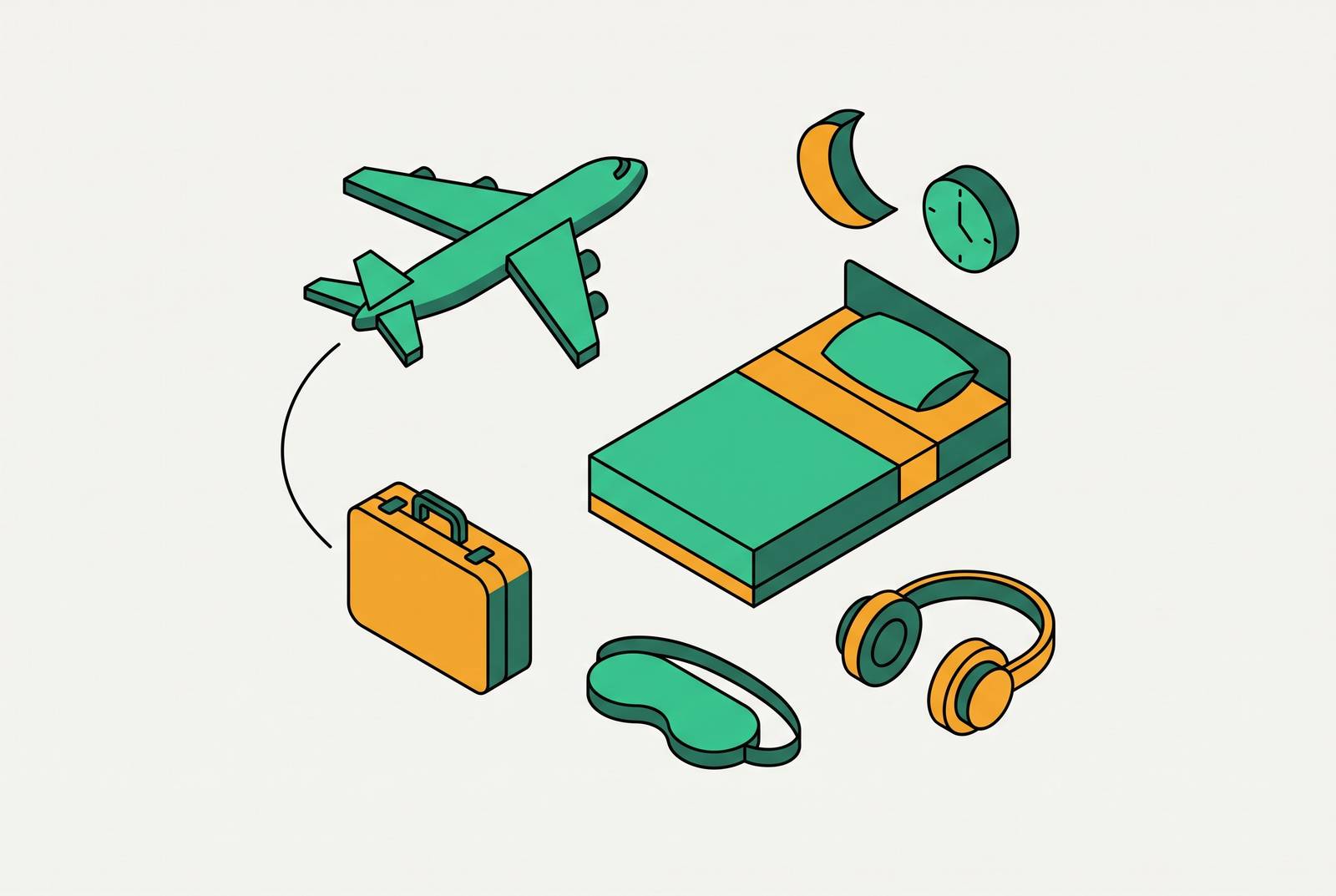
The environmental disruptors from the GWI data (noise, lighting, bedding) all have in-flight equivalents that travelers can manage directly Global Wellness Institute Sleep Initiative Trends for 2025. Noise-canceling headphones handle the noise variable. An eye mask and a deliberate seat choice handle lighting. A neck pillow and some attention to lumbar support handle comfort, even if imperfectly, given the constraints of an economy seat.
Light discipline matters even inside the cabin. Avoiding bright screens during the hours that correspond to nighttime at the destination, and seeking out light during what will be daytime there, helps nudge the internal clock in the right direction before landing. L-theanine fits naturally into this window too, producing calm without the sedation that would interfere with a connection or a jet-lagged navigation through an unfamiliar airport, and matcha is a reasonable substitute for coffee on these days, given its lower caffeine load and reduced risk of an adenosine rebound that would worsen the jet lag already in motion.
Alcohol and dehydration deserve blunter treatment. Melatonin, if used, should be timed to the destination's nighttime, not the departure city's, which is the single most common misapplication travelers make with it. Brief aisle walks help too, since poor circulation and stiffness carry forward into worse sleep quality once the flight ends. Alcohol disrupts REM architecture and cabin dehydration compounds fatigue, making hydration and alcohol moderation practical but evidence-consistent guidance for managing sleep architecture in transit.
Post-arrival protocols: stabilizing sleep timing and architecture in the first 72 hours
The NUS recovery timeline sets the frame for everything that happens after landing: duration is back within 15 minutes of baseline in about two days, but timing and architecture disruption can run past a week. Sleep duration returns to within 15 minutes of baseline within about two days, while timing and architecture disruption can persist more than a week, so the first 72 hours carry more leverage than any other window in the whole trip.
Day one has a single priority above the rest: anchor wake time to local time immediately, regardless of how little sleep happened in transit. It's the most evidence-backed circadian tool available without turning to pharmacology, and it works precisely because it forces the rest of the day, meals, light, activity, into alignment with the new time zone.
Morning light at the destination does the heaviest lifting for resetting the master clock, and it matters most after eastward travel, when the internal clock is running later than local time and needs to be pulled forward. Naps need boundaries during this window: something brief, under 30 minutes, taken before early afternoon, relieves the acute pressure to sleep without pushing back the following night's bedtime, while a longer nap undoes the timing progress made that day.
The supplement timing from earlier phases carries through here, adjusted for the recovery task at hand. Rhodiola in the morning supports mitochondrial energy through the worst of the daytime fatigue without suppressing the cortisol rhythm the body is trying to re-establish. Ashwagandha in the evening, through its GABAergic activity and cortisol-lowering effect, supports the architecture-recovery phase specifically, since nighttime awakenings are the last piece of the puzzle to normalize.
The hotel room itself maps directly onto the same three disruptors identified at the start, using blackout curtains or a sleep mask for lighting, a white noise app or earplugs for noise, or a travel pillow or a request for different bedding for comfort. None of these are exotic interventions. That number is the clearest signal available that sleep, for this population, has stopped being a comfort question and become a performance one. 91% of frequent travelers are willing to pay up to 10% more for sleep.
Sources
- Sleep Initiative Trends for 2025 - Global Wellness Institute
- Modeling the effects of flight itinerary on jetlag duration | SLEEP | Oxford Academic
- Frontiers | Improved jet lag recovery is associated with a weaker molecular biological clock response around the time of expected activity onset
- Insights about travel-related sleep disruption from 1.5 million nights of data - PMC
- What Is Circadian Rhythm?