Strategic Napping Protocols for Afternoon Cognitive Recovery
A 10- to 26-minute nap timed right can restore afternoon alertness safely.
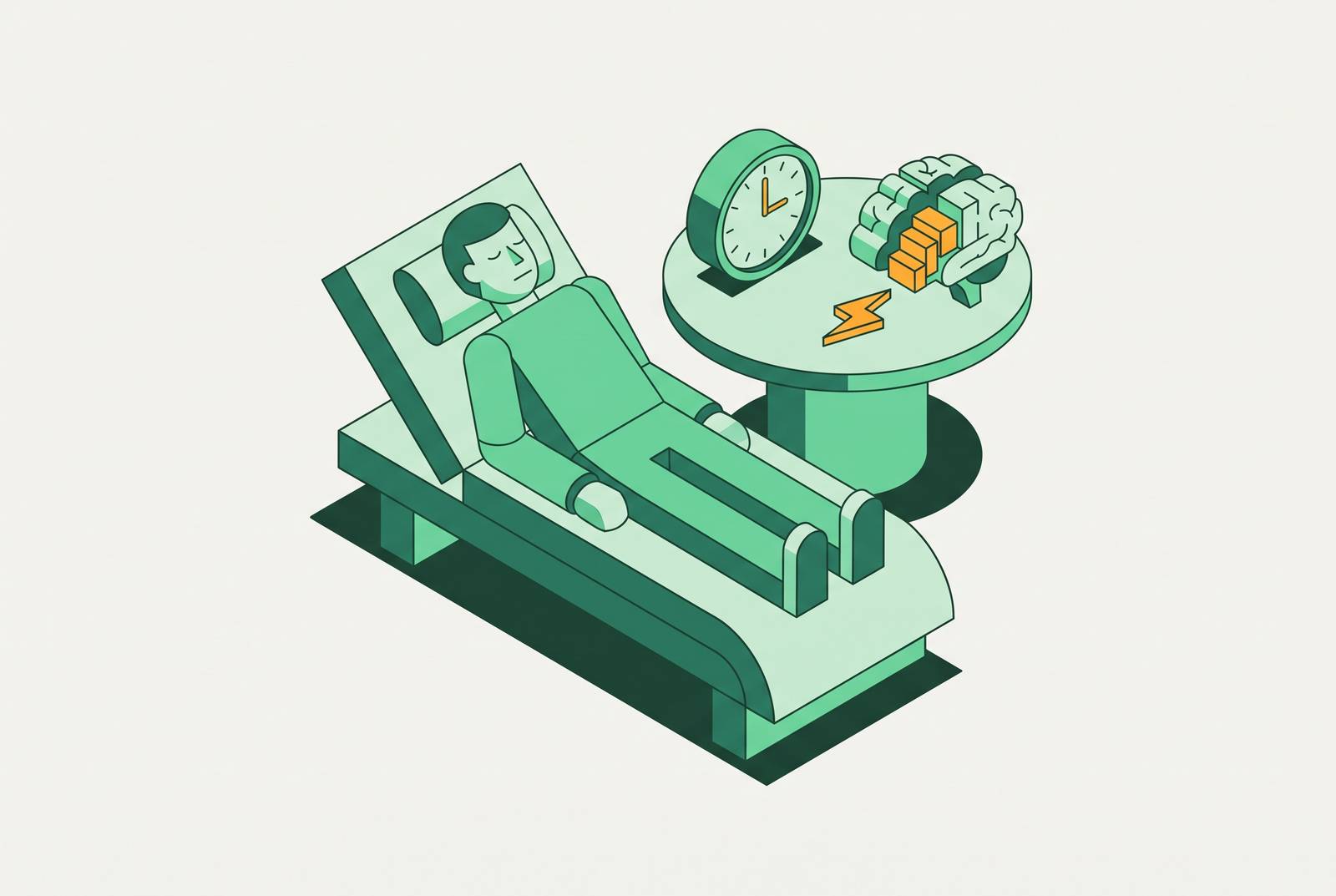
The wall that hits most people between one and three in the afternoon has nothing to do with discipline. It's the predictable output of two biological systems colliding at the same hour of the day, and no amount of resolve changes their timing. Circadian and ultradian rhythms produce a natural dip in alertness in the early-to-mid afternoon regardless of how well someone slept the night before, and for most people that window overlaps with the tail end of a high-caffeine morning: the coffee taken in the morning has metabolized within 3 to 5 hours, and the cortisol and blood sugar spike it triggered is now on its way down. Those two declines land on top of each other. The trough that results is deeper and more disruptive than either mechanism would produce alone, making the early afternoon the lowest-performance window of the entire waking day for most people. Once the dip is understood as two overlapping physiological curves rather than a lapse in focus, the right question changes: not how to push through it, but how to time a deliberate reset so the recovery matches the biology causing the slump.
Sleep stages and whether a nap helps or hurts
Anyone who has woken from an afternoon nap feeling worse than before they lay down has experienced the mechanism that separates a restorative nap from a wasted one. Sleep moves through stages, and which stage a person is in, and whether they exit before or during a deeper one, decides whether the nap sharpens the mind or leaves it foggier than it started. Stage 2 sleep is the stage that matters most for recovery. It's marked by brief bursts of brain activity called sleep spindles, and those spindles strengthen long-term memory while restoring the brain's capacity for sustained attention. The trouble starts when a nap runs long enough to slide past Stage 2 and into slow-wave, or deep, sleep. Waking in the middle of that stage, before a full sleep cycle completes, produces sleep inertia: the heavy, disoriented grogginess that convinces a lot of people napping just doesn't work for them. The danger zone is a narrow band of duration, long enough to let the brain drift into slow-wave sleep but too short for the cycle to finish before an alarm cuts it off. That band is exactly where naps stop helping and start hurting, and it explains why so many well-intentioned 45-minute naps taken on a couch backfire. Shorter is almost always safer, and the aim of a strategic nap is to exit sleep before its architecture shifts into that deeper, harder-to-leave stage.
What the research establishes about nap duration
Once Stage 2 is identified as the target, the research points to a fairly narrow range of nap durations that actually deliver on it, with the strongest and most consistent evidence at the shorter end. A 2021 systematic review and meta-analysis found that short daytime naps improve cognitive performance overall, with the clearest gains appearing in alertness, though the benefits were not uniform across every measure tested, and the review's authors found that when a nap was taken mattered more than how long it lasted. That finding reframes duration as a secondary variable: it sets the ceiling on how deep a nap can go, while timing decides whether the nap lands in a useful window.
At the longer end of the spectrum, a 2026 study published in the journal Life looked at strategic 45-minute naps in sleep-deprived elite Kung-Fu athletes and found they produced better cognitive recovery than physical recovery, with both decision accuracy and reaction time improving meaningfully. That result matters, but it comes from a specific and demanding context: competitive athletes carrying real sleep debt, not a general office worker who slept a reasonable seven hours the night before [1]. A 45-minute nap suits genuine sleep debt, since the body needs more than a light doze to claw back function after real deprivation. For someone who slept adequately and is just fighting the ordinary circadian trough, that same 45 minutes runs a real risk of tipping into the slow-wave danger zone described above. The duration that fits a person's nap should track the size of their sleep debt, not the amount of free time on their calendar.
Three named napping protocols
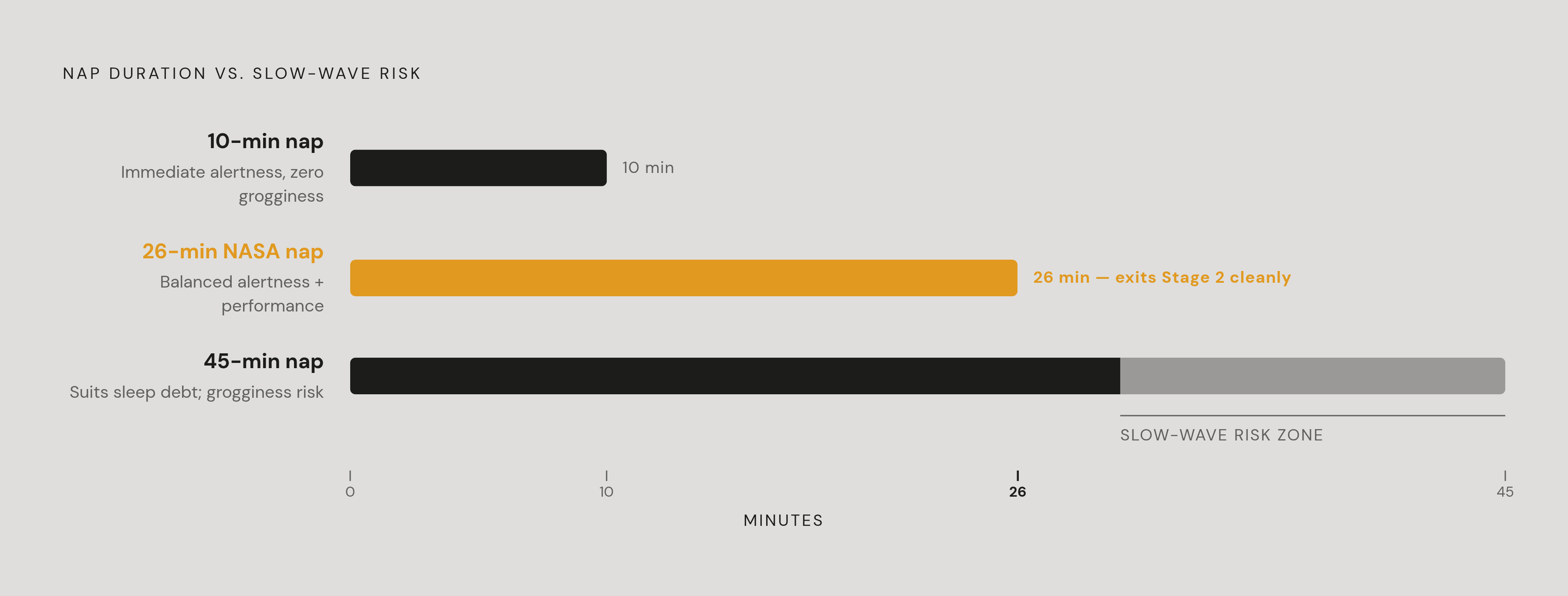
Three specific protocols cover nearly every situation an afternoon slump can present, and the choice between them comes down to how much time is available, how much sleep debt a person is carrying, and which outcome, alertness or fuller recovery, matters more that day.
The first is the 10-minute nap, built for immediate alertness with essentially no risk of grogginess. Ten minutes keeps the brain in light sleep the entire time, nowhere near the slow-wave stage that causes sleep inertia, and it delivers several hours of improved alertness afterward. It's the right choice when time is tight, when the setting doesn't allow for anything longer, such as a car, an office chair, or a short break between meetings.
The second is the NASA nap, a 26-minute protocol that aims for balanced alertness and performance recovery. It's the most broadly validated of the three, developed and tested in the demanding, safety-critical context of commercial aviation, and it has since been replicated widely in the practitioner literature. This targets Stage 2 sleep reliably for most adults without sliding into slow-wave sleep, making it the best default protocol for knowledge workers, creatives, and other high-performers with a 30-minute midday window. It asks for more time than the 10-minute version but delivers a fuller reset without the gamble that comes with longer naps.
The third is the caffeine nap, a short nap preceded by a small dose of caffeine, aimed at people who need both mechanisms addressed at once. This one is not a gimmick. The nap and the caffeine hit the system at almost the same moment, so a person wakes into a brain that has both fewer adenosine molecules attached to its receptors and a nervous system stimulated by caffeine coming online. What someone drinks before that nap changes how it feels on the way down.
The nap timing window that protects nighttime sleep
Duration and protocol only work if the nap lands in the right part of the day, and timing turns out to be just as consequential as how long someone sleeps. A 26-minute nap taken at the right window restores alertness and leaves nighttime sleep untouched, but taken too late in the day it can undercut the sleep pressure a person needs to fall asleep that night.
The window that works best for most people runs from 1:00 to 3:00 PM. It lines up with the natural circadian dip described earlier, and it's early enough that adenosine, the chemical that builds sleep pressure across the day, has time to rebuild fully before bedtime. Napping after 3:00 PM carries more risk, particularly for anyone with insomnia or sleep that's already fragile, because clearing too much adenosine too late in the day can delay sleep onset or reduce the quality of sleep that follows. The common objection that "napping ruins your sleep" holds up under those specific conditions, late-afternoon timing and pre-existing sleep trouble, but it doesn't apply to a short, well-timed nap taken in the early-to-mid afternoon.
A 2024 chapter on strategic napping, part of the Sleep and Sport volume by Lastella and colleagues, makes a related point directly: napping can supplement sleep that falls short at night without undermining the sleep that follows, as long as it's timed appropriately. For that population, a well-placed nap is a legitimate tool, not a luxury or a sign of poor discipline. It's one of the few tools available for partially repaying a debt that accumulates every night sleep runs short.
How morning caffeine habits shape afternoon cognitive debt
The depth of the afternoon trough is set well before noon, by decisions made within the first hour of waking. Cortisol follows its own daily rhythm and peaks naturally 30 to 45 minutes after waking, a pattern known as the cortisol awakening response. Drinking a strong cup of coffee during that window adds a second stimulant on top of a hormone that's already surging, and the adrenal system pays for that combined spike later in the day with a steeper decline, deepening the very trough this article opened with.
A popular response to this has been to delay the first cup of coffee, letting the cortisol peak pass before introducing caffeine. The mechanism behind that advice holds up: it correctly describes how cortisol and caffeine interact. The clinical evidence that delaying coffee actually reduces the size of the afternoon crash has not been established with the same confidence, and readers should treat the delay protocol as a reasonable, mechanistically sound habit rather than a guaranteed fix backed by controlled trials. Coffee itself is only part of the picture. A 2025 review covering 15 studies on caffeine sources found tea produced a milder cortisol increase, about 20%, compared to roughly 50% above baseline for coffee. The type of caffeine consumed in the morning, not just the timing, shapes how steep the afternoon decline turns out to be.
Heavy daily caffeine use carries a separate, slower cost. Chronic high intake gradually downregulates adenosine receptors, building tolerance so the same dose does less over time and pushing people toward larger doses just to feel normal, without any corresponding gain in actual performance. A nap breaks into that cycle in a way caffeine alone cannot: it restores natural adenosine clearance and gives the receptor system a chance to reset, partially undoing the dependence loop regardless of whether the morning's coffee was timed well or poorly. None of this argues against caffeine. It argues for treating the morning cup, and what accompanies it, as a variable that either shallows or deepens the hole the afternoon nap has to climb out of.
Adaptogenic and nootropic compounds in the nap protocol
Supplements belong at the end of this discussion, not the start of it, because they extend a recovery a nap has already begun rather than replacing the nap itself. Two compounds illustrate the point well, and both come with real evidence attached, along with real limits on what that evidence shows.
Bacopa monnieri is the most clinically mature botanical nootropic available, and it works on a timeline measured in weeks, not minutes. A standardized extract dosed at 300 milligrams a day, delivering 90 milligrams of total bacosides, produced measurable improvements in memory and cognitive performance over 12 weeks, with cognitive gains appearing as early as day 14 and memory improvements following by day 28, alongside increases in brain-derived neurotrophic factor, or BDNF, by day 84. A 2026 randomized controlled trial published in Current Research in Complementary & Alternative Medicine found the same extract also produced significant improvements in perceived stress, sleep quality, and cortisol levels among adults dealing with non-chronic stress. That cost is not visible the day the caffeine is taken. Bacopa is a background investment, something built into a daily routine over months so that by the time the afternoon slump arrives, the nervous system managing it is somewhat better buffered against stress and somewhat quicker to recover.
Ashwagandha, particularly the KSM-66 extract, leads other adaptogens on cortisol modulation, with a calming profile that suits it to evening use or to functioning as a steady daytime stress buffer rather than an acute afternoon fix. Its strength lies in blunting the body's stress response over time, which makes it a poor match for the sharp, immediate reset a nap is built to deliver, and a reasonable complement to one when taken consistently as part of a broader routine.
Both compounds share the same relationship to the nap protocols described earlier: they support the system that naps are trying to restore, but they don't substitute for the specific, mechanical act of sleeping for 10, 26, or 45 minutes at the right hour of the day. The nap is the intervention. The supplements are what a person builds around it once the behavioral foundation is already in place.