ADHD Trait Spectrum and Productivity System Design
Design productivity systems around measurable ADHD trait profiles, not diagnoses.
ADHD is on a dial, not a switch, and most people, diagnosed or not, land somewhere on that dial. Anyone building a productivity system should build it not around a diagnosis, but around where a given brain actually falls on a handful of measurable traits. Get that wrong and the system fails before it starts.
Attentional dysregulation is a continuous trait across the general population, not something locked inside a clinical diagnosis. It also occurs across a wide range of other conditions, including autism spectrum disorder, schizophrenia, and depression, which is part of why researchers now treat "ADHD traits" as a dimensional, transdiagnostic construct instead of a box you're either in or out of. Global estimates put adult ADHD prevalence somewhere between 2.6% and 6.8%, but that number only counts the clinical tail. The much larger group, people with real but subclinical attentional, inhibitory, or working-memory friction, is never counted in that statistic at all, and their work breaks down through the exact same mechanics anyway.
The three core executive function deficits that drive productivity breakdown
Goal-directed behavior runs through a small set of prefrontal cortex functions: response inhibition, cognitive flexibility, and working memory. These are three separate systems, and each one breaks productivity in its own way. Most productivity advice treats them as one blob called "focus," and that's the first mistake.
Working memory gaps appear as losing the thread halfway through a task, forgetting why a browser tab got opened in the first place, or failing to hold a multi-step plan in mind long enough to act on it. Inhibitory control failures look different: acting on impulse, jumping to a new task before the old one is finished, an inability to filter out whatever's loudest in the room. Inhibitory control failures look different: acting on impulse, jumping to a new task before the old one is finished, an inability to filter out whatever's loudest in the room. Cognitive flexibility deficits appear differently again, in trouble shifting between tasks, getting stuck looping on one approach, freezing when a plan changes mid-stream.
Time-blindness deserves its own billing, because people mistake it for a personality flaw when it's actually a measurable cognitive difference. Research published in Brain Sciences found that children formally diagnosed with ADHD or Developmental Dyscalculia scored lower on sense-of-time tasks than typically developing peers, and attention and hyperactivity symptoms tracked more closely with poor time perception than math difficulties did on their own. The transdiagnostic framing pushes that finding down into trait-level expression too: struggling with time isn't limited to clinical ADHD.
Not everyone with elevated ADHD traits shows the same executive function profile, and generic productivity advice tends to skip past that detail. Some people test dramatically different from controls on these tasks; others show almost no measurable gap even while reporting real day-to-day struggle. Some people test dramatically different from controls on these tasks; others show almost no measurable gap even while reporting real day-to-day struggle, and that mismatch between self-report and objective testing is itself a data point. Advice built for an average ADHD brain is advice built for a brain that, statistically, doesn't exist.
Two cognitive subgroups hidden inside the ADHD trait label
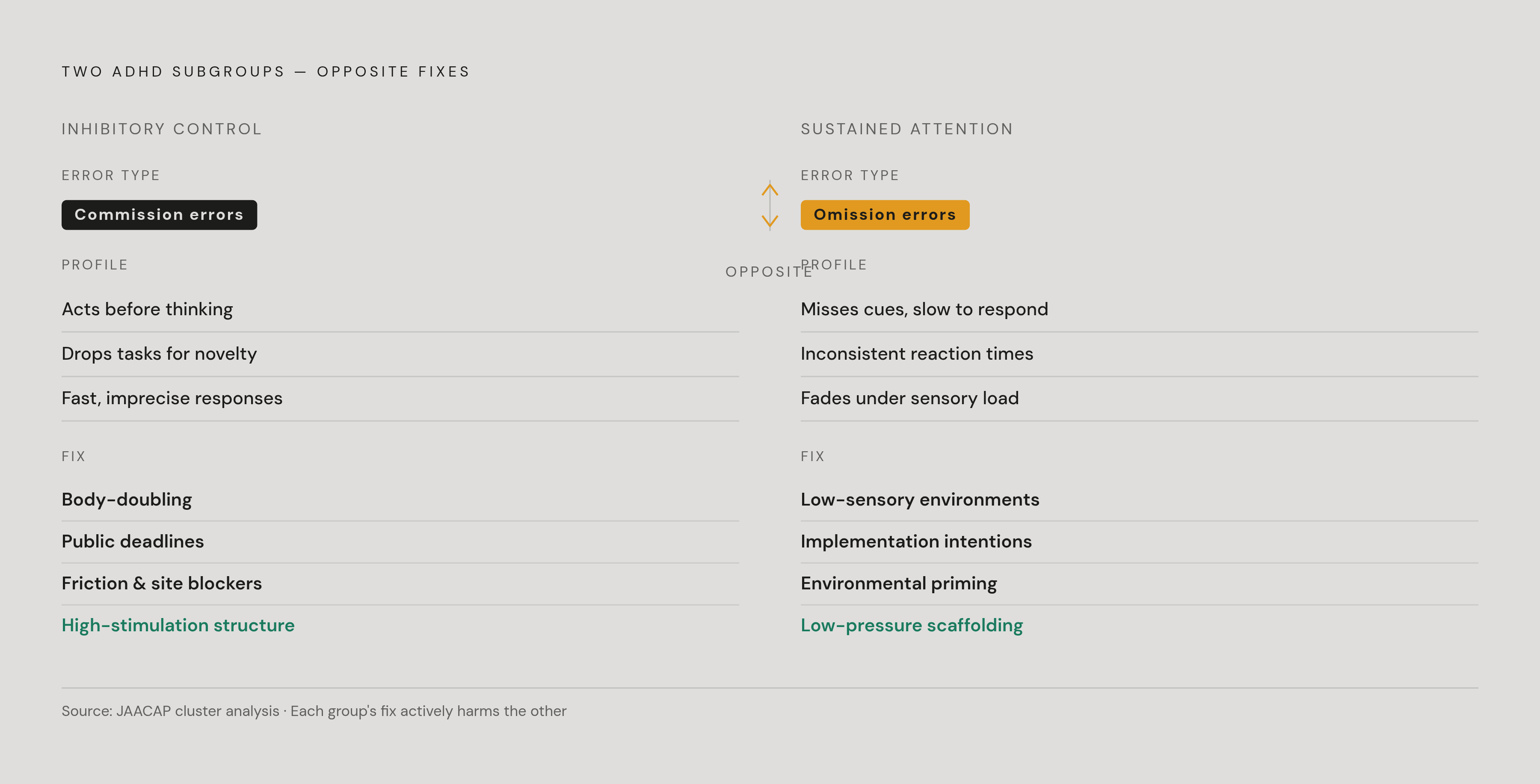
Cluster analysis published in the Journal of the American Academy of Child and Adolescent Psychiatry found two distinct subgroups within ADHD populations, sorted by how people actually perform on cognitive tasks rather than by symptom checklist.
The inhibitory control subgroup shows commission errors: acting too fast, saying yes before thinking it through, dropping a task the second something more interesting appears. The sustained attention subgroup shows omission errors and long, inconsistent reaction times: missed cues, slow starts, output that swings from sharp to sluggish across a single afternoon.
These profiles don't just look different, they need opposite fixes, and mixing them up is where most accountability systems fail. A high-stimulation structure, body-doubling, loud deadlines, public commitments, sharpens the impulsive subgroup and overwhelms the inattentive one into shutdown. A quiet, low-pressure system that eases the inattentive person into work reads as boring and unmotivating to someone impulsive, who needs friction and stakes to stay in the game. Neither camp should be handed the other's toolkit, no matter how well it worked for a friend or a coworker.
Sensory processing complicates the picture further. Sensory processing patterns interact with ADHD symptoms in ways that can shape how executive function difficulties present in practice. Any intervention that ignores a person's sensory profile is working with half the information it needs. In practical terms, the first question to ask is blunt: does this person run too fast and scattered, or too slow and inconsistent? System design starts there, not with a generic template pulled off a productivity blog.
How time-blindness specifically breaks conventional planning systems
Time perception problems in ADHD sit on a dimension. Sense-of-time difficulties are better captured by dimensionally derived groupings than by strict diagnostic cutoffs, which loops right back to the trait-spectrum framing running through all of this.
Time-blindness appears in three recognizable patterns. First is the "now versus not now" horizon problem, where anything not due immediately might as well not exist on the mental radar. Second is chronic time underestimation, a near-permanent misjudgment of how long a task will actually take, which quietly produces lateness and missed deadlines even in people trying hard to be on time. Third is urgency-driven activation, the familiar pattern of only being able to start once a deadline sits close enough to generate real pressure.
Standard calendar systems assume a reliable relationship with future time that the time-blind brain doesn't consistently maintain. Google Calendar, a paper planner, a to-do app with due dates, all of them lean on that same projection skill. When it's missing or unreliable, the tool quietly stops getting opened. The fix is making time visible on a continuous basis instead of only at the moment of planning: physical clocks, visible countdown timers, analog displays sitting right in the workspace where the eye catches them without being asked to.
Matching system structures to trait clusters: practical design principles
Working memory gaps call for externalization, full stop. Treat no mental storage as trustworthy. Capture tools need to sit right in front of you, not buried three taps deep in an app. Work gets chunked into loops small enough to fit inside a single working-memory load, checklists replace memory for repeatable sequences (a daily startup and shutdown checklist does real cognitive work here), and every unnecessary decision point between wanting to start and actually starting gets stripped out.
Inhibitory control deficits need friction built in on purpose, not removed. A "parking lot" list catches new ideas that show up mid-focus without letting them hijack the current task. Commitment devices, public deadlines, body-doubling, software that locks distracting sites during a focus block, all add a barrier between impulse and action that willpower alone won't supply. Novelty-seeking doesn't need suppressing so much as redirecting: let it run loose during brainstorming and creative phases, and fence it out during execution.
Time-blindness responds to making time physical rather than abstract. Analog clocks and visible timers turn an abstract concept into something the eye tracks without effort. Every task gets a time tag, an estimated duration plus a "when" anchor, and every block gets padded with buffer time because the time-blind brain underestimates duration on a near-consistent basis. That buffer is a correction for a known, repeatable bias. It's a correction for a known, repeatable bias, and skipping it just reintroduces the same lateness the system was built to fix.
The inattentive subgroup, slow and inconsistent to get moving, benefits from implementation intentions: "when X happens, I will do Y" cuts the decision cost of starting down to almost nothing. Environmental priming affects how quickly a task gets started too. A workspace low on sensory noise, one that visually cues the next task before it's time to start it, reduces the effort needed to begin. Routine functions as scaffolding here in a literal sense: a predictable sequence of steps removes the energy cost that comes with deciding what to do next.
Why sleep matters for managing attentional trait challenges
Somewhere between a quarter and half of people with ADHD report chronic sleep trouble: insomnia, delayed bedtimes, restless nights, daytime drowsiness. That sits directly upstream of everything else in this piece, not beside it.
Sleep disruption worsens exactly the deficit clusters a productivity system is trying to compensate for: inattention, impulsivity, emotional dysregulation. A study published in Scientific Reports found that sleep deprivation significantly increased commission errors, omission errors, and reaction-time variability in the ADHD group, Sleep loss doesn't hit everyone the same way. It widens the exact gap this whole piece has been describing, and it widens it hardest in the people who can least afford it.
Sleep does this much work because it activates the glymphatic system, the brain's waste-clearance process, which flushes out metabolic byproducts that would otherwise build up and produce next-day cognitive sluggishness. Sleep counts as active maintenance, on par with any other system-level intervention discussed here, and skipping it undercuts every other fix on this list before it gets a chance to work. No app, checklist, or timer compensates for a brain running on four hours of sleep.
Energy management across the day for variable-attention brains
Attention and energy in ADHD-trait brains don't move on a predictable schedule the way they tend to for neurotypical peers. The same person who hyperfocused for three straight hours yesterday afternoon can sit down today and fail to start a single task. That variability is the real planning constraint, arguably bigger than any single deficit named above, and scheduling around the clock instead of around energy state is where most calendars quietly fall apart.
The fix is mapping work to energy state instead of clock time. High-complexity cognitive work, writing, analysis, real creative problem-solving, draws heavily on inhibitory control and working memory, so it belongs in whatever window tends to bring peak alertness, not spread evenly across an eight-hour day as if every hour were interchangeable. Low-stakes, routine tasks are the right filler for the low-energy stretches, treated as available options rather than obligations to force through.
Caffeine sits at the center of this and deserves more scrutiny than most productivity advice gives it. At roughly 50 to 200 milligrams, caffeine raises alertness and produces faster reaction times, which sounds like what a scattered brain needs. But higher doses inside that range push toward anxiety and jitteriness, a particular problem for brains already prone to hyperarousal or impulsive action. A standard cup of coffee delivers somewhere around 80 to 100 milligrams, enough on its own to tip many ADHD-trait people into the anxious, scattered zone rather than the calm, focused one they were reaching for. The mid-afternoon adenosine rebound, the crash everyone knows, lands hardest on a brain whose inhibitory control was already the weak point to begin with. For this population, straight coffee is a poor default, not a neutral one, and treating it as harmless just because it's legal and everywhere misses the actual pharmacology.
The caffeine-plus-L-theanine combination as a lower-scatter alternative for variable attentional profiles
L-theanine works through a different lever. It raises alpha brain wave activity in the 8 to 12 Hz range, the frequency band tied to the calm, focused state people report during meditation or deep creative flow. That's a meaningfully different target than caffeine's blunt alertness push, which is why pairing the two beats reaching for either one alone.
Studies show the alpha-wave increase kicks in within 30 to 40 minutes of ingestion, producing a state of calm alertness that is meaningfully different from caffeine's more stimulating push. That detail matters directly for this audience, since standard caffeine doses are precisely what tend to push anxious, ADHD-trait brains into scatter instead of focus.
Multiple randomized controlled trials on the combination, roughly 50 milligrams of caffeine paired with 100 milligrams of L-theanine, found more consistent improvement in attention-switching accuracy, reaction time, and subjective alertness than caffeine taken alone. Attention-switching is the lab-measurable version of the cognitive flexibility deficit described earlier, the same one that appears as getting stuck in a loop or struggling to pivot when a plan changes. A lower, paired dose that improves that specific function without the jittery overshoot beats a large solo cup of coffee on every measure that matters here.
Adaptogenic and nootropic ingredients that address the stress-cognition loop underlying ADHD trait expression
Chronic stress raises cortisol, and elevated cortisol degrades prefrontal cortex function, the same brain region responsible for inhibition, working memory, and cognitive flexibility this entire piece has been built around. For anyone with variable attention, that sets up a feedback loop with no natural exit ramp: the trait produces stress, and the stress then makes the trait worse.
Ashwagandha is one of the better-studied adaptogens working on this loop. Research indicates it may improve sleep quality in stressed individuals through GABAergic activity, the same pathway some prescription sleep medications target directly. Given how large a share of the ADHD population reports chronic sleep trouble, an intervention working on that pathway hits one of the two or three variables that matters most here, not a minor side benefit. Ashwagandha functions less as a cognitive enhancer in its own right and more as a stress buffer, protecting executive function indirectly by keeping cortisol from running that feedback loop unchecked.
Sources
- Sense of Time in Neurodevelopmental Disorders: ADHD and Developmental Dyscalculia from a Dimensional and Transdiagnostic Perspective
- Attention-Deficit/Hyperactivity Disorder Subtypes Defined by Cognition Have a Distinct Neural and Clinical Profile and Differ in Response to Atomoxetine - ScienceDirect
- nature.com
- alzdiscovery.org